Archive for the ‘Uncategorized’ category

Scaredy Cat Shudder Squeak Scream FEAR

August 10th, 2011

I don’t like it when people use fear to motivate others.  It feels like a false motivator to me.  I know it can’t last long and I know it doesn’t feel good inside to be afraid of something.

I’m not entirely sure, but it seems somehow like the fear motivator assumes I’m not very smart.

It makes me think of the Second World War when I think about people being motivated by FEAR. (Wholly different fear motivators in
the case of wartime and WWII in particular, of course, and entirely unrelated to intelligence.)

For some with diabetes, it’s a fear of having to take insulin.  For some it’s a fear of going low.  Or high.  For others, it’s fear of amputation or blindness.  For still others, it’s more and deeper and simply terrifying.

While I can understand these fears to a point, I cannot understand nor condone a medical professional using fear to motivate a patient.  It’s like a doctor being a bully to get a desired result.  I can’t refer to that person as a “professional” when they behave more like a thug.

Although, I did meet a lady at a diabetes support group last week who said she lives in constant nearly debilitating fear of diabetes complications.  That fear motivates her to “exercise every day and not eat any bad food.”

While on the surface, those behaviors are healthy for her; however, I can’t help but ask: at what cost?

If you are living with nearly debilitating fear all the time… how is that living?

I understand that some people are just going to wait to deal with any physical issue until they HAVE to.  I think that explains why some kids don’t give themselves shots—if Dad and Mom will do it, why should they
have to? 
If someone doesn’t have type two diabetes now and instead has prediabetes, what’s the big deal?  If you’re feeling fine with a BMI of 50 why should it matter?

It should matter to you and for you because YOU matter, and being healthy is intrinsic to living your life and loving and enjoying all there is in your life.  There shouldn’t be ROOM in that equation for fear.

If you can’t see that you are worth it, and your life is worth it, I worry that fear may be the last tool people who care about you have to help you get motivated to make some healthy changes for yourself.

That doesn’t make it any less irritating to see but it does make it much sadder.

In any case, I’m still wary of those who use fear to motivate.

How do you get beyond the fear you have about your life with diabetes?

HOW to get yourself moving

August 9th, 2011

Motivation is a key element of fitness—without motivation all the good intentions and smart ideas in the world will lie inert and be of no good to anyone.

I’m all about politely acknowledging the THEORY behind ideas and then moving quickly into MAKING THEM HAPPEN in real life.  (Always have been; just ask my sister!)

When it comes to weight loss, we can talk and write and read and shop until we’re blue in the face, but unless you actually EAT LESS you aren’t moving toward accomplishing your goals.

The same is, of course, true when it comes to exercise.  I read an interesting tidbit in my Runner’s
World magazine earlier this morning: someone asked the expert whether it was better to eat unhealthily and exercise (in this magazine, run) or whether it was better to eat pristinely and not exercise.  I thought the answer was pretty good: it’s the same thing as asking whether it’s better to shoot yourself in your right foot or in your left foot.  Either way, you’re shooting yourself in the foot!

Along those lines, I will say that I think sometimes people feel a need for more motivation and ideas when it comes to figuring out WHAT kind of exercise to do.

To answer this, I suggest a few ideas for HOW to get your exercise groove on.

1. Redefine Exercise.  Exercise can be any number of movements.  In fact, it can oftentimes be simply that: MOVEMENT.  Not everyone needs the same thing.  A contractor who tears down buildings with his bare hands a la Mike Holmes  may not need or want the same movement-oriented fitness as someone who sits at a desk twelve hours a day.  Perhaps the contractor needs more flexibility training than strength work—so for the contractor, maybe yoga would push him out of his comfort zone and into a new level of fitness.

2. Be Involved in What You Enjoy.  Anyone can go through the movements and turn
off their brains, but it takes a level of involvement to reach a healthy level of fitness.  Don’t try to multi-task your exercise if you are working on reaching a healthy level of fitness.  (No magazines on the bikes at the gym.  No cell phone conversations on a jog.)

If you want to get moving with other people, try a pickup basketball game, or a hilly hike, or even a game of tag with your kids and their friends.  (I also borrow my friends’ dog for some tag every now and again—talk about winding me! She can put me to SHAME!)

Above all, when you are engaged in repetitive motions particularly on a machine at the gym, STAY ENGAGED and keep your focus on what you’re doing while you are there.  If you let your mind wander, you risk losing focus and intensity and not getting the benefits from the moves you deserve.

3. If You Hate It, Find Something Else.  No one suggests that you have to hate what you do for exercise—in fact, it’s the exact opposite!  There are so many different activities that will help you move and be fit that it is a waste of time and energy to force yourself to do something you hate.  This isn’t scales on the piano or multiplication tables—it’s physical movement and activity.  Your body will respond to new things and become stronger as a result of new challenges.
Take a look at your local parks and rec offerings to see if there is a class you might enjoy.  Ever tried Tai Chi?  Karate?  Rock climbing? Golf? Ballroom dancing?  Hip hop?  (Just a sample from a nearby city’s bulletin!)

Have fun out there!

Party of One?

August 8th, 2011

Do you ever eat at a restaurant and have NO IDEA how much bread you ate?  Or
how much rice or pasta you consumed?  Not to mention the chips and salsa…

I get involved in the conversation and sometimes don’t remember how many pieces of bread I ate until they’ve taken away the basket.

Shoot.

At the same time, bolusing for each piece doesn’t seem to work out very well, either.  (I’m sure I look quite disengaged when I’m hunched over staring at my waistband.  Who wants a disengaged dinner date??)

And what about when they ask if you’re ready to see the dessert menu?

(Geez; I’ve just been eating for 45 minutes and they’re asking me about DESSERT?!)

Staying a healthy weight involves managing several of these aspects of dining out with friends.  For me, it means not only passing up dessert, but also telling the wait staff I don’t want a spoon or fork to “share” with someone else.  (It absolutely astounds me how often this request is disregarded.  And yes, I do factor that into the tip!)

For a lot of people, it means asking the restaurant staff to remove the bread basket or tub of chips as they sit down.  For others, it means trying to hold off on eating anything until the meal itself arrives.

For those of us with type one diabetes, our “full” factor may not kick in at all due to the fact we are missing amylin in addition to insulin, so watch for the pace of others at your table and follow their cues.

Whatever you find that works for you, eating out does require awareness and discipline.

Mindless Eating collected some interesting studies on how groups of people eat compared to those eating alone.  Say your average calorie consumption when eating meal X alone at a restaurant is 400 calories.  When you order that same meal while with another friend, you are likely to consume 530 calories (33% more) and if you are dining with three others (family of four) you are likely to consume 630 calories (58% more).  Heaven forbid you dine with seven others; your likely consumption increases by 96%– 784 calories!

It’s the pace of dining that affects us and our calorie consumption according to Dr. Wansink “…when you eat with a group, the average amount others eat suggests the amount that’s appropriate for you to eat.”

All of these tips and tricks really do factor in when we are trying to learn or re-learn our eating habits to improve our weight and health.  For the first few weeks of any
new focus on weight loss, it may be smart to avoid as many big-meal dining experiences as you can.  But you know you will return so you may as well start in with some smart strategies early.

Eat as slowly as possible, with utensils, and take several “breaks” by putting down your utensils and sipping water.

Order soup, not salad.

Remember that it takes about 20 minutes for anything you eat to register on your hunger scale—so eat more slowly.  By the time you’ve eaten the bread before the meal and the meal itself you should be so full dessert isn’t necessary.

For me, I am always doing my best at this.  I’m always aware of the pitfalls of too many meals out!  Cooking my own meals is a major help, as is planning dinner during breakfast so I know how to eat the rest of my day.

And, above all, I’m glad I’m married to a tall skinny guy.  I’m always trying to avoid looking like Laurel and Hardy when I’m with him.

I always felt like Oliver Hardy when I weighed the same as my foot-taller husband!

Hey, it’s motivation that works for me.

What works for you?

What Are YOU Training For?

August 5th, 2011

I read an article this afternoon and I thought the author brought up a really good point: How Much Is Enough?

Whether you are training for an event like a marathon or weightlifting competition or an ice skating performance or football tryouts, you need to be aware of WHY you are doing what you do with your physical training.

We aren’t all running 5ks, and we aren’t all going out for the soccer team.  Your workouts
should reflect WHAT your goals are
, and they should be related to getting you faster, stronger, or more agile.

Your goals should motivate you and keep you focused to work hard and improve your fitness.

It’s always good to think for a little bit about what you want and need out of your exercise routine.  (I hate the word “routine” because I think you need to keep a varied program going to keep your body challenged and your mind engaged.)

Do you want to be able to lift your grandson?  If that kid doesn’t weigh 300 pounds why do you want to be strong enough to lift a 300 pound barbell?

Do you want to be able to do your laundry without hurting your back?  If you aren’t doing body weight and spinal strength and stability exercises, you may be missing the boat.  If you are only doing dumbbell exercises with 3 pound weights, and your laundry weighs 15 pounds, how does that make sense?

Do you want to be able to win the local 10k Turkey Trot held every Thanksgiving? Do you want to qualify for the Olympic team?  Or do you simply want to be able to run the entire distance without having to stop and walk?

Each of these goals is PERSONAL to YOU and reflects who YOU are and WHAT YOU WANT to do in your life.  If your neighbor is bench pressing 135 pounds every night in his garage, you don’t need to automatically feel odd about “only” doing pushups.  It’s what will help you reach YOUR goals that you need to stay focused on!

It’s about what YOU need to stay healthy and avoid injury on your way to achieving the goals YOU want in your life, and what makes sense for YOU.

Go after those goals. They ARE within reach.

Hydrate Hydrate Hydrate

August 4th, 2011

By the time we make it to August, we’ve been hearing about (not to mention feeling!!) the heat for months.  We’ve moved from “wishing for Spring” to “hating the dog days” in what may feel like a week.

And in the supreme heat you’ve probably heard and read quite a bit about hydration.  But have you been getting the fluids you need?

Do you even know why you need so much?

Well, our bodies are 55-60% water.  (Yes, that means you can multiply the number on the scale by .4 and say the rest is “water weight” if you need to.)  According to the USDA:  Our bodies depend on water to keep our cells and body systems running smoothly. Most importantly, it is used to maintain blood volume, which is imperative for regulating body temperature and delivering oxygen and nutrients to the rest of the body. Water also provides a medium for the biochemical reactions that occur at the cellular level. In addition, water is crucial for the removal of waste products through the formation of urine by the kidneys.

So when it gets so hot outside you can barely breathe, the sweat you use to regulate your body temperature ends up dehydrating you; not only does it become harder to sweat, but your blood volume is diminished and can’t help keep your body at the right temperature.

That’s bad.

BUT, the good news is that you don’t have to drink only water and non-caffeinated beverages to keep yourself hydrated.

Nope: you can eat your water, too.

The more fresh fruits and vegetables you can consume (and the fewer high sodium processed foods) the better for your hydration.

How handy, then, that summer fruits like watermelon and peaches and vegetables like tomatoes and cucumbers are so readily available to us—for some of us, they are right in our back yards!  (Did you know broccoli is 90% water? Broccoli?!)

Rather than foregoing the recommended daily water altogether, when it’s extra hot reach for high-water fruits and vegetables to ensure you are staying healthy, safe, and hydrated.

Go Climb A Tree

August 3rd, 2011

Who knew there was a Finnish Forest Research Institute?  Okay, I mean, who in America knew such an institute existed.  I sure didn’t.

Yet this research institute exists and they are not the only scientists currently looking at the interaction between nature and human health.

Guess what they have determined?  NATURE HEALS by “reducing stress, boosting immunity and calming aggressiveness.” Yay!

Why does this matter?

Have you tried to manage your blood glucose during periods of stress?  It gets incredibly difficult, which in turn adds stress, which in turn raises blood glucose… ah, yet another vicious cycle in our lives.

Even if you aren’t living with diabetes, have you noticed how much better you feel after you spend an hour outside around some green trees?

Given that all research points to nature helping us humans to fight stress, boost our immune systems, and even lower our blood pressure, I yet again suggest we all GET OUTSIDE for some great healing through outdoor activities.

Check it out:

  • go for a hike
  • walk with your dog
  • walk with your neighbor’s dog
  • walk with your neighbor
  • have a picnic in the park
  • climb a tree
  • stop at a vista point and get out of your car
  • walk around for 20 minutes after dinner at a restaurant
  • volunteer at a neighborhood road race
  • go camping!
  • throw a Frisbee
  • walk through the ritzy part of the neighborhood and see if you can get some good ideas for your yard
  • hop on a bike and see where you end up (remember to bring glucose for this one in particular)
  • get a little dirty
  • plant some flowers
  • plant some vegetables
  • meet some new neighbors
  • say hello to a stranger

Spend just a moment when you’re outside to reflect on how long those trees have been growing, and how much they’ve seen and survived (not to mention how little the trees care about all of the things we do every day).  It can be pretty humbling!

Nature can give all of us some much-needed perspective about the world.

Maybe that’s the thing we’ve all been missing.

Pouting and Crying

August 2nd, 2011

If you saw yesterday’s blog you know I pretty much pouted my way through the San Francisco Marathon on Sunday.

I think that is pretty lame of me, and someone at the finish line (I thankfully did reach it on my own two feet) put me so squarely in my place it’s almost embarrassing.

The last mile was fortunately flat, and I knew where I was by that point because I knew roughly where the finish line was compared to the ball park.  So, when I got to the ball park I knew I could make it.  (I’ve walked it many times to attend SF Giants baseball games!)

And then, d’oh!, they had us run BEHIND the ball park instead of in front of it (adding maybe a half mile to what I expected).  AND we had to get up a 14 inch curb to do it.

(Let me tell you, it might as well have been a mountain by that point; 14 inches is super duper high after 25 miles.)

So here I am, trying at this point to pick up my pace so I can finish under five hours.  It doesn’t even matter to me anymore what happens, really; I want to get out and be done.

As I am what feels like sprinting but probably looks like just huffing to the finish line and I cross the line, I stop my watch and start looking for my husband, and collect my medal and heatsheet (this is my second one of those and wow do you feel cool when you get one of those!)  and I would
say I’m completely in a daze.

As I’m in this daze, I look to my left just briefly and everything I’ve been rolling around in my brain makes a clank.

I see a woman in tears. 

She just FINSIHED A MARATHON.

Who am I to pout when someone next to me just accomplished this HUGE thing that she has been working for for several months, maybe years, and maybe she was running it in someone’s honor or maybe she was just going after a goal of her own.  I have no idea what she gave up in order to cross that finish line.  I have no idea what she gained along her way. 

I only know that whatever it was she lost and gained was enough to make her cry when she earned that medal around her neck.

And that was enough to (at long last) shut me up. 

I’ve had a number of people applaud what I did on Sunday, which feels so strange.  I don’t see how keeping on going despite how much I was hating it was all that big of a deal that someone should pat me on the back!

But, I guess if it were easy, everyone would do it and it wouldn’t mean that much at all.

I feel like I should apologize to that lady for in some way minimizing something that was such an accomplishment for her; when I was thinking to myself that it didn’t matter I was wrong. 

I don’t like that I in a way felt this marathon was “no big deal.”

I guess we all have our paths and we all have rocks and surprise turns and unhappy detours along the way, and it definitely gets complicated when things like blood glucose levels or body weight or cholesterol levels feel like they aren’t on our side.  We certainly don’t all make it to each finish line with a smile on our faces.

But that shouldn’t stop us from setting goals and working hard and always keeping some sort of finish line in view. 

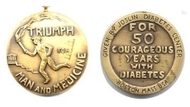
ESPECIALLY when we get a medal.

We each earn THIS one after 50 years with type one!

San Francisco Marathon 2011 Report

August 1st, 2011

Never regret. If it’s good, it’s wonderful. If it’s bad, it’s experience.”
– Victoria Holt

I completed the San Francisco Marathon yesterday; my fourth marathon so far.

Notice I said I “completed” the course, not that I “ran” the marathon.  It wasn’t a great day for me out there.

This is a pretty interesting course through as much of San Francisco as I, someone who has lived within an hour of the city for the nearly 31 years, would care to see.  There are hills, there is the Haight, there is running through Golden Gate Park.

And then there is the Golden Gate Bridge.  (This one is the only event that will shut
traffic lanes of the bridge to runners; we were on the actual road!)

But, all of that said, I still didn’t have a great time out there yesterday.

I spent a long time trying to figure out what was wrong with me as I ran (and walked!)—as you may know, marathons are about 90% mental.  (The months of physical training turns out to be the easy part.)

The hills make it a challenging course: you start flat, hit a little hill, go flat again, bigger hill, down the hill, flat for a bit, up onto and over the bridge (hill!), turn around, go back onto and over the bridge in the other direction (still a hill!), flat again, up a big hill, come partway down that, go up another hill, down that one, up a long slow hill, stay up there for a while, hit a big downhill, go up a little hill, and slowly peter back down to finish where we started.

Sounds fun, doesn’t it? 

My mental energy just wasn’t there yesterday, which in turn meant my physical energy wasn’t really there either.  For an event requiring focus and determination and a lot of self motivation, yesterday simply wasn’t my day.  There are a couple reasons for that; not to mention the fact that on Saturday I felt somewhat sick all day and was low at midnight (hadn’t been up to eating as much dinner as I thought) before getting up at 3am for the early SF start time.

So, I started the run at 6:10am and finished five hours later.  (My other times have been 4:30 or faster.)  I could have told you 20 minutes after starting my CGM on Saturday that my sensor would not be a friend to me on Sunday’s run, and it wasn’t: it kept telling me I was over 300 and I’d check and be slightly over 200.  I was low at midnight, so needed to make sure that didn’t happen again during the run.  I’ve always maintained it is easier for me to run high than run low, despite feeling my best out there between 90 and 160.

I ate some oatmeal at 4:00am and underbolused on purpose.  At 5:35am I was 264 but didn’t take a big correction as I was about to run and still had the oatmeal insulin on board.  Right before the start I was 222 and took just .05 units.

The gun went off, and we started.  I tried to start slowly (still need to work on that) and just enjoy the run.  There were so many people at the start I didn’t get a last glance at my husband, so that made me a bit sad to begin.  I had chosen purposefully slow music to keep my pace in check at the start.

At 7:30am I checked again and was 173.  Happy with that, I had some carbohydrates to keep me properly fueled for the bridge that I could see ahead of me.

At 8:10am, I took some insulin to help out with my 257 and ate again, per my usual.

Then at 8:50 I was 256.  Argh.  Let it go, corrected a smidge, and kept going.  An hour later, 282.  Clearly, this was not my event that day.

At 10:40 I ate again and took a little insulin to cover those carbs.  I could take more insulin as the finish line approached since I wouldn’t be running when the insulin peaked.

So why was I high the entire course?  My best guess is of course two different factors combined.  I think my 46 at midnight six hours earlier reared its glucagon head at some point during the course, although that should not have been a major deal.  The other thing I did was to lower my basal rate to only 25% of normal, like I normally do for hilly runs.

That would have been great, had I been running my normal speed.  But due to the few days before the run, I think I just didn’t have it to run my normal speed.

All in all, I’m glad I did it, and I’m glad it’s done.

My friend was at a water stop (why the ground is wet) and caught me actually SMILING as I ran!

And now I get to enjoy some weeks of zero or minimal running before I tackle my next run: the Giants race!  That one is a half marathon, thankfully, which should feel much easier since it’s, well, half the distance of yesterday’s course.

Love that.

The Diet Soda Debate

July 29th, 2011

It was not unusual for me to go through a six-pack of Diet Cokes in my years in high school and college.  I used to call Diet Coke the “nectar of the gods” I drank it so much.

It’s embarrassing and a little frightening to think about it now!

What made me give it up?

When I went on Weight Watchers and really started to try and lose my excess weight, I started drinking a heck of a lot of water.  What a difference that made in my life!  So in part I gave up so much soda because my bladder just isn’t that big.

And then a few years later I started to really get into being fit.  And I started thinking about how what I put into my body really was making my body what it is.  I’m not all the way there yet, at all, but I realized just how many chemicals, particularly aspartame, that scared me.

When I see news reports linking diet soda consumption to higher weight and risky waist to hip ratios I wonder even more.

Sure, I am at zero risk of developing diabetes as a result of diet soda consumption.  But that doesn’t mean I want to taunt unknown other effects of those chemicals!  (And no, I never had diet soda or aspartame or anything close before I was diagnosed with type one diabetes.)

One group studied the body measurements of people who drank diet soda and those who did not.  After nine and a half years:

Diet soft drink users, as a group, experienced 70 percent greater increases in waist circumference compared with non-users. Frequent users, who said they consumed two or more diet sodas a day, experienced waist circumference increases that were 500 percent greater than those of non-users.

Why does waist circumference matter?  It signals the amount of abdominal fat, a major risk factor for a whole host of chronic conditions that include cardiovascular disease and cancer.

The other study reported was conducted on mice: they gave half the diabetes-prone mice (how did they know that?) food with added corn oil, and the other half received food with added corn oil and added aspartame.

After three months on this high-fat diet, the mice in the aspartame group showed elevated fasting glucose levels but equal or diminished insulin levels, consistent with early declines in pancreatic beta-cell function. 

Oh dear.  When someone starts discussing beta-cell function it’s already too close for comfort in my world.  (Pancreatic beta cells, responsible for insulin production, are what my body attacked to cause my type one diabetes and why type one is an autoimmune disease.)

As someone already living with a chronic condition, I want to avoid any other reasons to be under a doctor’s care.  So for me, the choice to avoid artificial sweeteners is a good one.  Now I drink a lot of water, a lot of tea, and soda water.  It works, and I don’t feel deprived.  It feels like a great healthy and simple choice to have made for myself and my body.

We’re all doing the best we can, after all.

Here’s to you and the healthy choices you make for you and your body!

A New Idea for Me About Evolution: Body Weight, Insulin Resistance, and Fructose

July 28th, 2011

This paper is fascinating me right now despite being sidetracked yesterday. Dr. Richard Johnson of Denver Colorado is the presenter and researcher; he presented at the World Congress on Insulin Resistance, Diabetes, and Cardiovascular Disease in November 2010.

(This is one of what seems like an infinite number of instances wherein “diabetes” means type two diabetes, by my figuring.)

Full disclosure here: I’m not a scientist.  One of the reasons I’m not a scientist is that I have to read science terms very slowly and I’m not patient enough to do so.  So please remember I’m pointing to words, terms, and phrases in the online work itself rather than paraphrasing in large part because I’m not familiar enough with what I’m writing about.  (Not that that stops me from writing about it.) 

Johnson believes that “fructose may not be simply an energy source, but may have specific metabolic effects that may aid in increasing fat stores.”

He goes on to say that islet injury from fructose is in part mediated by urate, and uricase deficiency is a genetic mutation that may just have saved our ancestor’s lives. (I can’t fully explain how the islet injury occurs to begin with, or why.)

So, in a world where fruit and fruit sugar is a main source of energy, those with a uricase deficiency would have had a tough time of insulin management, which would today appear as insulin resistance (one of the hallmarks of type two diabetes).

Until  you consider Survival of the Fittest: those best able to survive periods of famine were those who had the genetic propensity to insulin resistance.

Why?

Because a body resistant to insulin makes more insulin to manage glucose in the blood.    It also in turn increases fat storage since that’s one of the functions insulin serves in our bodies.  More body weight (fat) means more insulin required, which means more insulin made, which starts the cycle all over again.

So those who carried extra body fat and body weight due to a uricase deficiency would have been those best equipped to survive a famine.

Wacky, isn’t it?

Our ancestor’s propensity to increase fructose consumption without proper genetic tools to manage that consumption helped them survive, and here we are in the twenty first century with insulin resistance and type two diabetes as one of the world’s most alarming health crises.

It’s important to keep in mind that the amount of fructose our ancestors consumed is NOWHERE NEAR the amount we consume today.  Johnson points out that in our lifetimes we have seen an incredible increase in the amount of sugar we consume compared to just three hundred years ago:
“…from a mean of 4 pounds of sugar intake per year in 1700 in the United Kingdom and United States, to greater than 150 pounds per year today….we found that 25% of the population was ingesting over 130 g of fructose per day, which equates to over 200 pounds of sugar per year …some individuals are ingesting more than 50 times the mean amount of sugar than was being ingested just 300 years ago.”

So while we owe our ancestors a debt of gratitude for surviving as well as they did, we need to make some changes in our own lives and in our own world so that our children and grandchildren and 10-times-great-grandchildren can thank us, too.