Archive for the ‘Living with Type 1 Diabetes’ category

Which Side of the Package Do You See?

August 19th, 2011

Do you look at the front of the package when you decide to buy food in a package, or do you look at the nutritional information label?

You have to love/hate the fact the US Food and Drug Administration works continuously to inform the public about what we have in front of us and how to make “wise choices” about what we put in our mouths. 

They even have a 30 minute video on the FDA website about the food label!

They want you to pay attention to three things on the label: calories, serving size, and percent daily value.  It’s a relatively entertaining video.  (Well, at least the first 3 minutes of it are relatively entertaining… my attention span is not 30 minutes long when it comes to a nutritional label.)  It isn’t a Disney production—it’s more like a video for science class.  But still.

And when was the last time any of us paid attention to only THREE things when it came to food?!

Having lived with type one diabetes for most of my life and having counted weight watchers points for years, me and that label are pretty familiar.

Now, it matters that you understand you have to agree that what the FDA says is true for you and your body before you continue reading this.  If you don’t agree, you need to know that and you need to be willing to discover for yourself what works and is good for YOU.

So getting back to the package: do you look at the information box with carbohydrates, fat, and calories and beyond or do you care more about information on the front, enticing you to purchase?

Sayings like “natural” and “gluten free” and “low fat” and “high fiber”.  Those that sound REALLY HEALTHY and encourage us to buy it and eat it
without thinking much more about it.  The government calls them “nutrient content claims” and “health claims” and “allergy information”… and they have some work to do when it comes to these claims plastered on the box!

The FDA has almost as much work to do when it comes to these claims as each of us have when it comes to making good healthy choices for ourselves and our families.

The FDA did start to require additional words when claims are made, in addition to requiring the claims fit within the guidelines (like containing 51% or more whole grain ingredients by weight per reference amount customarily consumed).  At this point, however, I fear these words are like that certain Surgeon General’s WARNING millions of smokers no longer even see.

Also: 2,000 calories is a LOT of food when it comes down to it.  So making decisions based on the information listed for a 2,000 calorie/day diet when a 2,000 calorie diet is way too much for YOU doesn’t make as much sense.  You have to make a lot of calculations.

But wait; if you live with diabetes, that’s what you’re doing anyway!
Being Excited, Speaking, and Staying Mum on the Subject of Diabetes

August 18th, 2011

I decided to go back to working as a lawyer part-time.  I miss being in an office with other people and I think this job sounds like a lot of fun—very detail oriented, to the point others would probably look at me like I’m crazy for thinking it’ll be fun.  (So I won’t bore you with the details!)

It was pretty interesting, though, to go into the interview and purposefully NOT mention diabetes.  I mean, for me it often feels like I speak only about diabetes all day long!

So when they asked me why I wanted to work part-time, I just said I have a fitness business.  Weird to not mention how diabetes is such a major part of my business and my life!!

I didn’t mention it not because I don’t want to talk about my diabetes—I didn’t mention it because it isn’t the best idea to discuss what is legally considered a disability at a job interview.  If I hadn’t gotten the job I could have wondered if I didn’t get it because they didn’t want a diabetic working there.  I simply thought it was safer for both me and a potential employer to avoid the subject altogether.  Just like kids, spouses, sexual orientation—just because it is safer at a job interview to stay on track—the job and my skills are the important things.

It’s one of those things that logically I know is pretty unlikely.  But at the same time… I also know how much misinformation is out there when it comes to diabetes.  I don’t know what the interviewers’ preconceptions are about my disease.  I do know how complicated life is with diabetes, and I know without a doubt that my diabetes isn’t going to affect my job performance.

So I stayed quiet about that part of Diabetes Outside.

After more than two years of staying anything but quiet about Diabetes Outside, it was a weird experience!  I didn’t even say the name.

Of course, I’m excited to talk about it more now that I’ve been hired whenever the “what do you do when you’re not practicing law” subject comes up.  But they’d better be careful—they will get an earful!

I’m really excited to share my exercise class for people with type 2 diabetes and prediabetes that starts next month.

I’m excited to tell people about my upcoming talk about Exercise and Type One Diabetes hosted by the Juvenile Diabetes Research Foundation on September 27.  

I’m excited to think and talk about a speech I’m giving to a group of Certified Diabetes Educators next month in San Jose.

There is a lot going on with Diabetes Outside! 

I’m Never Sure

August 15th, 2011

I’m never sure when it comes to really anything how much to attribute to my diabetes and how much to attribute to… me.

For example: did I tire out running up the hill the other day because I had been low the day before, or did I tire out running up the hill because I was… running… up… a hill?

Do I need to pay attention to my hydration because of how that may affect my diabetes or because of how that may affect my strength and endurance?

Stuff I think about that may/may not have to do with my diabetes

Do I have dry skin because it’s summer or because I have diabetes and it’s summer?

Do I wear glasses because I have diabetes or because I’m my father’s daughter?

Am I grumpybecause I’m grumpy or because I’ve been high and I’m grumpy?

See what I mean?

The only kind of answer I’ve reached for myself to this question is to say there is no answerI can’t
separate my physical self from my physical self with/without diabetes.
  I’m me and that includes my diabetes.  So what, in the end, does it matter whether I have diabetes eyesight or Dad’s eyesight?  They are my eyes.

The main difference I see between the two definitions (me versus me with diabetes, or my diabetes) is that it’s a pretty big wall.  A pretty big wall between myself and people without diabetes.

I don’t get a whole lot of support if that wall is too high.

No one else in my family can understand what it feels like to try to chug up a hill with a blood glucose of 281.  No one else in my family can understand just what it takes out of me to be low for three nights at 2am with an average reading of 46.  They just can’t.  I think they would if they could, because it’s a big part of my life and they’d like to understand, but they can’t.

So yes, I get an immeasurable value from my friends with diabetes because they do understand what those things feel like and that makes me feel less alone.  They know what it’s like to have swinging blood sugars and want to put the whole thing down and get a break from carrying the responsibility of keeping our blood glucose levels as normal as possible all of the time.  They understand just how frightening it is to be so low you don’t know where you are, and come out of that low with wet clothes and freeze until you can change into dry clothes.

It’s just how we live.

Yet, I have a load of clients and friends who need to be concerned about their hydration levels in the warm summer months and cold winter months as they work out.  I have I think more friends than I realize who wear contacts or glasses, or who have had laser eye surgery.  Every single person I’ve ever met has had to take medication for an illness or antibiotics for an infection or gotten shaky if they haven’t eaten.  Each person on the planet has felt grumpy for one reason or another.

We’re all the same in that we are all different in different ways.  Diabetes is just one of my ways.

So yes, I feel everything I feel and need to worry about everything I worry about because of my diabetes.  And I feel everything I feel and need to worry about everything I worry about because I’m me and that’s how I feel and what I worry about.

What do you think about that?  How do you make it work for you and your life?

What’s That You Say?

August 12th, 2011

I see 2 slogans/concepts 2 diabetes organizations have built their identities on.  The 2 different organizations are nationwide supporters, according to them, of MY diabetes, but the two concepts confuse me when put together.

The two concepts put into (catch) phrases and slogans:

YOU CANNOT PREVENT TYPE ONE DIABETES

and

STOP DIABETES

The first one is currently displayed on a billboard along the freeway, at the exit for my house.  The
other one hangs on my keychain.

It’s confusing.

Neither one is particularly inspiring on its own for me as a type one diabetic/person with diabetes/my name is Amy.

It isn’t that I don’t understand these organizations need money to keep alive and to accomplish their goals.  It isn’t that I don’t understand that people have determined that making things sound awful is a great way to get donations.

It’s that I feel overlooked.

Overlooked by the two loudest voices out there proclaiming to support me.

It’s confusing.

Maybe they have been instructed by their advertising boards that people in Amarica can’t remember complicated issues.
(I just HAD to leave that typo in.)

It is likely the same “sound bite” and “dumb it down” idea that has hit us all.

But that mentality isn’t what we who live with diabetes actually live.  We live complicated thought
processes 24 hours a day without vacation.  We manage the incredibly complex task of keeping our blood glucose levels in near-normal ranges and continue on with the rest of our daily lives at the same speed as everyone else.

It’s confusing.

So maybe I’ll just need to amend the two campaign slogans at least for myself.  I think I’ll have to add to each so they work for me and for those who I know who live with diabetes.

I think it’ll go something like:

While you cannot prevent type one diabetes, you can absolutely live the life you want by paying attention and taking care of yourself.

When I choose to stop diabetes from preventing me from doing what I want to do, I win.

Won’t fit on a billboard or a keychain, but it seems like a much more accurate and positive fit for me and my life.

What do you think?  What slogans would work for YOU and YOUR diabetes?


What I’ve Learned from My Continuous Monitor

August 11th, 2011

I know I’ve often given my Continuous Glucose Monitor (CGM) a bad rap in my blog.  It has taken me years to get used to it (I first got one in 2008) and even longer to get to a point where I could sort of stand its alarms.

I’m not completely there yet with the alarms, and the inaccurate sensors that I get sometimes DO irritate me.  So I’m not saying everything is rainbows and butterflies; far from it.

BUT, and this is one I’ve been thinking about for a couple weeks now, it gives my blood glucose levels a VISUAL presence and it gives them a VOICE.

And those two things turn into a great big GIANT deal.

I think one of the most dangerous parts of living with whatever form of diabetes you live with is the ability to have no idea for years what your blood glucose levels are.  (Hey, it’s how I existed through high school, so I know.)

They are quiet.  They don’t disrupt often if you’re high.  If you’re low, they will tell you and if you’re lucky or new to diabetes or have been high for a prolonged amount of time, those lows will creep up and whisper “eat!”

They are quiet, and they are invisible.  No one else knows what your blood glucose levels are at any given time. It makes you feel a little isolated a lot of the time.

Blood glucose levels are so crazy easy to ignore, it’s amazing that we monitor them as well as we do.

Yet, having lived denying the need to know what my blood sugars are, and having lived needing to know what they are all the time (checking so many times in a given day it’s a bit overwhelming), I really have come to appreciate my CGM.

First of all, I can look at my pump screen and see what direction I’m heading.  Totally useful when it comes to planning my next move, be it insulin, food, exercise, sleeping, anything.  If I see an UP arrow, I know it is time to check what I’ve got on board and think about taking more insulin to get my blood glucose back in range.

Secondly, the alarms are really useful.  I like that my CGM alarms will interrupt me and tell me to pay attention when I need to pay attention.  Conversely, I also like that I can be in the middle of something and know that I’m in a good range because my CGM hasn’t said anything for a few hours. Beyond even that, if my CGM has been alarming all day long, my husband knows I’m having a tough day without me having to say a thing.

It’s kind of, for me, the difference between plants and pets.  I can’t tell you how many times I have actually watered any plants I’ve had.  I just am not very good at that kind of maintenance.  Sure, I know they need watering, and of course, sometimes I’ll see them and recognize they are looking pretty bad.

But pets will come up, stick their noses in my face, and bark or meow or actually get my attention.  They’ll say HEY FEED ME!  I’M HUNGRY!

It makes things a lot easier when you have some help to pay attention to what you need to pay attention to. 

Score one for my CGM.

Scaredy Cat Shudder Squeak Scream FEAR

August 10th, 2011

I don’t like it when people use fear to motivate others.  It feels like a false motivator to me.  I know it can’t last long and I know it doesn’t feel good inside to be afraid of something.

I’m not entirely sure, but it seems somehow like the fear motivator assumes I’m not very smart.

It makes me think of the Second World War when I think about people being motivated by FEAR. (Wholly different fear motivators in
the case of wartime and WWII in particular, of course, and entirely unrelated to intelligence.)

For some with diabetes, it’s a fear of having to take insulin.  For some it’s a fear of going low.  Or high.  For others, it’s fear of amputation or blindness.  For still others, it’s more and deeper and simply terrifying.

While I can understand these fears to a point, I cannot understand nor condone a medical professional using fear to motivate a patient.  It’s like a doctor being a bully to get a desired result.  I can’t refer to that person as a “professional” when they behave more like a thug.

Although, I did meet a lady at a diabetes support group last week who said she lives in constant nearly debilitating fear of diabetes complications.  That fear motivates her to “exercise every day and not eat any bad food.”

While on the surface, those behaviors are healthy for her; however, I can’t help but ask: at what cost?

If you are living with nearly debilitating fear all the time… how is that living?

I understand that some people are just going to wait to deal with any physical issue until they HAVE to.  I think that explains why some kids don’t give themselves shots—if Dad and Mom will do it, why should they
have to? 
If someone doesn’t have type two diabetes now and instead has prediabetes, what’s the big deal?  If you’re feeling fine with a BMI of 50 why should it matter?

It should matter to you and for you because YOU matter, and being healthy is intrinsic to living your life and loving and enjoying all there is in your life.  There shouldn’t be ROOM in that equation for fear.

If you can’t see that you are worth it, and your life is worth it, I worry that fear may be the last tool people who care about you have to help you get motivated to make some healthy changes for yourself.

That doesn’t make it any less irritating to see but it does make it much sadder.

In any case, I’m still wary of those who use fear to motivate.

How do you get beyond the fear you have about your life with diabetes?

Party of One?

August 8th, 2011

Do you ever eat at a restaurant and have NO IDEA how much bread you ate?  Or
how much rice or pasta you consumed?  Not to mention the chips and salsa…

I get involved in the conversation and sometimes don’t remember how many pieces of bread I ate until they’ve taken away the basket.

Shoot.

At the same time, bolusing for each piece doesn’t seem to work out very well, either.  (I’m sure I look quite disengaged when I’m hunched over staring at my waistband.  Who wants a disengaged dinner date??)

And what about when they ask if you’re ready to see the dessert menu?

(Geez; I’ve just been eating for 45 minutes and they’re asking me about DESSERT?!)

Staying a healthy weight involves managing several of these aspects of dining out with friends.  For me, it means not only passing up dessert, but also telling the wait staff I don’t want a spoon or fork to “share” with someone else.  (It absolutely astounds me how often this request is disregarded.  And yes, I do factor that into the tip!)

For a lot of people, it means asking the restaurant staff to remove the bread basket or tub of chips as they sit down.  For others, it means trying to hold off on eating anything until the meal itself arrives.

For those of us with type one diabetes, our “full” factor may not kick in at all due to the fact we are missing amylin in addition to insulin, so watch for the pace of others at your table and follow their cues.

Whatever you find that works for you, eating out does require awareness and discipline.

Mindless Eating collected some interesting studies on how groups of people eat compared to those eating alone.  Say your average calorie consumption when eating meal X alone at a restaurant is 400 calories.  When you order that same meal while with another friend, you are likely to consume 530 calories (33% more) and if you are dining with three others (family of four) you are likely to consume 630 calories (58% more).  Heaven forbid you dine with seven others; your likely consumption increases by 96%– 784 calories!

It’s the pace of dining that affects us and our calorie consumption according to Dr. Wansink “…when you eat with a group, the average amount others eat suggests the amount that’s appropriate for you to eat.”

All of these tips and tricks really do factor in when we are trying to learn or re-learn our eating habits to improve our weight and health.  For the first few weeks of any
new focus on weight loss, it may be smart to avoid as many big-meal dining experiences as you can.  But you know you will return so you may as well start in with some smart strategies early.

Eat as slowly as possible, with utensils, and take several “breaks” by putting down your utensils and sipping water.

Order soup, not salad.

Remember that it takes about 20 minutes for anything you eat to register on your hunger scale—so eat more slowly.  By the time you’ve eaten the bread before the meal and the meal itself you should be so full dessert isn’t necessary.

For me, I am always doing my best at this.  I’m always aware of the pitfalls of too many meals out!  Cooking my own meals is a major help, as is planning dinner during breakfast so I know how to eat the rest of my day.

And, above all, I’m glad I’m married to a tall skinny guy.  I’m always trying to avoid looking like Laurel and Hardy when I’m with him.

I always felt like Oliver Hardy when I weighed the same as my foot-taller husband!

Hey, it’s motivation that works for me.

What works for you?

Go Climb A Tree

August 3rd, 2011

Who knew there was a Finnish Forest Research Institute?  Okay, I mean, who in America knew such an institute existed.  I sure didn’t.

Yet this research institute exists and they are not the only scientists currently looking at the interaction between nature and human health.

Guess what they have determined?  NATURE HEALS by “reducing stress, boosting immunity and calming aggressiveness.” Yay!

Why does this matter?

Have you tried to manage your blood glucose during periods of stress?  It gets incredibly difficult, which in turn adds stress, which in turn raises blood glucose… ah, yet another vicious cycle in our lives.

Even if you aren’t living with diabetes, have you noticed how much better you feel after you spend an hour outside around some green trees?

Given that all research points to nature helping us humans to fight stress, boost our immune systems, and even lower our blood pressure, I yet again suggest we all GET OUTSIDE for some great healing through outdoor activities.

Check it out:

  • go for a hike
  • walk with your dog
  • walk with your neighbor’s dog
  • walk with your neighbor
  • have a picnic in the park
  • climb a tree
  • stop at a vista point and get out of your car
  • walk around for 20 minutes after dinner at a restaurant
  • volunteer at a neighborhood road race
  • go camping!
  • throw a Frisbee
  • walk through the ritzy part of the neighborhood and see if you can get some good ideas for your yard
  • hop on a bike and see where you end up (remember to bring glucose for this one in particular)
  • get a little dirty
  • plant some flowers
  • plant some vegetables
  • meet some new neighbors
  • say hello to a stranger

Spend just a moment when you’re outside to reflect on how long those trees have been growing, and how much they’ve seen and survived (not to mention how little the trees care about all of the things we do every day).  It can be pretty humbling!

Nature can give all of us some much-needed perspective about the world.

Maybe that’s the thing we’ve all been missing.

Pouting and Crying

August 2nd, 2011

If you saw yesterday’s blog you know I pretty much pouted my way through the San Francisco Marathon on Sunday.

I think that is pretty lame of me, and someone at the finish line (I thankfully did reach it on my own two feet) put me so squarely in my place it’s almost embarrassing.

The last mile was fortunately flat, and I knew where I was by that point because I knew roughly where the finish line was compared to the ball park.  So, when I got to the ball park I knew I could make it.  (I’ve walked it many times to attend SF Giants baseball games!)

And then, d’oh!, they had us run BEHIND the ball park instead of in front of it (adding maybe a half mile to what I expected).  AND we had to get up a 14 inch curb to do it.

(Let me tell you, it might as well have been a mountain by that point; 14 inches is super duper high after 25 miles.)

So here I am, trying at this point to pick up my pace so I can finish under five hours.  It doesn’t even matter to me anymore what happens, really; I want to get out and be done.

As I am what feels like sprinting but probably looks like just huffing to the finish line and I cross the line, I stop my watch and start looking for my husband, and collect my medal and heatsheet (this is my second one of those and wow do you feel cool when you get one of those!)  and I would
say I’m completely in a daze.

As I’m in this daze, I look to my left just briefly and everything I’ve been rolling around in my brain makes a clank.

I see a woman in tears. 

She just FINSIHED A MARATHON.

Who am I to pout when someone next to me just accomplished this HUGE thing that she has been working for for several months, maybe years, and maybe she was running it in someone’s honor or maybe she was just going after a goal of her own.  I have no idea what she gave up in order to cross that finish line.  I have no idea what she gained along her way. 

I only know that whatever it was she lost and gained was enough to make her cry when she earned that medal around her neck.

And that was enough to (at long last) shut me up. 

I’ve had a number of people applaud what I did on Sunday, which feels so strange.  I don’t see how keeping on going despite how much I was hating it was all that big of a deal that someone should pat me on the back!

But, I guess if it were easy, everyone would do it and it wouldn’t mean that much at all.

I feel like I should apologize to that lady for in some way minimizing something that was such an accomplishment for her; when I was thinking to myself that it didn’t matter I was wrong. 

I don’t like that I in a way felt this marathon was “no big deal.”

I guess we all have our paths and we all have rocks and surprise turns and unhappy detours along the way, and it definitely gets complicated when things like blood glucose levels or body weight or cholesterol levels feel like they aren’t on our side.  We certainly don’t all make it to each finish line with a smile on our faces.

But that shouldn’t stop us from setting goals and working hard and always keeping some sort of finish line in view. 

ESPECIALLY when we get a medal.

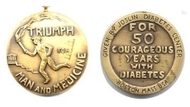
We each earn THIS one after 50 years with type one!

San Francisco Marathon 2011 Report

August 1st, 2011

Never regret. If it’s good, it’s wonderful. If it’s bad, it’s experience.”
– Victoria Holt

I completed the San Francisco Marathon yesterday; my fourth marathon so far.

Notice I said I “completed” the course, not that I “ran” the marathon.  It wasn’t a great day for me out there.

This is a pretty interesting course through as much of San Francisco as I, someone who has lived within an hour of the city for the nearly 31 years, would care to see.  There are hills, there is the Haight, there is running through Golden Gate Park.

And then there is the Golden Gate Bridge.  (This one is the only event that will shut
traffic lanes of the bridge to runners; we were on the actual road!)

But, all of that said, I still didn’t have a great time out there yesterday.

I spent a long time trying to figure out what was wrong with me as I ran (and walked!)—as you may know, marathons are about 90% mental.  (The months of physical training turns out to be the easy part.)

The hills make it a challenging course: you start flat, hit a little hill, go flat again, bigger hill, down the hill, flat for a bit, up onto and over the bridge (hill!), turn around, go back onto and over the bridge in the other direction (still a hill!), flat again, up a big hill, come partway down that, go up another hill, down that one, up a long slow hill, stay up there for a while, hit a big downhill, go up a little hill, and slowly peter back down to finish where we started.

Sounds fun, doesn’t it? 

My mental energy just wasn’t there yesterday, which in turn meant my physical energy wasn’t really there either.  For an event requiring focus and determination and a lot of self motivation, yesterday simply wasn’t my day.  There are a couple reasons for that; not to mention the fact that on Saturday I felt somewhat sick all day and was low at midnight (hadn’t been up to eating as much dinner as I thought) before getting up at 3am for the early SF start time.

So, I started the run at 6:10am and finished five hours later.  (My other times have been 4:30 or faster.)  I could have told you 20 minutes after starting my CGM on Saturday that my sensor would not be a friend to me on Sunday’s run, and it wasn’t: it kept telling me I was over 300 and I’d check and be slightly over 200.  I was low at midnight, so needed to make sure that didn’t happen again during the run.  I’ve always maintained it is easier for me to run high than run low, despite feeling my best out there between 90 and 160.

I ate some oatmeal at 4:00am and underbolused on purpose.  At 5:35am I was 264 but didn’t take a big correction as I was about to run and still had the oatmeal insulin on board.  Right before the start I was 222 and took just .05 units.

The gun went off, and we started.  I tried to start slowly (still need to work on that) and just enjoy the run.  There were so many people at the start I didn’t get a last glance at my husband, so that made me a bit sad to begin.  I had chosen purposefully slow music to keep my pace in check at the start.

At 7:30am I checked again and was 173.  Happy with that, I had some carbohydrates to keep me properly fueled for the bridge that I could see ahead of me.

At 8:10am, I took some insulin to help out with my 257 and ate again, per my usual.

Then at 8:50 I was 256.  Argh.  Let it go, corrected a smidge, and kept going.  An hour later, 282.  Clearly, this was not my event that day.

At 10:40 I ate again and took a little insulin to cover those carbs.  I could take more insulin as the finish line approached since I wouldn’t be running when the insulin peaked.

So why was I high the entire course?  My best guess is of course two different factors combined.  I think my 46 at midnight six hours earlier reared its glucagon head at some point during the course, although that should not have been a major deal.  The other thing I did was to lower my basal rate to only 25% of normal, like I normally do for hilly runs.

That would have been great, had I been running my normal speed.  But due to the few days before the run, I think I just didn’t have it to run my normal speed.

All in all, I’m glad I did it, and I’m glad it’s done.

My friend was at a water stop (why the ground is wet) and caught me actually SMILING as I ran!

And now I get to enjoy some weeks of zero or minimal running before I tackle my next run: the Giants race!  That one is a half marathon, thankfully, which should feel much easier since it’s, well, half the distance of yesterday’s course.

Love that.