Archive for the ‘Random Musings’ category

It’s All In Your Mind

October 12th, 2010

Do you remember those super-oxygenated waters?  The American Council on Exercise studied them in 2001 and concluded that they did not live up to their “scientific” claims that the body would absorb the extra oxygen in the super water and the drinker would have improved stamina and athletic performance, reduced recovery time, and better mental clarity.

(Heck, I’d buy it, too, if that were the result!)

But scientists being scientists that wasn’t enough for them.  A few years ago they used the same “scientific” claims and tested two groups of runners.  One group got regular water and the other group got regular water, but they were told it was super water.

(I love that; how many of us have ever thought a Starbucks coffee was inherently better than a different coffee?)

The group of runners ran three times and interestingly, those told their regular water was super water ran faster.  The really interesting thing was that their heart rate, blood lactate levels, and rates of perceived exertion remained constant despite the increased speed.  They in fact said they felt lighter on their feet and were ready to purchase the super water.  Too bad for them—it was just regular water, but the mental game had changed

They believed they had an advantage and that belief on its own was enough to generate the very advantage they thought the super water supplied.

This study simply points out something I’ve seen time and time again with my bootcampers and with myself: this exercise thing?  A lot of it is in your head rather than your muscles.

Those words “I can’t” don’t mean much to me as a trainer.  They really mean “I don’t want to” more often than not.  If I believed everyone who said they “couldn’t” do something and let them stop trying… well, I think I wouldn’t be a very good trainer.  Sometimes, sure, “I don’t want to” is a fair statement and it has its place in life and in exercise.  But make sure you can differentiate between “I can’t” and “I don’t want to try.”

So here’s the thing to learn from this study: not only are you possibly shortchanging yourself by underestimating your abilities, YOUR MIND can change the circumstances.  Notice the physical effects of the subjects running faster were identical to them running a slower pace.  This shouldn’t happen physically—your heart rate, perceived exertion, and blood lactate levels should increase with the increased stress of running faster.  But here, their bodies thought they were having an easier time with the run because their minds thought so, too.

I think that’s a pretty neat thing to learn.  Get your mind on your side, and the world opens up for you. 

Now get going.

Having Someone Else Check Your Blood

October 11th, 2010

I was at a Diabetic Youth Foundation event this weekend and my brain is so full of ideas and experiences I’m struggling to write today because they all want to dash out! 

There are so many families out there who are doing great things for their kids with diabetes.  Great job, everyone, in learning what it takes to make diabetes work in your family!

One mom shared that, although her 11 year old daughter is beginning to assert her independence, there are times she asks her daughter if she checked her blood sugar.  When her daughter, laying on the couch, sighs and says “no” sometimes she also says “will you do it?” and sticks out her hand.

How great is that?!

Of course, the mom is thrilled to help her daughter with this “little” thing that, when added together over the course of several times every day for the rest of our lives, is in actuality a humungous thing.

And the best part is the daughter gets a break from the job.

Cool deal for all involved.

So then I started to think about what it would feel like if I asked my husband to check my blood sugar.  He worked up at camp and did midnight checks on the campers all the time, so I know he knows what to do.  He’s also seen me do it maybe a kazillion times in the twelve years we’ve been together. 

But I still think his eyes would bug out and his eyebrows would hit his hairline if I randomly went to him and said “you know, I’m tired of this; can you do it for me?”  It’s a pretty entertaining mental picture.

And, I’d have to get over the assumption that he’d do it completely wrong.  ;)  He’d probably do just fine!  But it would really be weird.

When I donate platelets (not whole blood anymore; it took too many days for me to recover when I lost that much fluid through donating so I only do platelets now) they do a finger stick to check my iron levels.  I always want to grab the lancet and just use mine instead.  They never let me—I’ll never understand why not!  And they always jab me in the middle of the pad of my finger so it hurts more (I’m an edge kind of girl).  AND they put a band-aid on the spot!  For someone who does a finger stick multiple times a day they are doing nearly every part of that process plain old WRONG.

But maybe next time it feels like too much, I’ll ask my husband to check me.  Or maybe I’ll ask him to do one or two before that so we can talk about how to do it the “right” way.

It’s good to have him as a backup every now and then.

Candy Candy Candy!!!!

October 8th, 2010

I must write on this topic T.O.D.A.Y. because I have had the magazine article next to my keyboard all week long and omg.

The magazine article (Self magazine October 2010) gives tips for to Conquer Candy Temptation.  The article of course has photos of Halloween candy all over it, so I’ve been looking at these photos every time I’m at my computer all week.

If only those tips helped me.

See, I’ve had this theory for a really long time that people with type one diabetes just have a nearly encyclopedic knowledge of candy.  (Just try telling someone not to eat something and see what happens.)

Fortunately, the message has been altered since insulin pumps and carbohydrate counting became mainstream.  However, it’s still a big deal when we eat candy and other people are around.  They are watching and they don’t seem to hesitate asking us what we’re doing.

So yes, I admit it.  I eat candy.  Yes, I’m a trainer and yes I watch what I eat because I don’t want to gain back any of the 45 pounds I lost eight years ago.  But I still find space for candy.

If you’re interested, the four tips the article provided are:

  1. Stock up on lollipops.  (They take a lot longer to eat and don’t tend to have as many calories as chocolate or other candies.)
  2. Rock a cute costume.  (If you know you have to squeeze into a certain outfit on Halloween you may be more motivated to avoid food you know won’t help you look good.)
  3. Eat treats after 4pm.  (What?!  The RD says really to avoid eating candy in the morning since you’ll crave it all day long if you start too early.)
  4. Be candy-free November 1.  (Donate extra treats to Operation Gratitude opgratitutde.com a nonprofit that sends packages to overseas military personnel.

I decided a while back, after I learned that I don’t gain or lose more than a pound or two throughout the year, that I’m okay with my candy habit.  It’s not a big deal, I cover the carbs with insulin, and I try hard to not feel badly about what I eat.  I’ve got a lot of other stuff going on in my life and making myself feel badly over eating a piece of candy seems like a lot of wasted energy going someplace not very useful.

And of course now that it’s Candy Corn season again, whenever I’m low I reach for the bag and have 11 pieces.  The white tips are the best! 

There is always a place to fit food in, somehow.

Battleground

October 7th, 2010

My  quote on Facebook  this morning was a Spanish proverb that translates: A man too busy to take care of his health is like a mechanic too busy to take care of his tools.

Someone mentioned how easy it is to lose sight of how important it is to take care of our health.  It is so easy I think we all could use a little reminder most days!

But I think having diabetes, either type one or type two, just complicates the idea.  First of all, do we consider ourselves “healthy” to begin with?  And secondly, we can never escape taking care of our disease so don’t we get credit for that?  (Of course we do!)

I think oftentimes we feel like we “fight” diabetes in our own bodies.  The explained and unexplained blood sugar changes have spent years teaching us that our body really is a battleground.  The weapons on both sides include finger pokes, needle jabs, low sweats, high dry mouths, dropping anxieties, climbing moments of apprehension, expired insulin, scar tissue, beeps, alarms, dried up jelly beans, cans of Coke, old test strips, and a zillion other minute and ever-present aspects of our lives with diabetes.

So isn’t it enough that we fight that fight every moment of every day?  Why should we have to fight even MORE to take care of our bodies?

Well, I don’t really have a good answer for that.  I think the best thing for each of us to do is simply shift our perspective on what life is like when we live with diabetes. 

We have a constant “fight” with diabetes that will never go away.  There are a load of ways we can equip ourselves for the battle, though, and assure our victory.  Most of them are not quick fixes and will take some continual tweaking over the course of our lives, but it’s good to get a start as soon as we can.  Diabetes doesn’t take a break and neither should we if we want to keep the upper hand.

I think first off, we need to learn to accept the disease.  One of the parents in the video about Bearskin Meadow Camp and the Diabetic Youth Foundation said he learned how much better it was for him to see a high and deal with it rather than agonize over the why behind every single one: it’s a high, there will be more, and let’s take care of it as soon as we can so that we can continue with life.  Keep management of the numbers as realistic as you can, and forget the concept of “control”—it isn’t possible to control any aspect of our diabetes.  If you were the boss at your job, would you think you controlled your employees??  Kick the notion to the curb and pick up the idea of “management” instead

After that, we need to also take care of the rest of our bodiesJust because we have this “fight” with our disease doesn’t mean that we can ignore our muscles and bones any more than we can ignore the dirt and grime in the bathroom just because we’re doing a great job at keeping the kitchen clean. 

Life just doesn’t work like that.

We can work together and get your body up to speed when it comes to physical fitness since the strength of your physical body will certainly help you succeed in battle.  You need as good a support team as possible to keep up your fight!  The health of your body depends on it.

Getting Off to a Great Start

October 6th, 2010

I know some of you have toyed with the idea of starting to run… but how?  You see my mentions of these crazy-sounding 15-20 miles and two of your friends just ran a 10k… but you’re feeling stuck at the thought of running down the block!!!

First of all, it is critical for you to realize every single person you see running started running by taking a step or two.  It was someplace a heck of a lot slower than what you see and a heck of a lot harder than it looks like now.

Which is all good information to have: we have all been there. 

Second point: some runs are good ones and some ones aren’t so good.  Don’t go out expecting to feel fantastic each day… that’s not the way the cookie crumbles.

Third point: running requires self-motivation.  I can’t make you enjoy running if you hate it, and I can’t make you lace up your shoes and keep putting one foot in front of the other.  That stuff comes from YOU. 

Last point: learn from others.  You will have to figure out what works for you and your diabetes, but overall, there are a ton of knowledgeable runners out there.  No need to (ha ha) reinvent the wheel.

In keeping with that last point, I post here an excerpt from Jason Karp, Ph.D.’s newsletter.  You can find Dr. Karp at www.runcoachjason.com

For beginners, the most important part of running is to make it consistent.  The focus should be on getting out the door every day to run.  Once you have developed a running habit and have a solid base, it’s time to add some quality to your running to increase your fitness. Start by adding one quality workout per week.  Do that for a while and then you’re ready to train using a planned training program.  Rather than follow a generic plan, however, look for one that is skewed to your strengths.  If your strength is endurance, focus more on mileage and tempo runs and less on interval training.  Run longer intervals, trying to get faster with training, such as 1,000-meter repeats at 5K race pace, increasing speed to 2-mile race pace or decreasing the recovery as your training progresses.  If your strength is speed, focus less on mileage and more on interval training.  Run shorter intervals, trying to hold the pace for longer with training, such as 800-meter repeats at 2-mile race pace, increasing the distance to 1,000 meters or increasing the number of repeats as your training progresses.  Work your strong points and train using the whole continuum of paces, from slow running speeds to very fast speeds to enhance both your aerobic and anaerobic abilities.

The Medal

October 5th, 2010

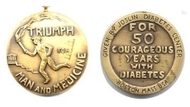
So it has really only recently (within the past two years) come to my attention that there is a MEDAL.  I could get a MEDAL for living with diabetes for 50 years.

Well, then.

I have run more miles than I care to count just for a single medal.  I’ve gotten on a plane, flown across the country, frozen my tuchis off, run 26 miles, and nearly crashed on the ice on the ground at the water stations for a medal!

But this one would be a pretty cool one to earn.

It’s the Joslin medal.

I think the history is critical to understand why they even count years with diabetes… keep in mind, I am really only in the third generation of type one diabetics who did not receive a death sentence along with their diagnosis.   I remember my grandma cried for days when I was diagnosed and I never understood why.  Now that I’m old enough to understand what a type one diagnosis meant to her, it makes more sense.  Maybe she remembered seeing kids in hospital beds, wasting away.

That has never been a part of my disease.  My disease doesn’t have a time limit. In fact, I quite honestly have never really seen many limits for myself related to my type one diabetes.  I know I faced one when I realized I could never be a commercial pilot… and when I realized I needed special permission for some things… but other than that… yeah, I kind of draw a blank.

Now, I understand there are limits out there.  I just don’t choose to see them. Why limit myself??  I’ve got limits in terms of time, space, means, ideas, geography, practicality, gravity, financial… with all of those limits out there why would I let my diabetes add one??

Yes: Be smart.  Learn.  Plan.  Figure.  Calculate.  Estimate.  Determine.  Be flexible.

But never stop.  Stopping will not only shrink your world, it will cause you to impose needless limits on your own life.

They don’t award medals for that kind of behavior.  Nope; they award medals for those people who have gone out and done their best amidst some daunting adversary conditions.

I’m thinking I have 27 years until I get that medal.  Maybe I should download the application now, just so I have it.

OMG I see they have a 75 year medal too!!!  Now I want that one too!!!!  :D

How long before you earn YOUR medal??

Why Is My Blood Glucose Sometimes Low after Physical Activity?

October 4th, 2010

I’m  going to try and run 20 miles this morning since yesterday’s run was a bit of a bomb (my foot, knee, and hip weren’t feeling like they had 20 safe miles in them!) so I’m stealing from Joslin since I won’t have time to write a blog today (20 miles takes a while).  This is good information to have in your brain when it comes to exercise… the more you know, the better you’re able to handle what life throws at you!


Low blood glucose is defined as a blood glucose level below 70 mg/dl if your meter measures whole blood, or 80 mg/dl or below if it measures plasma glucose (a plasma blood glucose of 90 mg/dl or below with symptoms is also a sign of hypoglycemia).

One of the most common causes of low blood glucose is too much physical activity. In fact, moderate to intense exercise may cause your blood glucose to drop for the next 24 hours following exercise. This post-exercise hypoglycemia is often referred to as the “lag effect” of exercise.

Basically, when you exercise, the body uses two sources of fuel, sugar and free fatty acids (that is, fat) to generate energy. The sugar comes from the blood, the liver and the muscles. The sugar is stored in the liver and muscle in a form called glycogen. During the first 15 minutes of exercise, most of the sugar for fuel comes from either the blood stream or the muscle glycogen, which is converted back to sugar. After 15 minutes of exercise, however, the fuel starts to come more from the glycogen stored in the liver. After 30 minutes of exercise, the body begins to get more of its energy from the free fatty acids. As a result, exercise can deplete sugar levels and glycogen stores.

The body will replace these glycogen stores but this process may take 4 to 6 hours, even 12 to 24 hours with more intense activity. During this rebuilding of glycogen stores, a person with diabetes can be at higher risk for hypoglycemia. Here are tips for safe exercising.

Guidelines for preventing exercise related hypoglycemia

  • Check your blood glucose before exercising to make sure your blood glucose is sufficient and/or consume an appropriate snack.
  • Avoid exercise at the peak of your insulin action.
  • Avoid late evening exercise. Exercise should be completed 2 hours before bedtime.
  • Avoid alcohol consumption prior to or immediately after exercise.
  • Avoid hot tubs, saunas and steam rooms directly after exercise. These continue to maintain an increased heart rate and may continue to lower your blood glucose.
  • Limit your exercise sessions to 1 or 2 per day. Additional sessions increase the likelihood of hypoglycemia.
  • In the past, it was believed that injecting insulin into exercising muscle increased absorption of the insulin resulting in hypoglycemia; now it is believed that the timing and action of the insulin are more likely to be the key factors.
  • Check your blood glucose immediately after exercise to prevent low blood glucose from occurring hours after exercise. It may also be necessary to check your blood glucose more often for 2 to 4 hours after exercise. Moderate intense exercise may cause your blood glucose to drop for the next 24 hours following exercise

If blood glucose is less than 100 mg/dl immediately after exercise

  • Follow post-exercise snack guidelines. If you are not scheduled for a snack or a meal for 30-60 minutes after exercise, 15 grams of carbohydrate should be sufficient to prevent a low blood glucose. If no meal or snack is scheduled for more than one hour, take 15 grams of carbohydrate and 7-8 grams of protein.
  • Increase carbohydrates before exercise.
  • Decrease the dose of active insulin for the next exercise session.
  • Consider decreasing the insulin dosage following exercise.
  • If your blood glucose at bedtime is still less than 100 mg/dl, double your bedtime snack, or if possible, decrease your insulin dose acting during bedtime.

Guidelines for unplanned exercise

Sometimes exercise or physical exertion occurs spontaneously or is unplanned. You may need extra food at these times in order to maintain the balance between your insulin or oral medication and the energy needed to exercise. A number of factors will determine if you need food and how much food is necessary.

  • Snacks may be necessary for exercise beginning 2 hours or more after your last meal.
  • Snacks may be needed for exercise lasting 1 hour or more.
  • Long duration or all-day activities may require both a snack adjustment and an insulin adjustment.
  • If you are attempting to lose weight, adjust your insulin or medication rather than eating extra food.

Be sure to talk to your diabetes educator for more information about how exercise will work best with your diabetes.

Eating and Counting, Counting and Eating

October 1st, 2010

It’s no big secret that diabetics care about the carbohydrate counts of the food we eat.  We have to—if we didn’t care about how many carbohydrates we ate, we’d be bouncing around with much more metabolized sugar in our blood stream than is healthy.  (I mean, more than we do anyway.)

I remember having to match the food I ate to the insulin I took.  What a miserable way to eat!  If I was hungry, I ate the same thing as if I weren’t hungry.  Every meal was supposed to be the same, in an effort to minimize the variances that comprise an interesting and enjoyable life.

No wonder that system didn’t work out very well for me.

Now that I match my insulin to the food I eat, I have a much better time with things.  Meals are more enjoyable, and it just feels good to use my brain and have options when it comes to feeding myself.

I read a question from a parent earlier who asked how people count carbohydrates at a restaurant, if the food isn’t listed in a calorie book.

Hmm.

I don’t think the point of counting carbohydrates is to make it an exact science.  I think the point is to get as close as we can, but there comes a point where you need to simply let go. 

If it were easy, we’d all do it and we’d all have non-diabetic A1cs and we’d never go high or low.

Right.

So get used to the fact that this is the human body.  If it were simple, we’d all live long healthy lives with little difficulty.  If it were a mathematic equation we’d study, pass the exam, and next time when we get the same exact question we’d have the same exact result.

But that isn’t diabetes.

Diabetes involves a TON of guesses.  Educated guesses, of course, but still: when it comes down to it we are guessing.  So quite honestly if you are off by 5 or 10 grams when you’re counting a new food, one day you’ll go low and another day you’ll go high.  It’s just how the disease works in our body.

Don’t skip a new restaurant because you don’t know if they rinse their pasta before serving the spaghetti, leaving starchy water on the pasta which may result in more carbohydrates on the plate.  Don’t avoid trying a new dish because you don’t know how many carbohydrates are in the sauce.  Don’t go only to restaurants with calorie counts on their wall… who knows if the person in the kitchen used a different size spoon than the person making the calculations?

Do take a class in carbohydrate counting.  Do get a set of measuring cups and use them as serving spoons at home for a few weeks.  Do look at what the sizes look like on your plate.  Learn the basics for what you need to count, and use that knowledge in the world.  Interact with your world and involve yourself.  Take guesses.  Let go of the idea of ever getting it “right”.  (It’s going to change tomorrow, anyway.)

Your world is as big and as beautiful as you let it be.  Don’t let the variances that affect your life with diabetes make that world smaller by one inch.

It’s Official. Gulp.

September 30th, 2010

I received my registration confirmation in my inbox this morning.  It’s now official: I’m running the Silicon Valley Marathon October 31st

I know I discussed this marathon months ago, but now that It Is Official I get to speak about it further.

I am running the Silicon Valley Marathon to support Run the Coast which in turn supports The Iron Andy Foundation, a nonprofit organization dedicated to sending kids with diabetes to camp.

If that doesn’t make you want to get up and run for several hours, I don’t know what will.

This will be a new one for me—doing something BECAUSE of my diabetes, ON DISPLAY in a way I’m not accustomed to ever in my life.  Cool.

Sure, working at Bearskin Meadow Camp my disease was on display and on the table all the time… but so was everyone else’s diabetes!  So this time may be a bit different.  Diabetes Outside has put my diabetes out therewhere it hasn’t ever really been before.

Duh.  Start a blog and write about diabetes what on earth do you expect.

Still, this marathon will be very exciting for me.  Physically, of course, I’m apprehensive about the 26.2 miles.  Mentally, a part of me is dreading the challenge and the other part of me is so excited to see what happens I can barely stand it.  Emotionally, I’m split as well.  I’m thrilled to be doing something and speaking about my diabetes and my running and my fitness with my disease and I’m thrilled to do so in an effort to send kids to diabetes camp.

But you probably know as well as I do just how privately we each deal with our diabetes every day.  I don’t mean that we hide our numbers or are afraid to say something to someone else… I mean that there are simply a LOT of blood checks and a LOT of minute adjustments and a LOT of calculations.  To speak about all of them would leave little time for anything else!

So, the other side of my emotional response includes some trepidation about being a type one diabetic, running for Run the Coast and Team Iron Andy, and doing so AS a diabetic, FOR diabetics.  It’s just going to be interesting.  I wonder if it will even be an issue.  (Probably since I’m blogging about it now, it won’t be.)

But I’d best stop typing and get back out there and train.  I only have a few weeks left! 

If you’re interested in donating to either Run the Coast or The Iron Andy Foundation, you can find links to do so on their websites.  Better yet, join us out on the course!

Enjoy!

Going the (mile) distance

September 29th, 2010

Sometimes clients ask me how many calories a workout burned.  It’s a weird question to ask, I think, since calorie burn depends on so many factors and almost none of them are visual factors.  But I usually give them a ballpark response, since they’re asking.  I factor in how physically big they are, how much cardio activity the workout called for, and how much effort I saw them put in through the course of the workout.

My guesses are not science, but there is some science in the answer.

If your specific calorie burn matters to you for each workout, you need to know that if you weigh 139 pounds, running a mile will burn 100 calories.  Runner’s World says that to calculate your burn per mile, multiply your weight in pounds by 0.72. 

So that means if you run fast or slow you’re still burning the same number of calories—it may just take you less time to do so if you run faster.

But (there is always a “but”!) that’s just your gross burn.  If you didn’t run a step, you’d still burn some number of calories just sitting around because of your basal metabolic rate (BMR).  (Hey… basal!!  Yep.  Same basal.)

Runner’s World also published a handy chart to see this concept in action.  Makes me want to run faster!

Activity for 150-lb person Gross calories burned per MILE Net calories burned per MINUTE
Running 5 mph (12:00 pace) 108 7.87
Running 10 mph (6:00 pace) 108 16.87
Walking 3 mph (20:00 pace) 85 3.12
Cycling 16 mph 18.57 3.82
Cycling 23 mph 36.2 13.35
Swimming 2.56 mph (1.46 min/100) 330 12.95