Archive for the ‘Living with Type 1 Diabetes’ category

Ut Oh. That’s what I said when I read this yesterday at ParentingDiabeticKids.com

July 15th, 2010

My daughter was diagnosed at 4 years old. She is now 9. She does not take her diabetes serious at all. She sneaks food constantly. We hide her 100 cal. snacks because she will eat them throughout the day. She is always high in the evening, and I mean high. I am worried, I don’t feel we are doing enough. We address this with her Dr. every time we go. She says this is normal for her age group. She loves grapes and her snack. 1 point a piece. But I can’t really buy them for her, because she sneaks them at other times in the day. Any advice, I am so worried about her. What do we do to make her believe this is serious. Just a little background…she was adopted at birth so counselors say her diabetes just may be one thing she feels like she can control. HELP

I feel pretty passionately about the fact that kids need help dealing with their diabetes.  Good, quality help and support.  They need tools they can use for the rest of their lives as they encounter the daily struggles diabetes and their lives will bring.

Okay.  So.  Back to the ut-oh.

1. I get how horrifying this must be for an adult watching her child sneak food; I mean, I understand that it is horrifying.   I can imagine how difficult it is for a parent of a diabetic kid.  I think they reflect on their own childhood and project that nostalgia onto their child’s childhood and feel like any opportunity for a carefree life has been stolen from their child.  I think they spend so much time feeling anxious and worried and trying to control their child’s diabetes they are robbing themselves too. 

This all makes sense and is completely understandable.  I feel for each and every one of you. 

I just think you need to do more than worry and try to control the disease and your child’s response to it.  I think you need to deal with YOUR feelings about the disease, too, and let your child do the same.

2. She’s nine years old; how seriously do you want her to take anything?!  Diabetes takes a really long time to ever deal with, and it’s a daily thing even long time diabetics continue to struggle with.  In this particular case, I think her parents here are setting her up for a lot of years of disordered eating by attaching emotional responses to food not only on her part as she hides her eating but also on her parents as they react to her eating.  I am saddened at the thought she may turn to diabulemia as a “solution” at some point to deal with food and her weight and her disease.

 Type one diabetes messes with how we see food mainly because it messes with how our bodies deal with food.  It’s tough; I wouldn’t ever say otherwise.  But just like we need to remove emotion from blood sugar meter readings, we need to remove emotion from the kitchen table, from the kitchen cupboards, from the refrigerator, from the grocery store, from the nearest convenience store or vending machine.  Food is food; just that.  Don’t give it more power than it requires.  It isn’t a menace, it isn’t a salvation, it isn’t medicine, it isn’t poison.  Diabetes dictates how we deal with food when it enters our bodies—let it only dictate that much when it comes to the eating parts of life, and leave it alone beyond that. 

3.  I read a lot of responses from parents to this post and several said they explain to their child that if they sneak food or don’t control their diabetes they will die

EXCUSE ME?!?!  Are you SERIOUS?! 

Sorry for this gut-level response on my part: I simply do not think it is appropriate in any way.  A child’s brain is not as developed as an adult’s brain and won’t comprehend “death” like an adult does.  That’s why we’re called the adults.  To use a scare tactic the child cannot comprehend on a child is useless to create anything but an unhealthy relationship between a child and his or her parent.  You have those fears, just like any parent has those fears for his or her child.  Your child simply does not understand how much you love them and how much you would do to protect them, and how threatened you feel on an instinctual level when you see their blood sugars going one way and them behaving a different way. It’s why they are called kids.

So stop using pointless and dangerous scare tactics.  I am confident you won’t like the result.

4. WHY IS THIS KID NOT ON A PUMP.  Really.  Why is she not carb counting and bolusing and beeping and dear me why is she not on a pump.  The pump is one of the most freeing tools a kid living with diabetes has at their disposal.  This girl needs to be on a pump.  This girl’s parents need her to be on a pump.  PUMP.

5. I also disagree with the expert on this, for the record.  I think he’s missing the point.  Although, he hadn’t see the responses from parents when he responded to this initial question, so maybe my perception was skewed differently than his.  I just don’t think he got to the heart of the matter between the parents and the child.  To punish a nine year old child for not taking proper care of her diabetes just seems ludicrous to me. 

I’m sure each parent reading this just rolled their eyes at me.  I’ll take that.  I don’t have kids, much less misbehaving kids.  I just don’t think that “diabetes care” and “behaving” belong in the same sentence.  Diabetes isn’t a chore; it’s a chronic disease.  You can forget to make your bed or clean up your toys, but when you are sent to your room for not checking your blood sugar I think it puts out a dangerous, unnecessary, and unhealthy power play.  Diabetes is hard enough; work together to fight the daily struggles and remove as many emotional power plays as possible.   

Together. 

Please.
Living with Diabetes Requires a Continuous Effort

July 14th, 2010

No big news flash on that one, for any of us who have lived with type one or type two diabetes for longer than, say, a week. 

It strikes me now and then just what a toll that continuous effort takes on us and on our lives.  We just always need to be alert for what our blood sugars are doing, and what comes next, and what is around the corner, and how our bodies will likely react to it.  We don’t need to be obnoxious about it, but we are always calculating and always figuring and to some degree always planning.  I go low if I forget to figure or calculate and I go high if I’ve planned incorrectly.  I don’t like being at either extreme and feel I’m not my best self when I am either low or high.

My husband (whose pancreas functions just fine) took me for a hike soon after we met; he wanted it to be a surprise.  I’m all for surprises, but I should have asked better questions and he should have given me better answers.  I didn’t know how far we were going, and he assured me he had low food with him (I had some too).  It wasn’t enough for an unknown and unplanned 2-3 hour hike.  (I would have been fine for a shorter hike, but this wasn’t that.)

I’m sure you know the ending: I was super low and despite eating all of the glucose we had with us, it wasn’t helping.  The story ends fine because we happened upon a group of friends who had apple juice with them.  (It happens a lot when you hike around Bearskin Meadow Camp!) 

I’m not sure what would have happened if we hadn’t bumped into them.

I think I was recalling this story because I know sometimes people perceive me as a control freak or an excessive planner.  I, in turn, am choosing to deflect that perception and focus the blame instead on my disease. 

Living with diabetes does require me to be in control of my body and a certain amount of my surroundings all the time.  My sister planned a bachelorette party for me but hadn’t thought about my pump in a mud bath.   My husband heard my pump alarming on the bathroom counter when I was in the shower the other day.  He was so proud of himself for being able to clear the alarm! 

It’s these kinds of things that, when they occur, remind me how personal this disease is.  I can’t really hand any of it off to anyone else.  I do have some fantasy in my head borne of the four days I spent in the hospital after my diagnosis—I dream that someday I’ll have something wrong with me that sends me back to the hospital where the nurses and doctors will be in charge of my blood glucose for a few days. 

I know that’s kind of a sad fantasy, but there it is.

So, my friends, the best I can offer today is a virtual hug or a virtual hand squeeze not because I can in any way stop or help the continuous effort required of you, but because I know how it feels to have that requirement, too.  

All the best.

Some Ideas to Help Us Remember

July 9th, 2010

I’ve done my share of forgetting to bolus over the last 15 years I’ve been on the pump.  I remember forgetting to take shots every now and then, too.  I’ve found it much much easier to forget to take boluses though.

Even setting those pump alarm reminder things doesn’t help; I rarely see an alarm and fully process it anymore! 

But how, if you are a parent, do you help your kid remember to check and bolus and do all that stuff

I know you want to nag and plead and yell and scream and just basically communicate to your son or daughter how desperately you hate that they have to deal with diabetes at all, and how very much you so want to take it from them and place it on yourself instead. 

But that isn’t possible.  And I think what comes across to a kid is an entirely different message altogether.  One neither of you wants. 

Here is an idea that might work in your family.  Do you have other ideas?  Keep the lines of communication open and as worry-free as possible.  Make it about your son or daughter’s ability to grow up in a fun and smart way, and let diabetes take back seat every now and then.  A managed disease flows from a manageable mindset about what it all takes, and a lot of love and caring. 

Help your caring show through more than your concerns by frequenting places like ParentingDiabeticKids.com.  Although I don’t agree with everything they say and each message that they give across to parents of kids with diabetes, I think I need to step back off my soapbox and just get you the tools that will help you, and help your kid.

Question: Should we Eat Less or Exercise More? Answer: Yes.

July 8th, 2010

In order to really lose serious weight, you are going to have to do both.  It simply isn’t worth beating around the bush on that one, or setting unrealistic expectations.  You need to eat less and exercise more if you are trying to get fit.  (You didn’t really expect I had a magic pill, did you??)

In order to maintain your weight, you will need to be smart about what you eat and exercise.  (You didn’t think I’d change my tune in one line, did you?)

I think this is a good thing.  I think it helps me to know I will always have exercise to help me out.  I know that hormonal changes, stress levels, family commitments, and even holidays will all affect how much I eat and what I eat.  So I have come to learn to expect my weight to fluctuate over the course of a month, and over the course of even a year.  I don’t worry too much about it, but I’m always paying attention to how my pants fit.  My pants, fortunately or unfortunately, never lie.

I love knowing that all I really need to do to handle these eating changes is to keep up my exercise.

I know for certain that my life would be “simpler” if I could eat the same amount of food every day at the same time—I could definitely manage my diabetes better that way.  But I’m also fairly sure that eating that way would create a barrier between me and others in my life—something I don’t think would serve me at all.  So I’ll have to settle for paying attention to it, being aware, always trying to eat more vegetables and less bread. 

I think that’s what life is: finding a way to balance in the grand scheme because we all know there is no hope for staying balanced every day.

The American Journal of Clinical Nutrition surveyed more than 4,000 females aged 14-22 over four years as they self-reported their weight and activity levels to see how they could prevent long-term weight gain in female adolescents and young adults.

Well, now, lookey here: females who exercised five or more days per week gained significantly less weight than did their peers.  (Recall, this was between the ages of 14 and 22—big years with many many changes in a person’s life and body.)

My response to this is an unqualified Awesome!  

Frequent exercise sounds harder than it is.  This is something we can all actually manage to do!  We can all stand to spend more time moving ourselves without the aid of a motor. 

Your pants will thank you.

Losing Weight

July 7th, 2010

Ah, yes.  Weight loss.  A part of our lives whether we like it or not.  Whether you run ten miles a day or haven’t run ten steps in a decade, we all need to be aware of our weight. 

And I’m not talking about the obligatory stand on the scale at the doctor’s visit. 

I’m talking about how you move and how your clothes fit.

Since continuing to endure the July 4 sausagefest that my life has turned into, I thought it was high time for a reminder about body weight maintenance and weight loss.  It’s a constant thing to keep a close eye on.  Remember that insulin not only facilitates glucose usage, but it also facilitates fat storage so keep a close eye on how much insulin you take—aim for only taking what you really need to manage your blood glucose.

I read in a Runners’ World magazine once that you could finish a marathon something like 10 minutes faster if you weighed 5 pounds less.  That was pretty impressive; the idea of actually trying to run faster is sometimes too much when I’m trying to run that many miles.  To think all I need to do to get faster is to weigh less is kind of nice.

So, straight from the Runners’ World archives, I give you today some good basics for weight loss.  The basics apply to everyone, not just runners.  People living with diabetes have the extra joy of needing to eat to manage low blood sugars, too, not unlike distance runners who need to continue a run after depleting their energy stores. 

Nancy Clark is a well-known nutritionist and the woman who coined my favorite two phrases: you can’t gain weight at breakfast and you can’t gain weight at lunch.

Here’s to that.

Weight Loss For Runners

THE 10 RULES OF WEIGHT LOSS

Nutritionist Nancy Clark shares 10 tips all runners should know if they want to drop some pounds.

By Nancy Clark
PUBLISHED 03/05/2008

1. To lose 10 pounds of body fat a year, you need to eat 100 calories less per day. Cutting too many calories from your daily intake will sap your energy level and increase your hunger, making you more susceptible to splurging on high-calorie foods.

2. Don’t skip breakfast. Eat within two hours of waking.

3. In fact, eat more breakfast than you think you should. Trade in some of your dinner calories for more calories at breakfast.

4. Don’t allow yourself to get hungry. Eat at least every four hours, and split a meal in half to make sure you properly fuel up pre- and postrun. For example, eat part of your breakfast before your morning run (a banana) and the rest of your breakfast afterward (a bagel with peanut butter).

5. Eat at least three kinds of food each meal from these four categories: breads, cereals, and grains; fruits and vegetables; low-fat dairy and soy; and lean meats, fish, and nuts. Breads, cereals, and grains should be the foundation of each meal, with protein as an accompaniment.

6. Shoot for a gradual loss of body fat. You’re more likely to put the weight back on (and more) if you drop weight too quickly.

7. Liquid calories add up fast and can lead to weight gain. Minimize the amount of sodas, juices, store-bought smoothies, sports drinks, coffee drinks, and alcohol you consume.

8. Eat closer to the earth, enjoying fruits, vegetables, and whole grains. Minimize the amount of processed foods you eat; they tend to offer less fiber and are less satiating.

9. If you can’t resist fast food, ask for nutritional information before you make your choices (or check in advance via restaurant Web sites). Avoid any menu items with the words “fried,” “crispy,” and “special sauce,” which are guaranteed to be high calorie.

10. Remember that the calories in the energy bars, sports drinks, and gels you consume during a run add up, even though you’re running. Consume them only as needed.

The Powers of Pushups

July 6th, 2010

If I could only do two activities for physical fitness for the rest of my life, I’d choose to run and do pushups.  Which is kind of weird, when I think about it, because I can’t say I enjoy pushups like I enjoy running. 

Pushups are just a really great exercise.

I remember a few years ago I had a bootcamper snort when I said that about pushups.  He said “yeah right” as he snorted.  Then we spent some serious time working on his form and he learned what I was talking about.

(I pay extra special attention to the snorters, and their form.)

So how can we make pushups something everyone can do?  There are a lot of different ways to modify a pushup until you are strong enough to do a straight-leg pushup. 

***NOTICE: there is no such thing as a “girl” pushup or “boy” pushup.  No.  Such.  Thing.  There are “straight leg” and “bent leg” pushups.  That’s it.

  1. First of all, think about the chest muscles you use to perform a pushup.  Chest muscles really only have a few functions they serve on their own: pushing away and gathering in, like during a hug.  The fibers themselves run in a fan shape from your shoulder joint and armpit across your ribs to your sternum.  You will mainly be using the fibers that function to push away from your body when you do a pushup (or bench press; a chest flye with dumbbells will recruit the fibers used in a hugging-type motion.)
  2. Secondly, think about where your hands and arms are in relation to those chest muscle fibers.  Make sure to keep your hands roughly underneath the muscle fibers you are trying to recruit in a pushup.   If you have your hands too far in front of you, you are likely to not only miss the effectiveness of the move but also put your shoulder joint at risk. 
  3. I should also mention, you must bend your arms when you perform a pushup.  If you aren’t bending your arms, you aren’t doing a pushup.  (I’m not sure what that is, but it isn’t a pushup.)
  4. Third, keep your body as straight as possible when performing a pushup.  Think about your heels, knees, hips, shoulders, neck and the crown of your head forming a straight diagonal line.  Maintain that same line whether you perform the pushup on your toes or on your knees.  (Keeping my body straight takes the most effort for me—after 75 pushups, I feel them not in my chest but in my abdominals and back from working to keep my spine and body straight!)  If you see your toes, you’ve lost your alignment.  Look at the ground halfway between your hands or even six inches in front of your hands.
  5. Work to bring your chest down to the floor and keep your upper arm parallel with the floor—anything deeper than that will likely cause you to lose your form and alignment and recruit other muscles to help you perform the move.  Wait to make them fancy until you’ve built a solid base of strength in all of your muscles, not just your chest and shoulders.

Listed from easiest to hardest on the scale of basic pushups:

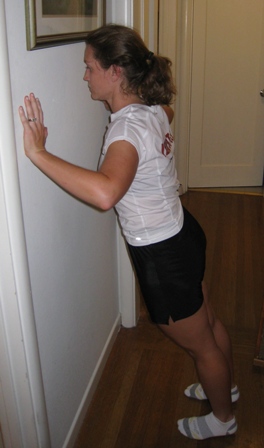
1. WALL PUSHUP

Wall Pushup-- Easiest since you aren't supporting your body weight

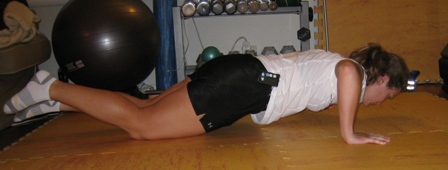
2. KNEE PUSHUP with your hips straight above your knees—your straight line here includes your hips, shoulders, and head

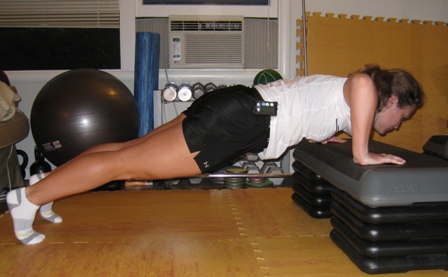
3.  ELEVATED KNEE PUSHUP keep a straight line with your knees, hips, shoulders, and head but with your hands on an elevated surface you won’t be pushing as much weight as you would if your hands were on the floor

4. KNEE PUSHUP with your hips past your knees – now your straight line includes your knees, hips, shoulders, and head

5. ELEVATED STRAIGHT LEG pushup- keep on your toes and your straight line includes your heels, knees, hips, shoulders, and head but again with your hands being on an elevated surface you won’t require as much strength to perform the move

6. STRAIGHT LEG PUSHUP—here’s the fun one to perform as your next party trick!  Keep that body ramrod straight and show off your hard work.

Then tell those snorters to snort off.

Heavy Stuff

July 5th, 2010

Just because I do a lot with my diabetes doesn’t mean it’s easy.

I don’t let it stop me, but it absolutely tries to, several times every day. 

Over the past few years I have started to share more of the basics of living with diabetes than I have in the past.  I think part of that is growing up some more, and some of it has to do with the fact it feels like I’m putting down more roots than I have in the past. 

I had a friend in my first year of law school say to me that she knew we would be friends for a long time, so she wanted to learn more about my diabetes.  A year later she said it was still a lot to learn! 

I don’t ever want to shy away from explanations, yet sometimes it feels like maybe I’m not getting my point across.  I feel kind of badly when I only explain part of something, but that’s the only way to do it.  There is simply too much information and too many factors to ever explain what it’s like to live with insulin dependent diabetes.  I spend some time explaining something and when the other person repeats it back to me, I smile and say “yes; most of the time” or “yes; when it works” or “yes; at least for a while until it changes.”

There are so many aspects of living with diabetes that really do require an adaptation of an additional sense to manage it.  I’m always factoring in my last reading, the reading before that, what I ate, what I did, what insulin I took, and on and on and on just to come up with a number where I think I’m at.  Then comes the actual checking (most of the time) and doing something about it (some of the time) or setting a mental note to remind myself to do something in the future (the hardest part, for me) and resuming the rest of my life.  Then it starts all over again, and the cycle repeats several times throughout the day and night. 

So sometimes I miss something in a conversation, or I come across a little scatterbrained, or I have to take a moment to remember what day of the week it is.  I have to remind myself that not everyone has to manually function for their pancreas like I do.

(And this is all when my numbers are in range; the swings are another thing altogether!!)

My weekend this weekend involved a few conversations that were oddly juxtaposed in my mind for some reason.  My sister hadn’t understood that I was applying for a service dog for my own disease and what and how I could benefit from having a service dog accompany me everywhere.  I also had a friend ask me if the 142 meter reading I posted to Facebook was a “good” number or what the numbers even really mean.  I also walked to a neighborhood fun run yesterday and had only factored in my insulin for the run itself, not for the 20 minute walk to the start line, so my numbers weren’t where I wanted them for the run.    

I can understand why we often keep our diabetes to ourselves.  It’s a huge thing to live with diabetes and when it feels like someone doesn’t understand, or that someone else could have seen something coming (like the walk to the start line) because they only see a small portion of the disease and not the entire thing, it somehow makes the disease feel heavier to carry.

At least it did for me over the past few days. 

I’m not sure what exactly I can do about that, either.  I’m sure I don’t ever want to not respond to a question.  I’m also sure that I want my family members to have enough of an understanding so that they realize, deep down, that diabetes is a serious disease and it’s through my determination and hard work that I do as well as I do. 

I also want to spend more time with others with insulin dependent diabetes.  THAT is something I know makes my disease feel lighter to carry.  No explanations.  Some sharing, but the rest of the time just being.  Because we all understand that we each are truly doing our best to function with so many variables and oddities and just plain screwey things that happen that it’s amazing most days we can make it through the day without yelling or crying or screaming (or all three).

Go us, working so hard.  We rock.

Happy July!

July 1st, 2010

Happy July!  Are you planning out your July 4 food already?  I’m on the fence between a hot dog and a burger.  It’s always a tough call for me!

July also brings with it some of the hottest days of the year for most of us.  As a runner, I need to pay particular attention to what the heat does to my body.  As a type one diabetic, I need to pay particular attention to what working out in the heat does to my blood glucose.

I have an air conditioner in the room where I work out, but what about summertime runs in the middle of the day or after work?  I need to be prepared for the heat and prepared for a drop in blood glucose when the temperature is not what I’m used do.  (This is why I was very concerned before my marathon this year that the Florida heat would be a shock to my system that was used to running the distances in my January cold environment—I can run through a lot, but I cannot run when I’m low, and my first few runs in the summer heat usually cause me to drop.  I was lucky that the freakish cold snap meant I froze but I could keep running!)

I went to a lecture last year by a running expert, Jason Karp Ph.D.  I like what he has to say and most of my experiences mirror his information amazingly well.  (I also get a kick out of his corny jokes.)  I’m summarizing his July newsletter here that discusses the main concerns for summertime workouts:

Running in the heat presents a number of thermal and cardiovascular challenges.  The two most important things you can do to prepare for your summer outdoor training sessions is hydrate and acclimatize.
HYDRATE

Beginning the workout fully hydrated or even ‘hyper-hydrating’ before a workout can delay dehydration during exercise, maintain exercise performance, and decrease the risk for heat-related illnesses.  Pre-exercise fluid intake enhances your ability to control body temperature and increases plasma volume to maintain cardiac output.  Drink before you run in the heat so you begin every workout fully hydrated, and continue to drink during workouts longer than one hour.  A good indicator of your hydration level is the color of your urine.  The lighter the color, the better.  The best hydrating drinks are those that contain sodium and glycerol (you can buy glycerol and mix it into your drink). 

ACCLIMATIZE
Chronically exposing yourself to a hot and humid environment simulates adaptations that lesson the stress.  Cardiovascular adaptations to exercising in the heat (e.g., decreased heart rate, increased plasma volume) are fully complete after 2 weeks, as the increased sweating response catches up to other adaptations.  You should take 2 weeks of slowly introducing yourself to the heat to be fully acclimatized and prepared for longer runs.  When preparing for high-intensity workouts such as interval training, however, you may not need as long to acclimatize.  Research has shown that just four 30- to 45-minute sessions of intermittent exercise in the heat is enough to cause acclimatization and results in an improvement in intermittent running workouts.  While exercising in the heat will always present a stress, acclimatization has a moderate prophylactic effect, minimizing the stress and reducing the risk of heat-related illnesses. 

I also point out for all of us living with diabetes that the first few workouts of the summer heat are NOT the workouts to push through feelings of exhaustion or low energy.  They are NOT the workouts to skip the basal rate reduction or to skip the snack before you start.  They are NOT the workouts to add on a couple miles when you don’t have glucose with you.  Save those workouts for a few weeks, when you’re used to the heat, you’re properly hydrated, and ready to rock it.

You Know What They Say About “Assuming”

June 30th, 2010

We are all experts at a lot of different things.  I sometimes forget that, especially when it comes to food.  I think we all know about carbohydrates.

My sister sent me an email last week; she was having dinner guests and one of the guests has type 2 diabetes.  I’m not clear if the guest asked for anything in particular, but my sister wanted me to look at the menu because she was worried the menu was “too starchy”.

So here it is:

-Potato and rosemary flat bread (made with gluten-free pizza dough–I KNOW that’s starchy!)

-Herbed carrot soup (has one potato in it for 6-8 servings; no cream, just veggies–but are carrots starchy too?)

-strawberry and lentil salad (the lentils and goat cheese and pecans are the protein, but are lentils also starchy??) 

My sister knows what foods have gluten and what foods have dairy; she has determined that for her, she does better when she avoids both food groups.  It was kind of funny to see that she was having a hard time coming up with a menu.  I assumed she was well-versed in all food counts (carbohydrates, proteins, fats).  I guess not!

I do the same thing with the rest of my diabetes.  I assume others struggle with blood sugar levels and highs and lows all day, every day.  I assume I’m like everyone else, a lot of the time.

It only takes this emailed question from my sister to remind me what happens when I assume. 

I guess I assume everyone knows what I know about living with diabetes because it just makes my life easier and makes me feel less alone when I struggle.  I took the evening off of a work function yesterday because I have had several extreme lows overnight during the last week and haven’t slept well as a result.  I appreciate that I feel comfortable saying that to my coworkers, but at the same time, I’m not sure I like taking the time off for a diabetes-related reason.  Then again, I haven’t been sick all year with a cold or sore throat, so I guess it evens out in the end.

Still, I should remind myself that living with diabetes and functioning for my pancreas does take time, energy, and knowledge of a lot of different things that most people don’t know about and don’t have to know about.  I should remind myself that I deserve a pat on the back and sometimes an extra hour of rest when I need it.  I should be okay with asking for what I need, and not assume others know what I face. 

Because you know what happens when you “ass-u-me”!

 (For the record, I suggested my sister add a rotisserie chicken or roasted asparagus to round out the meal.  I’m not sure what she ended up serving; I just know that usually when friends have dinner together, they aren’t getting together for the food.  I’m sure it was a lovely evening all around.)

Just Around The Corner

June 29th, 2010

The founder of Dogs 4 Diabetics, Mark Ruefenacht,  gave a little welcoming speech at the graduation on Saturday.  He said that when he first started D4D he’d tell people what he was doing and would sometimes get the question “what are you doing that for; the cure for type one diabetes is right around the corner”. 

You know, every single person over the age of 15 in that room let out a groan. 

We laughed, but I don’t think it was funny.  I think it was sad.  We had all been duped after being diagnosed into believing we just had to hang on a little while longer with this disease and wait until we got closer to that corner and found the cure.

Just a little while longer.

Yeah.

We all have to hear from our friends and loved ones that they’ve read or seen that some good research is being done on mice, or stem cells, or what have you.  We all endure the headlines saying you can cure diabetes by eating blueberries instead of ice cream.  We all have to do all of this with a smile on our face and a syringe in our hand.  It’s what we do.

Mark said he responded to those who questioned why that he had lived with diabetes for forty some years, and that cure had been just around the corner for forty some years He wasn’t waiting.  He was being proactive and doing something to improve the lives of diabetics NOW.  (and wow has he succeeded)

I’m not waiting either.

So you know what?  I’m making that my cure for diabetes.

I’m going to say I have cured my diabetes; it feels like I have.  I’m not fighting why I have it, I’m not fighting when can I get rid of it; I’m just going to say okay, this is what I deal with. 

I’m going to say, you know, I understand my feelings of bitterness about my earlier misplaced hope and misdirected energy towards that old cure, right around the corner.  But none of those feelings ever actually HELPED me live with my disease.  So I’m acknowledging them, and moving forward.

I’ve said this before: if you think you just have to hold off dealing with your disease for a couple years and you’ll no longer have diabetes, no kid or adult is going to deal with their disease.  Type 1 diabetes doesn’t get better.  It only gets easier to live with after you can realistically fit it into your life, learn to live with it and really move toward a life you love.

So what if that right there is the cure?  Maybe then we can act to improve our lives with or without our disease. 

Let’s go!!