Archive for the ‘My Workouts’ category

Fitting Fitness In—Despite Your Stress

July 20th, 2010

I think it’s important to figure out ways to keep yourself working out while you’re stressed and busy.  I know, I know.  It’s difficult.  And some days you won’t be able to squeeze it in.  However, make sure that those days are very few and far between.  Take care of yourself and your body; the rest of your life will thank you for it!

Saw this in the July 2010 issue of Oxygen magazine and I like what they say:

Q: When I’m stressed, I find it difficult to train.  How can I keep myself motivated?

A: Exercise reduces stress, increases energy and enhances mood, so the most important time to fit in a workout is when you’re stressed!  The very act of making yourself a priority counteracts stress and even helps prevent it.  Here’s how:

Pick a time of day to exercise that you are most able to commit to at least three times a week.

Choose a form of exercise you enjoy doing.  For instance, don’t force yourself to run if you genuinely don’t enjoy it.

Train with a friend or personal trainer—you’re less likely to bow out of an obligation to others.

Find a quiet place, take some deep slow breaths and visualize yourself exercising and feeling strong, fit and healthy.

Last, give yourself a reward for sticking to your commitment to reinforce the healthy choices you are making for yourself.

Are you seeing a trend here?  Exercise helps you combat the bad stuff in your life.  Feel good about that.  Make time to exercise, and feel better about what you’re doing for yourself.  Feeling strong, fit and healthy isn’t a quick fix and it is impossible to achieve overnight—but the benefits reach wide and last a lifetime if you let them and keep at it.

So go, carve out some time to exercise.

Enjoy the benefits.

Fitting Fitness In

July 19th, 2010

Cardiovascular fitness is a big thing for me: I like knowing I can run if I need to, and I like knowing I can keep running longer than most.  I find my long runs perfect opportunities to work out whatever obstacles have arisen in my personal and professional life since my last run.  I enjoy the sense of accomplishment I feel after running X number of miles (when X > 10) and I think it’s fun to tell people at lunch how many miles I ran before they woke up that morning.  I generally think any run less than an hour shouldn’t really qualify as a workout.

Yet I know I’m in the minority.   (It has also taken me nearly a decade of running to reach that point, for the record.  I’ve worked to get there because it was something I wanted to do.)

I’m not saying I’m right and I’m not saying I work harder or less hard than anyone during a workout.  I’m saying that for me, running gives me a lot. 

And it also takes a lot.  A lot of time.

Good thing that several shorter bursts of cardio throughout the day can have multiple benefits for your overall cardiovascular health!

Give yourself 10 minutes before you take a shower in the morning, 10 minutes at lunch and 10 minutes before you read your mail at home, and you’ve squeezed in 30 minutes of cardiovascular activity that day.  You’ll get your metabolism kick started several times throughout your day, you’ll have the energy to make it all the way through your shorter session without too much fatigue, and you won’t have as many mental demons to battle for a shorter workout.

You know you can fit in those 10 minute segments.  Honestly; you know you can

I’m not saying that if you’ve signed up for a 5k all you need to do to prepare yourself for the run is to jog for 10 minutes three times a day.  I’m saying that if your goal is increased cardio health, try taking smaller bites out of the apple and choke down that exercise in a manageable way for yourself. 

My experiences with exercise and my insulin needs deal almost exclusively in exercise sessions longer than 30 minutes.  I know that for me, I need to be exercising at least 15-20 minutes before I sense any drop in my blood sugar (absent any other strange happenings in my day).

When I first started to exercise, I couldn’t jog a block.  If I did, I’d be low within 15 minutes.  So watch yourself and your effort levels and how they affect your blood sugar levels if you are just starting out.  You can easily benefit by having several shorter bursts of exercise spread throughout your day—if you do it regularly enough you may need to lower your overall basal rates due to your increased metabolism.    

Pretty cool.

What a Huge and Beautiful Opportunity

July 16th, 2010

Get Up, Get Out!  and No Child Left Inside!  Are two slogans of the Karno Kids Foundation, organized by ultra endurance athlete Dean Karnazes. 

Dean blogged today about the fact that kids are not participating in being outdoors in nature and being as active as any of us would like for them.  I think we all have fond memories of the summers we spent on our bikes or skates or flip flops to and from the community pool.  We want that for today’s kids, too.

Yet how do parents of diabetic kids feel comfortable taking their kids out and having them run and play and fall and scrape and get all mucky and then check their blood glucose with dirty fingers? 

(alright, that one was an easy one: alcohol swabs and more snacks and less insulin)

I think with diabetic kids it’s easy for a parent to see them as “broken” because they do have a malfunctioning pancreas.  Yet it is essential for them to get out and behave just like any other kid and get their elbows scraped, knees skinned, and every now and then an arm broken, just like their friends.

Our lives are more complicated by diabetes, absolutely.  Yet we still need fresh air and sun-streaked hair and dirty knees, too.

The blog comments are fascinating at Dean’s blog today; if you are a parent and/or someone interested in helping get kids out and active, I suggest you check it out here!  I’ll stop writing so you still have time to go over there and read.  

But, in case you don’t have that kind of time, here’s one of my favorite comments posted by Jason Hayden:

It’s up to us as parents to set an example for our kids. We should be our kids best role models and expose the to all of the amazing activities out there. Bring field guides when you hike so that you can look up everything the kids find, teach kids how to fix their bikes, get out of your own comfort zone and try new things so that the kids see it’s ok to be uncomfortable when trying something new.


It shouldn’t matter what the weather is the kids can still get outside…20 below or 100…appropriate gear, appropriate hydration and food, appropriate duration for the conditions…everyone can still have fun if you plan these things out right.

Get outside, get in the dirt, have fun!

Caffeine and not added glucose?! Really?!

July 13th, 2010

Well, this here is an interesting idea.  To have caffeine rather than sugar before you exercise when you have type one diabetes?  Interesting. 

The ADA RSS sent out an abstract on a UK study this morning.  Note that there were FIVE people they did the study on.  Five.  Do you know five people with type one diabetes who will each have the same physiological response to the same event?  I don’t.  Shoot, I think I’d want there to be thousands of type ones in a study before I’d create a “rule” about exercise and diabetes.  But still, this one could be a great idea—I just want more results before I get too excited.

Rather than eat food or adjust insulin before exercise, the study participants simply had this dose of caffeine instead.  The 5mg of caffeine (double the daily recommended dose in the United Kingdom; I don’t really have much of a frame of reference for how much that really is for me) stimulates more adrenaline and other hormones, which in turn (as we all know!) raises blood glucose levels.  So the need for extra gluose is taken care of “internally” I guess we could say.

I’m curious what the blood glucose levels were a few hours after the exercise.  With random hormones running around in my body, it usually takes  2-4 hours before I skyrocket.  But then again, that’s usually after I’ve watched someone do minor surgery on me and I’m not exercising, which would assuredly help  battle a hormone-related climb.

I wonder if I’ll be curious enough to try this caffeine idea out for myself.  Yesterday I lowered my basal way too much for the exercise I planned, and then forgot I had done so and also ate.  I ended up checking during my exercise session and being 341.  Yeeks.  So much for that plan!

I like the thought of being able to exercise without extra the pre-planning.  I like that idea a lot.  I like the idea of exercise without eating 15-30 minutes before I start.  I like that idea a lot too.

So for a little study with a few folks across the world, I’m rather intrigued by this one. 

Cool!

Sharing What I’ve Learned Out There

July 12th, 2010

I’ve been running for years.  This weekend, I was away and ran in a new place.  I had mapped out a planned route on gmaps pedometer (my favorite website, I think maybe ever) and even came close to following it!

Along the way, I had some time to ponder what I’ve learned about running over the course of many hundreds of miles out there over the years.  It isn’t much, but this here is some solid information you should have if you want to get out there for a walk or a jog.

1.       You never regret taking water with you.

I have often come back with water left in my bottle and I never ever regret that.  It is much much easier to have additional water than to be out of water.  Granted, most parks and playgrounds have water fountains but you can’t always be guaranteed of that.  So, unless you know where your next water fountain is, and unless you know that the fountain is operational, bring enough for the run.  Bring more when it’s hot.  Bring even more when you’re running in the middle of a summer day.  If you are asking yourself whether or not you have enough water, you probably don’t have enough water.  

Bring more.

2.       Always take double the sugar you think you’ll need. 

I have blogged about this before, but seriously, you need to have enough glucose with you when you run.  And then some. 

Even if you eat before you go out for a run, you still need to have sugar with youEvery run.  You don’t know what’s going to happen out there.  You may have a surprise attack of energy that launches you into hypersonic speed—be ready for that unexpected surge of energy to ask for fuel.  You may hit a microclimate of heat or a hill higher than you remembered it; be ready to continue on with your run even after you’ve eaten the first round of glucose.  Running with extra glucose helps you keep going.

When you have sticky fingers, your extra water will get you a few drops to wash off with.  But beware of checking those fingertips—the sticky glucose will give you a false meter reading!

If you’re looking for a trash can to throw away your sticky Gu packet or crumpled Ziploc bag, head to a park or ATM machine—most of those will have trash cans.  You can also spot trash cans at a lot of bus stops. 

Let your mind wander as you run and keep your eyes open.  (If you come across the answer to “who empties those bus stop trash cans” please let me know.)

3.       The air quality around a farm or stable of any kind is treacherous.

I really shouldn’t need to explain this one.  I will say, however, that this weekend I ran an additional mile because I was so distracted by the smells emanating from the acres of large (ahem) animals that I missed the street where I was supposed to turn.  One can only breathe through your mouth so long.  (And dear me what are you inhaling?! ) 

Gmaps hadn’t told me about those animals.  Eww.

Question: Should we Eat Less or Exercise More? Answer: Yes.

July 8th, 2010

In order to really lose serious weight, you are going to have to do both.  It simply isn’t worth beating around the bush on that one, or setting unrealistic expectations.  You need to eat less and exercise more if you are trying to get fit.  (You didn’t really expect I had a magic pill, did you??)

In order to maintain your weight, you will need to be smart about what you eat and exercise.  (You didn’t think I’d change my tune in one line, did you?)

I think this is a good thing.  I think it helps me to know I will always have exercise to help me out.  I know that hormonal changes, stress levels, family commitments, and even holidays will all affect how much I eat and what I eat.  So I have come to learn to expect my weight to fluctuate over the course of a month, and over the course of even a year.  I don’t worry too much about it, but I’m always paying attention to how my pants fit.  My pants, fortunately or unfortunately, never lie.

I love knowing that all I really need to do to handle these eating changes is to keep up my exercise.

I know for certain that my life would be “simpler” if I could eat the same amount of food every day at the same time—I could definitely manage my diabetes better that way.  But I’m also fairly sure that eating that way would create a barrier between me and others in my life—something I don’t think would serve me at all.  So I’ll have to settle for paying attention to it, being aware, always trying to eat more vegetables and less bread. 

I think that’s what life is: finding a way to balance in the grand scheme because we all know there is no hope for staying balanced every day.

The American Journal of Clinical Nutrition surveyed more than 4,000 females aged 14-22 over four years as they self-reported their weight and activity levels to see how they could prevent long-term weight gain in female adolescents and young adults.

Well, now, lookey here: females who exercised five or more days per week gained significantly less weight than did their peers.  (Recall, this was between the ages of 14 and 22—big years with many many changes in a person’s life and body.)

My response to this is an unqualified Awesome!  

Frequent exercise sounds harder than it is.  This is something we can all actually manage to do!  We can all stand to spend more time moving ourselves without the aid of a motor. 

Your pants will thank you.

Losing Weight

July 7th, 2010

Ah, yes.  Weight loss.  A part of our lives whether we like it or not.  Whether you run ten miles a day or haven’t run ten steps in a decade, we all need to be aware of our weight. 

And I’m not talking about the obligatory stand on the scale at the doctor’s visit. 

I’m talking about how you move and how your clothes fit.

Since continuing to endure the July 4 sausagefest that my life has turned into, I thought it was high time for a reminder about body weight maintenance and weight loss.  It’s a constant thing to keep a close eye on.  Remember that insulin not only facilitates glucose usage, but it also facilitates fat storage so keep a close eye on how much insulin you take—aim for only taking what you really need to manage your blood glucose.

I read in a Runners’ World magazine once that you could finish a marathon something like 10 minutes faster if you weighed 5 pounds less.  That was pretty impressive; the idea of actually trying to run faster is sometimes too much when I’m trying to run that many miles.  To think all I need to do to get faster is to weigh less is kind of nice.

So, straight from the Runners’ World archives, I give you today some good basics for weight loss.  The basics apply to everyone, not just runners.  People living with diabetes have the extra joy of needing to eat to manage low blood sugars, too, not unlike distance runners who need to continue a run after depleting their energy stores. 

Nancy Clark is a well-known nutritionist and the woman who coined my favorite two phrases: you can’t gain weight at breakfast and you can’t gain weight at lunch.

Here’s to that.

Weight Loss For Runners

THE 10 RULES OF WEIGHT LOSS

Nutritionist Nancy Clark shares 10 tips all runners should know if they want to drop some pounds.

By Nancy Clark
PUBLISHED 03/05/2008

1. To lose 10 pounds of body fat a year, you need to eat 100 calories less per day. Cutting too many calories from your daily intake will sap your energy level and increase your hunger, making you more susceptible to splurging on high-calorie foods.

2. Don’t skip breakfast. Eat within two hours of waking.

3. In fact, eat more breakfast than you think you should. Trade in some of your dinner calories for more calories at breakfast.

4. Don’t allow yourself to get hungry. Eat at least every four hours, and split a meal in half to make sure you properly fuel up pre- and postrun. For example, eat part of your breakfast before your morning run (a banana) and the rest of your breakfast afterward (a bagel with peanut butter).

5. Eat at least three kinds of food each meal from these four categories: breads, cereals, and grains; fruits and vegetables; low-fat dairy and soy; and lean meats, fish, and nuts. Breads, cereals, and grains should be the foundation of each meal, with protein as an accompaniment.

6. Shoot for a gradual loss of body fat. You’re more likely to put the weight back on (and more) if you drop weight too quickly.

7. Liquid calories add up fast and can lead to weight gain. Minimize the amount of sodas, juices, store-bought smoothies, sports drinks, coffee drinks, and alcohol you consume.

8. Eat closer to the earth, enjoying fruits, vegetables, and whole grains. Minimize the amount of processed foods you eat; they tend to offer less fiber and are less satiating.

9. If you can’t resist fast food, ask for nutritional information before you make your choices (or check in advance via restaurant Web sites). Avoid any menu items with the words “fried,” “crispy,” and “special sauce,” which are guaranteed to be high calorie.

10. Remember that the calories in the energy bars, sports drinks, and gels you consume during a run add up, even though you’re running. Consume them only as needed.
The Powers of Pushups

July 6th, 2010

If I could only do two activities for physical fitness for the rest of my life, I’d choose to run and do pushups.  Which is kind of weird, when I think about it, because I can’t say I enjoy pushups like I enjoy running. 

Pushups are just a really great exercise.

I remember a few years ago I had a bootcamper snort when I said that about pushups.  He said “yeah right” as he snorted.  Then we spent some serious time working on his form and he learned what I was talking about.

(I pay extra special attention to the snorters, and their form.)

So how can we make pushups something everyone can do?  There are a lot of different ways to modify a pushup until you are strong enough to do a straight-leg pushup. 

***NOTICE: there is no such thing as a “girl” pushup or “boy” pushup.  No.  Such.  Thing.  There are “straight leg” and “bent leg” pushups.  That’s it.

  1. First of all, think about the chest muscles you use to perform a pushup.  Chest muscles really only have a few functions they serve on their own: pushing away and gathering in, like during a hug.  The fibers themselves run in a fan shape from your shoulder joint and armpit across your ribs to your sternum.  You will mainly be using the fibers that function to push away from your body when you do a pushup (or bench press; a chest flye with dumbbells will recruit the fibers used in a hugging-type motion.)
  2. Secondly, think about where your hands and arms are in relation to those chest muscle fibers.  Make sure to keep your hands roughly underneath the muscle fibers you are trying to recruit in a pushup.   If you have your hands too far in front of you, you are likely to not only miss the effectiveness of the move but also put your shoulder joint at risk. 
  3. I should also mention, you must bend your arms when you perform a pushup.  If you aren’t bending your arms, you aren’t doing a pushup.  (I’m not sure what that is, but it isn’t a pushup.)
  4. Third, keep your body as straight as possible when performing a pushup.  Think about your heels, knees, hips, shoulders, neck and the crown of your head forming a straight diagonal line.  Maintain that same line whether you perform the pushup on your toes or on your knees.  (Keeping my body straight takes the most effort for me—after 75 pushups, I feel them not in my chest but in my abdominals and back from working to keep my spine and body straight!)  If you see your toes, you’ve lost your alignment.  Look at the ground halfway between your hands or even six inches in front of your hands.
  5. Work to bring your chest down to the floor and keep your upper arm parallel with the floor—anything deeper than that will likely cause you to lose your form and alignment and recruit other muscles to help you perform the move.  Wait to make them fancy until you’ve built a solid base of strength in all of your muscles, not just your chest and shoulders.

Listed from easiest to hardest on the scale of basic pushups:

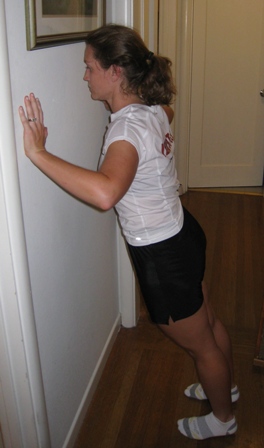
1. WALL PUSHUP

Wall Pushup-- Easiest since you aren't supporting your body weight

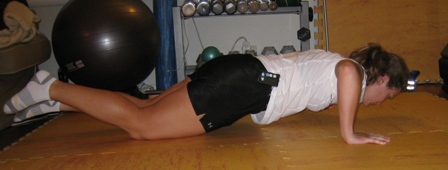
2. KNEE PUSHUP with your hips straight above your knees—your straight line here includes your hips, shoulders, and head

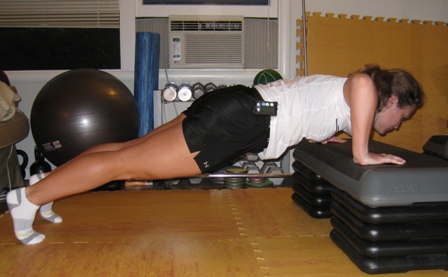
3.  ELEVATED KNEE PUSHUP keep a straight line with your knees, hips, shoulders, and head but with your hands on an elevated surface you won’t be pushing as much weight as you would if your hands were on the floor

4. KNEE PUSHUP with your hips past your knees – now your straight line includes your knees, hips, shoulders, and head

5. ELEVATED STRAIGHT LEG pushup- keep on your toes and your straight line includes your heels, knees, hips, shoulders, and head but again with your hands being on an elevated surface you won’t require as much strength to perform the move

6. STRAIGHT LEG PUSHUP—here’s the fun one to perform as your next party trick!  Keep that body ramrod straight and show off your hard work.

Then tell those snorters to snort off.

Summerteam Workouts!

July 2nd, 2010

Some of the best relaxing days I’ve spent have included a fair share of activity.  So I list some ideas to get you started being active outside the gym and in fun ways with others over the holiday weekend.  Some of these should work for you year-round, some might just be extra special holiday barbeque fun times.  Three-legged race, anyone? 

Go for a hike

Go for a swim

Go ride a bike

Go play catch

Play Frisbee

Take a walk

Take your dog for a walk

Take your friend’s dog for a walk

Take your friend for a walk

Climb over a picnic table without using your hands

Design and play a relay race with your friends

Design and play a relay race with your kids

Lie around in the sun (oh yes wearing sunscreen) and stand up without using your hands

Walk to the grocery store

Walk home from the grocery store (if it’s a big trip, have someone drive your load home while you meet them back at the house)

Play “horse” at the school playground basketball courts

Grab a tennis ball and throw it against your garage door for 10 minutes with your right hand and 10 minutes with your left hand (non-dominant hand should have you running all over the place!)

Don’t let anyone help you to your car with your groceries

Play tennis again, even if it’s just hitting serves across the net

Play tag

Have a water balloon fight

Play hide and seek after the sun has gone down and you’re waiting for fireworks to start

Make your own list!!  Take 10 minutes and write down as many ideas as you can.  Better yet, plan with your family by doing the same thing—10 minutes, everyone makes their own list.  Then choose some favorite ideas from each list and get moving!

Enjoy!!!

(If you were hoping for a more diabetes-related post today, watch this video and start noodling on it.  I’m curious what everyone has to say on this!!!  They are discussing type one, even though they only say “diabetic” so I was curious for the first few minutes. http://www.youtube.com/watch?v=BdxPfxIbKqo)

Happy July!

July 1st, 2010

Happy July!  Are you planning out your July 4 food already?  I’m on the fence between a hot dog and a burger.  It’s always a tough call for me!

July also brings with it some of the hottest days of the year for most of us.  As a runner, I need to pay particular attention to what the heat does to my body.  As a type one diabetic, I need to pay particular attention to what working out in the heat does to my blood glucose.

I have an air conditioner in the room where I work out, but what about summertime runs in the middle of the day or after work?  I need to be prepared for the heat and prepared for a drop in blood glucose when the temperature is not what I’m used do.  (This is why I was very concerned before my marathon this year that the Florida heat would be a shock to my system that was used to running the distances in my January cold environment—I can run through a lot, but I cannot run when I’m low, and my first few runs in the summer heat usually cause me to drop.  I was lucky that the freakish cold snap meant I froze but I could keep running!)

I went to a lecture last year by a running expert, Jason Karp Ph.D.  I like what he has to say and most of my experiences mirror his information amazingly well.  (I also get a kick out of his corny jokes.)  I’m summarizing his July newsletter here that discusses the main concerns for summertime workouts:

Running in the heat presents a number of thermal and cardiovascular challenges.  The two most important things you can do to prepare for your summer outdoor training sessions is hydrate and acclimatize.
HYDRATE

Beginning the workout fully hydrated or even ‘hyper-hydrating’ before a workout can delay dehydration during exercise, maintain exercise performance, and decrease the risk for heat-related illnesses.  Pre-exercise fluid intake enhances your ability to control body temperature and increases plasma volume to maintain cardiac output.  Drink before you run in the heat so you begin every workout fully hydrated, and continue to drink during workouts longer than one hour.  A good indicator of your hydration level is the color of your urine.  The lighter the color, the better.  The best hydrating drinks are those that contain sodium and glycerol (you can buy glycerol and mix it into your drink). 

ACCLIMATIZE
Chronically exposing yourself to a hot and humid environment simulates adaptations that lesson the stress.  Cardiovascular adaptations to exercising in the heat (e.g., decreased heart rate, increased plasma volume) are fully complete after 2 weeks, as the increased sweating response catches up to other adaptations.  You should take 2 weeks of slowly introducing yourself to the heat to be fully acclimatized and prepared for longer runs.  When preparing for high-intensity workouts such as interval training, however, you may not need as long to acclimatize.  Research has shown that just four 30- to 45-minute sessions of intermittent exercise in the heat is enough to cause acclimatization and results in an improvement in intermittent running workouts.  While exercising in the heat will always present a stress, acclimatization has a moderate prophylactic effect, minimizing the stress and reducing the risk of heat-related illnesses. 

I also point out for all of us living with diabetes that the first few workouts of the summer heat are NOT the workouts to push through feelings of exhaustion or low energy.  They are NOT the workouts to skip the basal rate reduction or to skip the snack before you start.  They are NOT the workouts to add on a couple miles when you don’t have glucose with you.  Save those workouts for a few weeks, when you’re used to the heat, you’re properly hydrated, and ready to rock it.