Archive for the ‘My Soapbox’ category

Sidetracked By An Op/Ed Column

July 27th, 2011

I sat down this afternoon at my computer with my highlighted article in my hand, ready to write about a concept new to me about evolution
and body weight and insulin resistance.

But then I opened Facebook, and the JDRF Bay Area had a link to an Op/Ed article written by a former JDRF advocate and published in the San Francisco Chronicle, and I got sidetracked.

It was the headline that hit me wrong.

“Lives Wasted as FDA Stalls on Artificial Pancreas Technology”

Let me say first off that I understand that this author is advocating for funding for research on type one diabetes.  I understand that advocacy before Congress requires highly charged vehement pleas, essentially, for money.  For that, people have to care about the goal
you have and have to want to help.

But here’s the thing that’s hitting me wrong about the entire article, and a lot of the pleas some of these research and other groups are required to adopt in order to wrestle sufficient funds out of others’ hands.  It’s not only the MESSAGE; it’s the tone.  They are discussing my disease, you know.

MY life isn’t being wasted.  MY diabetes isn’t the “constant, frightening, deceptive and malicious” one this author discusses her daughter lives with every day.

My friends with diabetes aren’t wasting their lives, either: they are nurses, teachers, mothers, scientists, engineers, dieticians, social workers, authors, attorneys, students, photographers, volunteers, artists, and more.  They are amazing and normal people who are busy improving their worlds as they live with their diabetes.

If I were waiting around on the latest “breathe into a tube instead of prick your finger” machine, or hoping for a pancreas transplant, or if I spent any time at all hoping for a cure; those things would make me feel like I were wasting my life.

Not one of us will get out of this alive, you knowWe don’t get guarantees.  We only get the here and the immediate right now today.
Sure, we need to plan and learn and dream and work and play and appreciate and share and do our very best as often as we can—but I for one think we have no time available for wasting.

(I also think that any death due to low blood glucose levels is horrible and think the only thing possibly more terrible is the thought that
someone might say that it was a “wasted” life.)

I’m clearly not the best Drama Queen when it comes to what it takes to live well with diabetes.  The author says “every hour of every day, individuals with type 1 diabetes have to balance insulin, food and activity to try to prevent low and high blood sugars, and the devastating and costly complications: seizures, comas, kidney failure, heart disease, blindness and amputations.”

Balance: yes.

Prevent: yes.

Devastating: really?!

Costly: alright; I’ll give her that.

Seizures: haven’t had one.

Comas: haven’t experienced one.

Kidney failure: haven’t had any.

Heart disease: not planning on it.

Blindness: none I can see in my future.

Amputations: ticklish as a schoolgirl.

So who is this lady talking about in her article?  What is she telling Congress?  Who do the SF Chronicle readers now think I, as a type one diabetic, am?  How many of them have I already met?

How many will I run past during Sunday’s marathon through San Francisco?

Will they see me as devastated, tragic, or doomed?

I can’t help but think of Bill Polonsky’s speech starter: Well-[managed] Diabetes is the Leading Cause of… Nothing!

If you’re waiting for the Big Bad Diabetes Wolf to come and get you, you may very well have a very long time to wait.  Don’t waste that time.

Go out and get living.

Am I Simply Jaded?

July 22nd, 2011

I think it’s probably way past time for me to admit that I’m jaded when it comes to “the latest and greatest thing” for checking blood glucose levels.

Maybe it’s the companies trying to rekindle an excitement in me that never existed.

Maybe it’s my frustration at how much money must be pumped into research and development that I would rather see invested in people and families or even in tools that don’t exist for issues that I think do exist.

This one, in the July issue of Diabetes Forecast, discusses essentially a breathalyzer blood glucose glucometer thingamajig.  (Wow; I guess I must have added “thingamajig” to my computer’s dictionary since it flagged “glucometer” but not “thingamajig.” Awesome.) 

Scientists are trying to “develop a portable, lightweight, and inexpensive breath-testing device that could replace traditional blood glucose meters—and finger sticks.” (Forecast credits the April 2011 edition of the American Journal of Physicology-Endocrinology and Metabolism but I can’t find it in the Table of Contents over there.)

Just like the gluco watch I’ve never seen.

Or the iphone app that reads something like fluorocarbons injected under the skin.  (Shiver.)

Of particular interest in this one, they only tested normal and high blood glucose levels.  If only we had to concern ourselves with those, right?

Seriously: is checking blood glucose with a meter that much work for us that we need to invest millions in finding other solutions to accomplish the same thing?  I’m not saying my CGM isn’t fantastic, and I’m not saying that my meter isn’t a huge step up from urine checking.

I’m saying that people are working so hard to eliminate something that isn’t that big of a deal when it comes to my life with diabetes.

Don’t get me wrong: I think there is work to be done.  I think we need more and better tools when it comes to insulin and insulin delivery and our bodies’ metabolism.  I love the work people are doing on making low blood glucose levels a thing of the past through the use of service dogs.

What I can’t understand is why those people working with service dogs are doing so in nonprofit organizations and these scientists are probably making far more than minimum wage.

It gets to me.

Anyway, I’m not trying to complain.  But I am, and for that I apologize.  I’d love to leave you with a better thing to think about over the weekend.

So here you go, inspired by a Geico commercial I heard on the radio this morning (that I can no longer remember it was so long ago):

When cheese gets its picture taken, what does it say?

What hair color do they put on the drivers licenses of bald men?

Why are a wise man and a wise guy opposites?

If you’ve got any answers, I’d love to hear them!!

Do You Experience Illness or Wellness?

July 19th, 2011

A therapist asked me a few years ago how it felt to me that I had been ill for the majority of my life.

Um.

Well.

I wasn’t sure how to answer her.

(You should know that I do a very bad job of hiding my emotions off of my face.  If I don’t understand something, I won’t fake it.  You’ll know just by looking at my face.  Same thing if I think something is great, or gross, or whatever.  It is not an aspect of myself I find very useful, despite the fact I’m sure it’s pretty entertaining for others sometimes.)

Anyway, I can’t tell you what my expression was, but I can tell you my eyes squinted and I got a crease in my forehead.

I couldn’t believe anyone would consider me “ill” because I have type one diabetes.  It isn’t a way I think of myself!

I’m more of a wellness and fitness kind of gal.

Which is why this article caught my attention in such a special way.  Of
course, I applied it immediately to my own life and saw how true the message
felt.

Illness versus Wellness.  I versus We.

When I tried to live with my diabetes all alone, I sucked at it.  I was in denial, I was terrified, I was simultaneously blatantly rebelling and hiding from my disease and my physical reality.  It was awful.  Truly awful.

When I got myself to a supportive environment at the Diabetic Youth Foundation, my diabetes immediately shrank.  I could be ME when I was singing goofy songs about having a blood glucose of 64 or when I was sitting quietly with a blood glucose of 378 and people knew how that felt.  I could be ME when I taught teens how to make figurines of clay and filled big vats of RIT dye for tie dying day with families.

I found myself in a group.  ALL of me, because my diabetes was what got
me into that group.

Insulin may be the key that unlocks the doors to our cells so that our bodies can use the glucose we eat, but my disease is what unlocked the door to a new world for me.

A world where I wasn’t alone.  I could be WELL and not ill.  Because that’s what I wanted, and what I think we all deserve.

A world where wellness can be my priority, and sharing that through Diabetes Outside is what I want to do all day, every day.

It is what I think it’s all about.  Life, Diabetes, and everything in
between.  Together.

Won’t you join me?

Monkey See, Monkey Do… Or Not (yes we’re the monkeys)

July 18th, 2011

I might have lost this bet.  I am rather surprised in some ways, but in other ways, it’s a no-brainer.

This study questioned general practitioners about their own activity levels and the activity levels they prescribe to their type 2 patients.

More confusingly, what they looked at was not the actual activity levels of the physicians, but rather the
physicians’ perceived barriers to physical activity.

I hope they didn’t word the questions in the same way. 

First off, they asked more than 600 physicians in France to complete the questionnaire; 574 declined to
participate.  Bummer for the researchers!  After all was said and done, 48 general physicians and 369 patients were included in the study.  So maybe this isn’t a great picture, but I think it does highlight on an important aspect of healthcare.  (This low return rate on the questionnaire is one of the things that surpised me.  It’s a shame because I’m pretty sure those physicians who do exercise returned their questionnaire.)

It matters to us patients how our healthcare professionals care for themselves.

The study found that the patients whose general physician didn’t think there were many hurdles with physical
activity in their own lives fared better when it came to the patient’s physical activity.

It makes sense: I think the average person would rather see a dentist who brushed their own teeth than one who didn’t.  We’d rather hire a plumber who had a toilet in their own house than one who used an outhouse.  (I could keep going but I won’t.  You’re welcome!)

So, it makes sense that if a general doctor tells a patient “exercise and be more active to help manage your diabetes” we at least on some levels will be more likely to follow that advice if the doctor exercises, too.

Maybe they can help their patients figure out how to beat some of the basic excuses when it comes to exercise
because they’ve had to figure out ways to make it work in their own lives.  Maybe it’s because a fit and active doctor
exudes good health
and we as patients want to learn from and copy that good example.

But I don’t think it’s unrelated.  I don’t think patients who see fit general doctors aren’t paying attention.  I don’t
think patients who do need to exercise look at their unfit doctor and don’t see it as a “get out of jail free” card.  (Which is a categorical shame.)

We are all looking for ways to make exercise work for us and our bodiesEspecially
those of us living with diabetes.

If your doctor, be they a general practitioner or an endocrinologist, isn’t speaking to you about exercise, NOW is the time to ask:

WHY NOT?

Is It All About Processing?

July 15th, 2011

Did you hear about the guy who lost 27 pounds in 8 weeks by eating the majority of his calories in the form of Ho Hos, Little Debbie cakes, and Twinkies?

Holy cow.

Somewhat reminiscent of the guy from SuperSize Me, this researcher wanted to prove that a calorie is a calorie, no matter what form it takes.

In fact he was correct: he lost the weight by cutting his normal 2,600 calories per day down to 1,800 calories per day.

It should seem like he lost some good health in there along the way!

Bless the researchers; someone else was trying to figure out what else mattered when it comes to processed food versus whole food.  THEY found some interesting things happening after each type of meal.

The study was conducted with the attention focused on the biological processes that occur in our bodies after we eat: the postprandial thermogenic response.  (My dad taught thermodynamics so I know that thermogenic has to do with the production of heat.  I tried Symlin for a few months so I know that postprandial means after eating.)

A calorie is in our world today a measurement we most commonly use to apply to food and exercise, but it comes from science and means, in thermodynamic terms, an amount of heat equal to 4.1840 joules.  (I have no recollection what that is or why it matters.  My last chemistry class was 18 years ago and I wasn’t very good at it at the time.)

ANYWAY, sorry for that tangent, but it matters for this study.  The researchers discovered that, 5-6 hours after the participants ate their cheese and bread sandwiches, the amount of heat/energy
produced was very different if the sandwiches were made of whole food or of processed food.

Fifty percent kind of different.

The average energy expenditure after the whole food meal was nearly 20% of the calories in the sandwich; the average for the processed food was 10.7%.

The wise researchers concluded that: “this reduction in daily energy expenditure has potential implications for diets comprised heavily of processed foods and their associations with obesity.”  I would say that potential implication is none other than that bugger Obesity.

It seems to me (an entirely unscientific person) that no matter what, food needs to be processed before our bodies can use it.  The potential outcome of that usage is calculated in terms of heat: the calorie.

I think we have outsourced those required processes to manufacturers instead of getting our food from farmers and processing it ourselves.

And look what has happened: rising obesity rates.

Think how fast that guy could have lost his 27 pounds if he had been
processing longer after he ate by eating whole food instead of processed snack cakes.

Yow.

Finding What You Enjoy

July 14th, 2011

I hear a lot of people tell me they hate to exercise, or they hate running, or they “can’t” run, or they used to exercise before their knees started to complain, or they aren’t coordinated enough to play sports, or any number of excuses.

It makes me sad, because I think exercise is fantastic and I think that all the excuses serve only to build a wall between “exercisers” and “non-exercisers” for no good reason.

When I meet someone and they learn I run marathons, some eventually come around to saying “I should run a marathon.”  My response to that never changes: “you have to WANT to do it; don’t even try if you don’t want it or you will be miserable every [literal and figurative] step of the way.”

And when someone says they don’t like to exercise, I think to myself that they just haven’t found an activity they enjoy.  Like the saying goes: “love your work and you’ll never work a day in your life;” so goes exercise.

Make it fun.

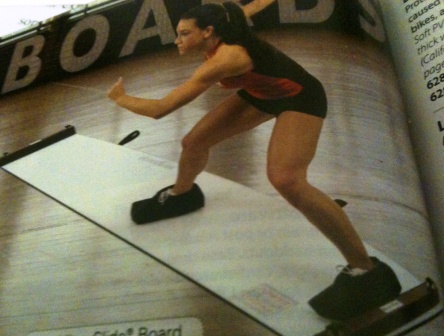
On the off chance that you might be inspired by some visuals, I took a gander through the Power Systems catalog that came in my mail today.  The catalog is designed for athletic trainers, gym owners, personal trainers and the home exerciser and they have more equipment and gadgets than you can even imagine.

Some look like a ton of fun.

Suction cup ski poles?! Love!!

Someday I'll get one of these slider things.

Some not so much.

I find yoga challenging enough without the weight balls, thank you.

Weighted Pants

Some look downright dangerous.

Be careful if you're prone to vertigo!

There isn't much to say here.

Some look like I should start saving up to purchase for bootcamp.

Power Jumper

I wonder if actors use these training for spy movies.

How FUN would this be?!

Each one shows someone exercising for a different purpose, and yet the goals are the same: improving their lives through exercise.

Which ones strike YOUR fancy?

Say it Loud

July 12th, 2011

I think some people are afraid of their blood glucose meters.  I think that fear needs to be eliminated because it makes diabetes too big and powerful—you have given it permission to dictate your emotions.

If you were trying to lose weight, you would emotionally not fare as well by stepping on the scale every day as you would by stepping on it only once a week.

Yet blood glucose readings need to be taken several times a day, without fail.

The more we can do to minimize emotions with the task, the better off we will be when it comes to the emotional side of life with diabetes.

So try this on for size.  You can do it with someone else in the room or not—you can say it under your breath.  But speak loud enough that YOU CAN HEAR YOURSELF say it.  Heck, you can be in a closet in the dark for all it matters—you just need to be able to read the screen.

Start the sentence when your meter has 2 seconds left.  That way you’ll have already started before any BG number appears on the screen and you’ll be more likely to finish the sentence.

It has two parts.  Each recognizes the PURPOSE behind checking blood glucose levels.  You need to (a) know the reading because it (b) helps you decide what to do next.

So, with 2 seconds left before the meter is finished, start saying MY METER SAYS MY BLOOD GLUCOSE LEVEL IS [fill in the reading].  THAT MEANS I NEED TO [complete the sentence].

For example, when I got back from my run yesterday I checked and said aloud: My meter says my blood glucose is 158.  That
means I need to enter the number into my pump and have the bolus wizard tell me if I need to bolus to bring down the number.

It’s kind of funky to hear it out loud.  But very good training for keeping things in perspective about why we do what we do when it comes to blood glucose management.

Rock on.

Hanz and Franz vs. Harriet and Francine

July 11th, 2011

Do you remember these two guys from SNL in the early 90s?  They were SO FUN.  I just had a fun moment with my husband when I went to him and said “what were their names?” as I hunched forward, said “PUMP [clap] YOU UP!”  He said “Hanz and Franz” right away.

I guess we’ve been together a long time.

Anyway, I thought of these two and their stuffed sweatshirts as I thought about what to write about today.  I also thought about the roughly seven thousand and three conversations I have each year with women who say their husbands can lose weight just by thinking about it for an afternoon.

It begs the question: are men and women different when it comes to muscle mass?

The first and most obvious answer to that question is to say “yes” that men and women differ.  The various reasons for that number in the thousands; the critical differences when it comes to exercise are body size and composition.

When scientists look closer at muscle tissue itself, though, the differences between men and women do not exist! 

While men in general have more muscle MASS, the makeup and strength in muscle tissues of men and of women are equal. (Women’s values in muscle strength, pulmonary ventilation, and cardiac output are generally 60-75% of those values recorded in men due to the variances in body size, body composition, and levels of testosterone.)

So are there exercises that men should do and women shouldn’t do?  NOPE.

Are there “female” exercises and “male” exercises?  NOPE.

Is there a biological reason for “boy pushups” and “girl pushups”?  NOT ON MY WATCH.  EVER. (This is one of the very few things I will actually yell at you for saying during a workout.)

Seriously; your body isn’t as different from your brother or sister’s body as you may want to believe.  You can both train the same and both perform the same exercises and achieve most of the same results.  Sure, the improvements by the numbers will never be identical due to the basic differences above in size, composition, and testosterone, but that doesn’t mean you shouldn’t go after what you want.

Male or female, muscle is muscle.  Use it or lose it.

I vote “USE IT!”

One of the Best Ways to Improve Your Life

July 8th, 2011

I really really don’t want this one to sound preachy.  So if it feels that way
to you, please accept my apologies.  I just really believe in this one.

I think one of the most important ways we can improve our lives with diabetes (type one or type two or one of the other four unnumbered types) is by taking charge of our medical care.

From the mental side of things to the physical side, there are about three kazillion things we think about all day and night every day when we live with diabetes.

So why do we allow things we CAN do something about to languish and fester and eat at us?  One thing I try and do all the time is to identify my biggest stressor and do what I can to get rid of it.

If that includes my medical care, you can bet I’m going to make some changes. It is so much easier to fix something like that than it is to work to lower my A1c it just makes sense to do the easy stuff first.


Deal With Your Doctor/CDE Situation

If you feel your doctor or CDE is judging you, there are hundreds of other doctors out there who might not.  Check with your insurance, Yelp the covered people, ask around.  Find someone you can be comfortable with most of the time. 

If you are incredibly anxious when you have an upcoming appointment, when you next see your doctor or CDE, tell them that.  Talk about how it feels for you to sit there for an hour and nitpick what you’ve done every day for the past few weeks.  Maybe they need a wakeup call, too, about what it’s like.

If you aren’t sure why your doctor is suggesting a treatment or drug or avoiding it with you, find out why they are making the choices they make for your body.

Heck, they ask us why we go high and low and what we eat and yaddah yah; it’s perfectly appropriate for YOU to ask THEM why they are doing something with your health.

It’s a responsibility you have when you inhabit your body: you need to know what’s going on when someone else is making changes (or not). 

The thing about living with diabetes: you are the expert on YOUR BODY and YOUR DISEASE.  Sure, they went to medical school and see a
lot of people with diabetes and they know a lot about the science involved… but the one thing they don’t know is one of the most crucial when it comes to life with diabetes: they don’t know YOUR body
like you do (from the inside!)
.

And that’s as it should be: if it were something simple enough like a broken bone, you’d see them, they’d fix it, and you’d go on your way.  But
with diabetes, there isn’t anything you can point to.  It involves a lot more communication and a lot more thought and a lot more trial and error.

So if your medical team isn’t up to snuff, take charge. 

You owe it to yourself.

Got a Spare $8,000?

July 7th, 2011

The George Washington University School of Public Health and Health Services’ Department of Health Policy released a study last year that reported the individual cost of obesity in the United States.

Not the cost in macroeconomic terms, the costs individuals pay for being obese.

Women pay an average of $4,879 and men pay $2,646 each year for obesity-related medical expenses and lost productivity.

Yikes.

Beyond that, the authors added in the value of each individual’s loss of life due to their obesity.  THAT took the toll up to $8,365 for women and $6,518 for men. Each year.

Yikes again.

We aren’t even counting what it costs to live with (presumably) type two diabetes.

Nor what the non-monetary costs are.

I suggest those non-monetary costs are much higher.

Do you travel less than you would if you weren’t concerned about fitting in a seat?  Do you attend fewer functions because you only have one or two “nice”outfits that fit?  Do you feel as though you can’t be yourself because you’re busy worrying about how big you are?

Do you think people aren’t your friend, don’t invite you to get-togethers, or talk behind your back about how much you weigh?  Do you take an awfully long time to climb a flight of stairs or walk to your destination?

If the answer is “yes” to any of these, I’m willing to bet you’d pay more than $8,000 to get it to stop.

_____

I’m not going to say that if I can do it, anyone can do it.  Anyone can do it regardless of my own success losing a lot of weight.

And it takes work, and not everyone is willing to work at it for as long as it takes.

But it IS possible, and you CAN do it.  But you absolutely must believe that you can; that’s I think where a lot of the trouble lies.  It isn’t about the monetary costs, and it isn’t about the non-monetary costs, and it isn’t about knowing or not knowing what to eat and not eat.  It isn’t about how long you’ll live or in what condition.

Most of it is about your belief in yourself. 

If you’ve got that, you can do anything.

So if you need to, take some time and have some honest conversations with yourself about what your body needs you to do.  Speak to your doctor, speak to me, speak with someone in your family, speak with a therapist.  Do what you need to do to get yourself to recognize your own needs and believe in yourself.

You (and your bank account) deserve it.