Archive for the ‘Living with Type 1 Diabetes’ category

Supporting One Another

March 2nd, 2011

In keeping with day two of the March Challenge (and trust me I can’t keep up this topic for very long, and by the way my bruise is still in my abdomen from my needles week) I decided to let the CDEs at Mayo Clinic have their say on the subject.

This one is I think directed at type 2s more than type 1s, but the basic points are just as good for anyone living with diabetes or living with someone living with diabetes.  I will point out, however, that not all of these suggestions will work for everyone—you need to be speaking to your friends and loved ones all the time—even AFTER you’ve figured out something that works—to ensure you are both comfortable with your jobs on this.

It’s worth it.  (If you need some help figuring out ways to make it work, I can help.)

Tips for diabetes caregivers

By Nancy Klobassa, R.N., and Peggy Moreland, R.N.

Friends or family members often ask us how they can help a loved one who has diabetes to make lifestyle changes. With a husband who has type 2 diabetes and two sons who have type 1 diabetes, I know that there’s a lot to learn about living well with diabetes on a personal level. Diabetes is a hard disease to handle alone.

Here are some ways that you can support your friend or loved one.

  • Voice your support. Let the person with diabetes know that you love them and are willing to help.
  • Learn about diabetes. Read books and reliable websites on diabetes. And go to doctor’s appointments and diabetes classes with your loved one.
  • Talk about your feelings. Let your loved one know that his or her diabetes affects you, too.
  • Let go. It’s not your responsibility to manage another person’s diabetes. Just because I’m a certified diabetes educator doesn’t give me nagging rights. My family members with diabetes feel more comfortable asking for help when I’m simply available to them.

I’ve also found that lifestyle changes that are good for a person who has diabetes are also beneficial to the rest of the family. For example:

  • Exercise together. Exercise for you and your loved one with diabetes. Invite your loved one to go to the gym or for a walk with you.
  • Choose healthy foods. Healthy meals benefit the whole family. If you have a relative with diabetes, you’re at risk. Making lifestyle changes now can postpone or prevent diabetes!
  • Encourage. Applaud your loved one’s efforts and successes and encourage him or her during struggles.
  • Be considerate. When having a party, offer healthy, tasty treats such as fresh fruit.
  • Seek outside help. If your loved one is sad or depressed, ask your health care provider about ways to get help. Ask about a diabetes support group in your area. You can also ask to meet with a certified diabetes educator.

Being the primary caregiver for a person who has diabetes can take an emotional toll. A diabetes caregiver may be the one taking ownership of his or her loved one’s diabetes if the person with diabetes doesn’t or can’t. If you find it’s too much for you, talk with your healthcare provider or diabetes educator. Together, you can determine at what point you may need outside assistance, such as from a nurse. -Peggy
March Challenge

March 1st, 2011

I think it’s time for a challenge for each and every one of us.  I’ve decided March is our Magical Month for this one.

Don’t worry: this is a good challenge.  There is one for people living with diabetes themselves and a special parent challenge too.

In fact, there are probably some of us who can meet the challenge in a couple of days!  But I still want you to work at it all month.

I’ve learned in the past few years that asking for help is not the sign of weakness I once believed it to be: instead, I’ve learned that asking for help is really a sign of strength.

Especially when it comes to living with diabetes.

So the challenge for your month (for those of you with diabetes) is to figure out ways someone else can help you with your diabetes, and ask for that help.

I have met countless diabetics who have done amazing things on their own.  (In fact, I admit I am probably one of them.)  They have managed this incredibly complex disease since childhood with a fair amount of grace and an impressive amount of perseverance AND accomplished great things in the rest of their lives to boot.

So this one may be hardest for those folks used to doing things on their own. 

I want everyone to take a few minutes this week and figure out one thing that you can ask someone else for that would alleviate one part of your diabetes for even a minute.

Then, once you’ve figured out what that is, ask for it.  Ask for it BEFORE you need it, and let the person know why you’re asking: because you TRUST them and because no matter how small it is, it will HELP YOU with your diabetes.

It may be as simple as “be quiet when I’m changing my site” or “walk through a glucagon drill so I can rest assured you know how to do it” or “bring me juice” or “know where I have low food in my desk drawer” or “drive me to my doctor’s appointment” or, if you are especially brave, “check my blood sugar for me”.  (For the record, I’m not that brave yet.)

The point is that these things are each examples of things that we know they don’t NEED to do.  In fact, we’ve gotten along just fine without them, thankyouverymuch.

But that isn’t what this challenge is about.  This challenge is about learning to let go a little of the burdens you carry.  It isn’t about the burden feeling heavy or large or really anything at all particular to the burden—this is about SHARING your diabetes in however small or large way as you choose. 

Now, PARENTS, you have a similar challenge.  This one is to think of one thing to GIVE your son or daughter to be in charge of.  If it is “restock the diabetes supply cabinet” or “make a list of the low food you can reach from your bed and from your desk at school” or “text me your number after school” or “count the carbs on your plate” or “change your site without me in the room” again, it doesn’t matter.  What matters for your son or daughter is that they learn in small and increasing ways how to live with their diabetes on their own, every day.  Because there will come a time they need to share their disease with a girlfriend or roommate or neighbor or coworker and they need to know how to be responsible for their own health, and how to ask for help and how to receive that help with grace and appreciation.

Dignity and respect are critical for each of these challenges, be it parental or individual.  No one is saying anyone is doing a poor job managing their diabetes!  No one is saying they should micromanage less.  No one is saying more needs to be done.

The challenge is simply to recognize and practice that people in our lives whom we love can also serve a FUNCTION for us with our diabetes.  It’s simply our job to know what to ask for, and to appreciate sharing the burden.

Good luck.

Out of Sight and Out of Reach (oh and Girl Scout cookies too)

February 28th, 2011

I love this book!  Mindless Eating: Why We Eat More Than We Think has been a subject of more than one blog over the past few months.  Some of the things I’ve read are not news, but the fact they have research to back them up somehow makes the information more fun.

First off, there is the see-food response you may be aware of.  It is very simple: you want to eat the food you see.  “Hunger” never enters the equation.

So, if you don’t want to eat (or overeat, really) then you need to make the food less visible to you.  They tested this one out by giving secretaries (the book says “secretaries” but I thought we had all shifted to “administrative assistants” years ago?) a candy dish on Secretary’s Day (sticking with the vocabulary in the book) filled with 30 Hershey’s Kisses.  Half the secretaries received a clear candy dish and half of them received a white dish. 

The secretaries with the clear dishes attacked the candy 71% more often than those with the white dishes.  This translated into them eating 77 more calories every day!  (Over a year this would have added more than five pounds of body weight!)  The scary thing is, they probably didn’t even realize what they were doing.

Doesn’t it make you want to cover all of your clear bowls and dishes?

And then there was the second part, that boils down to the fact we are all lazy people; we don’t want to have to work too hard for our food.  Using the same setup with candy dishes at the (different) office, this time the scientists used clear dishes with lids and varied where they placed the dish.  They placed the dishes one of three places:  on the desk, in the desk, and six feet away from the desk.

Those with the dish on their desk within eyesight had an average of nine kisses (225 calories).  If they had to look inside their desk and open a drawer, they only had an average of six kisses (150 calories).  If they had to walk six feet to reach a candy they only ate four (100 calories). 

They had to think about whether it was worth the effort and time to stand up and reach for a candy.  Those split seconds of thought were all it took for the secretaries to slow down their consumption.

So if you know in your heart that you don’t want to eat all of those Girl Scout Cookies you just bought (they are cute and it’s such a good program), for heaven’s sake put them out of reach.  I put mine in our freezer and we still have boxes left from last year!  Make consuming impulse foods like candy or cookies less impulsive… make yourself take a trip around your house to access them if you can’t get them out of your brain.

Those little tricks can make a BIG difference.

What Seems A Crazy Misconception

February 25th, 2011

I kind of structure my life so that I am an open book.  It just seems easier that way. 

When it comes to my diabetes, I am the same way.  Sure, that means I end up answering some of the same questions a lot, and it isn’t always the most convenient time for me to take a moment and explain something, but I would much rather be an open book than have others question my disease in silence.

I’m certainly not quiet about my diabetes at the law office.  I check all the time (I swear; all the time!) at work and eat often.  It’s a small and friendly office, so I’ve been discussing my diabetes there for years.

But yesterday I learned something new.

I learned that my friends perceive me and my diabetes a lot differently than I perceive myself and my disease.

We were discussing a friend of a friend who also has diabetes and had experienced two separate low blood sugars (can you believe after 23 years I still have to think about “is that hyp-O or hyp-ER”) and lost consciousness. 

While driving.  

Twice.

I tried to explain to my friends how a sudden low blood sugar can happen, how it is not at all the person’s “fault” and how, perhaps hypocritically, I think probably an insulin change may not be the only thing that this person needs in order to be re-awarded a driver’s license. 

And then one of my friends said to me that she was glad I never need to worry about that happening to me.

And I literally heard my brain process that comment.  Its response was: KA-THUD.

What?!” I replied.  “Sure I do!” 

It was interesting that she thought that because I check my blood sugar and wear a pump and CGM that I somehow am not at risk of a low that blindsides me to the point I need medical attention. 

I logically understand this is a great perception and one I want to encourage in others, that I don’t let having diabetes prevent me from taking charge in my life.  I think it just felt odd to me to see how truly my friend believes that to be true.

While I don’t let my diabetes prevent me from doing much of anything that I want to do, I do know that my disease is serious and has serious outcomes if I ignore what my body tries to tell me. (Or, for that matter, what my meter, pump, or CGM try to tell me.  Or my friend’s D4D!) 

I also know that there are times when I need help from others when it comes to a low or even a high blood sugar. 

I don’t consider any of this—any need for help I may have at any given moment—a drawback in my life.  I don’t consider needing help a weakness in the slightest.  In fact, I think it’s really great that I DO have people in my life who CAN and WILL help… even those people who I have never met. 

And I assure you, I know that I do need that help.  I need to know it’s there when I don’t physically need help, and I need to call on it when necessary.

And knowing that makes me feel luckier than nearly anything else.

To Sum Things Up… And An Announcement

February 18th, 2011

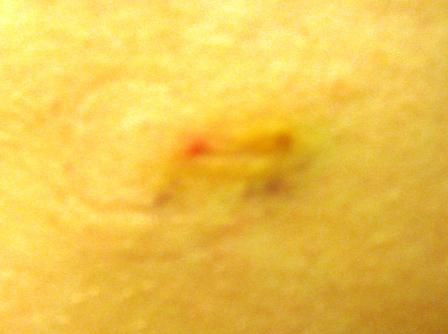
So I was all set to abandon my idea of blogging about needles for the week and not blog about needles today… and then I changed my site and saw the bruise that had formed under my site I’ve been wearing all week.  So maybe this would be why I thought about needles all week!  I knew it had issues when I put the catheter in and blood filled the catheter when I took out the introducer needle… but I went on anyway because other than that I thought it was a good site.  (It was!)

My Needle Bruise

Inspiration for My Blogs on Needles

THE ANNOUNCEMENT

I’m going to be making some changes to my website this weekend to better explain what I do and what you can expect from me.  Keep checking here (blog.diabetesoutside.com), Facebook (www.facebook.com/diabetesoutside), and Twitter (@diabetesoutside) for updates!!

Needles: What More Can I Say?

February 17th, 2011

I wanted to spend the week blogging about needles and diabetes.  Now that it’s Thursday I’m feeling like I’ve run out of things to say.  I mean really: as a type one diabetic I need to inject insulin to stay healthy (and alive) and sometimes I don’t like that.

Yup; that about sums it up.

So now what? 

Now, I start in on what other people do.  (whee!)

Many parents and I think not a few adults understand fear of needles when it comes to life with diabetes.  I am fortunate to have gotten over any fear I had right away… I don’t enjoy shots, but I can’t say they have ever made me quake in my boots.

But what about those who ARE terrified of needles?

Of course those are the ones who need to explore other options for themselves beyond the traditional needle.

Lucky for all of us, scientists and engineers have been working on alternate injection methods for decades.  I remember gazing at the ads for the injectors that didn’t have needles but somehow sprayed insulin through the skin.  (It wasn’t until I was a little older and a little more aware of the laws of physics that I realized that might not cut down on the pain…but I’ve never tried it so I don’t know.)

Although I should really have said on Monday: I’m really not a “jab and go” type one diabetic.  I take my time with each shot and go slowly I always have, and haven’t seen a need to go faster with my shots.  I’m amazed (AMAZED) by people who can go fast.  I always want to ask “what if you hit something?” but usually want to ask a millisecond before they inject and I am afraid of messing with their concentration at that point.  I worry.

Although the article discussing needle fear mentions people who are so afraid of needles that it can take them an hour to take a shot.  An hour?!  Yikes!!!  I can think of about 3,219 better ways to spend an hour.  No, more than 3,219 ways.  A lot more.

There is just so much there is to do in this world, and so much those of us living with diabetes specifically have to do every day I can’t imagine letting a fear of needles add any more time to my thoughts. 

I suggest that if you are struggling with needles and/or taking shots, make an appointment with your doctor to discuss other options for you.  This, I repeat, is YOUR LIFE and YOUR DISEASE so don’t let someone emotionally bully you into doing something you aren’t comfortable with.  If you need to speak with someone specifically about needle fear or anxiety, I’d say do it now rather than struggle longer than necessary. 

We know insulin is here to stay so let’s find ways to make it work FOR you instead of against you in your life or the life of your child.

Needles— Then, Now, and Forever

February 16th, 2011

I know we’ve all had moments we look at our syringe and think “do I really have to do this?!”  And shortly after asking the inevitable answer: yes: just do it.

We know that the shots don’t always hurt.  We know they don’t always bruise or bleed.  We know these things, but that doesn’t really change anything.  We know they won’t ever end, and that makes each one perhaps just a little bit gloomier. 

(To be fair, some days brushing my teeth feels just as gloomy.  I for some reason thought maintenance of my body was somehow going to happen without me working at it.)

Although I have been on a pump for sixteen years, I still need a needle to set up my catheter.  I still take shots when I’m high or when it is convenient to go without my pump for an hour or longer.  No matter how I slice it, insulin cannot be absorbed in my stomach so I need to get it subcutaneously.

I know that insulin injections have improved a thousand fold in the decades since they were first available as a treatment for type one diabetes.  I think of the reused needles and the boiled syringes and shudder at the thought of the laboratory at camp established to sterilize and sharpen the syringes in the 1930s through 1970s. 

I see the insulin pens and insulin ports and little teensy needles on syringes marked with half units and smaller dosages and know that I am very fortunate.  I marvel at what those who have gone before me and wonder what they would think of diabetes care now: I wonder if they would even recognize it!

I will say: I don’t appreciate hitting something when I stick the needle in.  I don’t appreciate the little divot that shows up in my thigh when I’m doing downward dog, made up of scar tissue caused by hundreds of shots in the same small area on my left thigh growing up.  I don’t appreciate the state of California making it illegal to throw away a syringe.  (Not that I have ever thrown a needle in a trash can; I use a clipper to cut off the needle or throw the entire syringe in a sharps.)  I really don’t appreciate hitting something and pulling out the syringe to a spurt of blood, although I do appreciate being able to show a very impressive dark bruise to my husband.

But, all in all, each of these complaints becomes so minor in the face of my other option. 

When I think of it that way, the needle gets a little shorter, a little sharper, and a little easier to manage.

My, What a Long Needle You Have…

February 15th, 2011

I read a blurb that sent me on a quick trip down memory lane the other day.  Sigh.

Back about 23 years to when I was first diagnosed, then to 1995 when I first went on the pump, and then my first years at camp (1998) and the first time I met a MiniMed rep my age.

I used to use very long needles.  Here I was, 10 years old and 58 pounds and I’m sticking a big ole needle in my leg.  I cringe now when I reflect on it—thankfully it didn’t seem that big!

I know when I had to get up the gumption to inject that first time I said to myself that someone in that hospital had survived a knife wound—so that little needle in my hand wasn’t nearly as frightening as that.  (I still use that trick, believe it or not!  It’s all relative.)

Then I went on a pump and used the same kind of what now seems really long needle.  It wasn’t until I went to work at Bearskin Meadow Camp that I even knew shorter needles existed! 

(Why didn’t my doctors tell me?!!?  Who else could I possibly rely on to advise me?!)

The same holds true for my infusion sets.

The blurb I saw said that short needles can be used by any adults regardless of weight or gender, meaning they aren’t just for kids or those with a low BMI.  Check it out!  You may be like me and have to request your doctor change your prescription, but it might just be worth it

So skin is the same thickness no matter your girth.

Good to know!

Hey– Look At That!

February 14th, 2011

I guess I should review the Diabetes Forecast magazine more closely—it sometimes has something kinda cool.

Reading the January 2011 Consumer Guide I saw this little gadget that is probably a great idea for some kids—it’s called the (cue sci-fi music) INSUFLON.  It’s like a little insulin port—you stick a catheter in every three days and deliver insulin through the port instead of giving injections.

Not as many shots/needles as syringes, not as accessible as a pump for little fingers.  It may just be a great fit for some kids.

(And, according to their website, a great option for some adults as well!)

Checking their web page, I of course saw something that raised a bit of a flag: they said that the INSUFLON was designed to help kids and their families come to terms with their diabetes.

I don’t know about you, but the injections were and are not what I need to come to terms with when it comes to living with type one!  Sure, it’s a critical and essential piece, but if that’s all you think you need to worry about, boy do you have a lot to learn.

(The I-Port injection port claims on its website it will mean better compliance with medications.  Um, I’m not so sure that the injections are the hard part of the diabetes equation here.  Am I the only one who thinks this?  They may be the plainest and simplest visible difficulty, but I assure you there is more going on than someone scared of needles.  Teensy kids excluded from this possibly unfair generalization.)

There are other “insulin ports” out there, but the INSUFLON goes in at a 20-45 degree angle, as opposed to the 90 degree angle required by the I-Port Injection Port.

Not to mention the INSUFLON has much better sound effects when you use its cool name. 

(I can’t even type it without hearing the cool sound effects!)

Are You A Good Advocate for Yourself?

February 11th, 2011

I know we see a lot of different medical professionals when we live with diabetes (and we aren’t alone with that!)… and I know sometimes we feel that “well, they went to medical school; they must know what they’re doing”…

… and while this may largely be true, you still need to be your own advocate when it comes to the care you receive.

If you don’t know precisely WHY your doctor changes something or tells you to start something new, don’t leave.  Interrupt her and make sure you clearly know why she is changing what she is changing.

If you don’t know precisely WHAT information your doctor considers important on that lab result, or what a certain procedure is, ask him.  He knows the answer and he should be able to explain it to you in a way you can understand.

It’s your body, you know.  No one else can possibly care about your body in the same way as you care.  (I believe this is also true with parents: a parent caring about a child is probably more intense than a child caring about her or himself, but I think there is a difference between the two.  Just a difference, is all.)

In my recent experience, I had to advocate for myself in a new way.  It did feel a bit odd, but I’m glad I handled it the way I did.

Once my doctor came into the room, I remembered that I’m now treating my doctors as though they are my professional consultants instead of grade school teachers.  I can’t get in trouble and they can’t make me stay after class.  I can, however, learn from them and their experiences to better my own life.

What a difference.

At my last visit, I asked my doctor to refer me to a dietician.  I haven’t seen one in a number of years and my nutritional needs have changed as I run farther distances more often.  Although I am a Lifestyle and Weight Management Coach, I still think it’s a good idea for me to meet with a professional and re-group.

I asked specifically for someone who knows type one diabetes inside and out and who knows marathon training very well.  Of course, that person had transferred into a different department and no longer sees patients, so I felt on my own.

Nevertheless, she sent me to the nutrition department.  They called to schedule an appointment for me, and I asked the scheduler the same questions: how many patients does the particular RD see with type one?  How many marathoners?

She had me speak with the dietician, and I was very straightforward with her.  I appreciated that she would take time to speak with me prior to an appointment, and told her that living with type one diabetes for over twenty years and being a personal trainer and lifestyle and weight management coach, I know nutrition.  However, just like a hairdresser probably doesn’t (and shouldn’t) cut her own hair, I want again a knowledgeable and experienced expert on my side.

That dietician went out and searched her dietician friends for someone who met my criteria.  Now, I haven’t met with anyone yet, but I know I’m going to reach someone who will be a benefit to me, my health, and my performance as an athlete.

When acting as my own advocate, I feel empowered to make healthy choices and healthy changes so that I can keep going as long as I want. 

So can you!