Archive for the ‘My Workouts’ category

Seeing a Mountain Ahead on My Path

April 10th, 2010

I have a 10k trail run scheduled next month, so I decided to run in a nearby park today so I could get some quality hill work in preparation for the 10k. 

I had a lot to think about during my run this morning.  I found out about a potential complication of type 1 diabetes yesterday.  (I feel for my friend and her husband; this diagnosis must have been stressful since it is so little-known and any cancer scare is, well, a cancer scare.)  Every time I hear about one of these little-known complications I kind of go through my entire emotional routine and feel like I face my disease more head-on than usual. 

As I’m running around this county park, I’m thinking these thoughts and my run is just generally difficult today; my eating yesterday was far from ideal and man the hills feel tough.  I am also thinking about my friends who live in the Midwest, and wondering if they have hills like these to run around in.  So, I’m thinking about how I would describe where I am to those who don’t live in the Bay Area.  Would I call them mountains?  Would I call them hills? 

I determined that my answer depends entirely on where I am when I describe them: am I at the bottom, or am I at the top?  If I’m at the bottom, they are mountains; when I get to the top, they are much more like hills.

The way I get from the bottom of the mountain to the top of the hill?  One little step at a time, one after the other, all the way.

This is precisely how I need to deal with my diabetes and face possible/ potential complications.  I know that I will face complications at some point.  I feel lucky that the complications I have already faced have been minor and manageable, and yet I am pretty sure any complication will become less minor and have a bigger impact on my life as I age. 

But I think, for me, I need to face that knowledge the same way I faced the hills on my run this morning.  Acknowledge what I’m looking up at, recognize it will be difficult, and also recognize that my perspective will change as I progress through and past any issue.  I need to just keep going, one little step after another.

I do what I can do every day with my disease; I require that of myself for my health now and for my health later.  But I also know that even if I were able to do everything there is to do every day, there are no guarantees; no one knows all there is to know about diabetes and its long term effects.  And that has to be enough for me.

I need to be proud of the steps I can and do take, and I need to keep taking them and keep going.  We all do. 

Here’s to us.
(Like you need more reasons to exercise:) WORKING OUT INCREASES YOUR CONFIDENCE

April 3rd, 2010

 I think we all spend a lot of time being down on ourselves.  Too much time, when we consider how short life really is—why would you want to waste any moment of your precious time telling yourself you aren’t good/smart/happy/rich/strong enough?? 

So let’s look for ways we can make POSITIVE changes and POSITIVE self talk a priority in our lives. 

Looking around at quick options to make these critical changes, gee, what could we do…? OH, LOOK! WE COULD EXERCISE!! 

Granted, I am biased on this subject.  However, my bias comes not only from my own experience seeing what happened to me when I changed my body by making food changes and exercising, but I see it every month at bootcamp. 

Every month a new bootcamp session starts and we get new people to the program.  The first week they don’t say anything.  The second week they smile more but are still quiet.  The third week, they smile and talk, and by the fourth week they act like they are part of the gang.

Exercise involves demands on your body.  These demands can be large or small, and every time you start an exercise program it is likely going to feel like a huge demand.  Your mental and physical responses to those demands are what counts. 

Mentally, you have to have some discipline to get yourself to do something another part of you doesn’t want to do.  It might just be “get out of bed a half hour earlier” or it might include “keep going” or even “speed up.” 

Physically, you also need to have discipline to reach or hold a position, or push a weight through your range of motion, and to endure the soreness of your muscles that reflect your body doing something to which it isn’t accustomed.

But what happens after you have made those demands on your body and know your mental and physical responses after a few weeks is one of the magical things about exercise: YOU KNOW YOU CAN DO IT.  That knowledge is worth a heck of a lot.  (I don’t need to tell you that—you’re the one who paid the price!)

The next time you come across a mental or physical demand, you realize that you have met such demands before and emerged victorious.  You have a quiet confidence that you can take with you wherever you want to go.  So turn down the volume on any negative self talk, and turn up the volume on your positive self talk.  You know you can do it; you already did.

Good for you.  Keep it up.

(Like you need more reasons to exercise:) WORKING OUT IS GOOD FOR YOUR MIND

April 1st, 2010

Exercise helps not only your physical body but your brain as well.  This means that not only can you look good strutting around the beach, you can sound smart too.  Beauty AND brains.  What a deal.

One main benefit of exercise (there truly are so many it’s hard to choose just one) is an increase in blood flow throughout your body.  When you’ve got more blood pumping around, some of it is bound to get all the way to your brain.  With an increase in blood flow through your brain, you will feel and be more alert and focused.  (Remember all those studies about kids being better students when they have recess?  Same thing.)

With increased blood flow to your brain, you are better able to preserve your brain tissue that starts to decline with age.  The use it or lose it mantra applies to your brain just like it applies to your body.  Similar to how a physical therapist moves paralyzed limbs to keep blood flowing through the limbs and preserve tissue, you need to use your brain and keep nutrient rich blood feeding your brain tissue in order to preserve that tissue.  Start it now, at any age, and keep it up for the sake of your mind!

You should want to treat your body better than you treat your car.  You can always buy a new car.  But a body?  A brain?  You only have one.  ONE.  For your ENTIRE LIFE. 

Living with diabetes, you know what happens when something in your body stops functioning the way it should.  Why risk the same thing with other organs like your brain and muscular and skeletal systems?  Please treat your body better than you treat your car.  Exercise can be so fun, and takes so little compared with its huge rewards.

(Like you need more reasons to exercise:) WORKING OUT IS GOOD FOR YOUR BONES

March 31st, 2010

Take a calcium supplement?  Worried about osteoporosis?  Want to improve the strength of your bones?  EXERCISE.

See this article: Exercise and Bone Strength by Mariana Shedden, M.S and Len Kravitz, Ph.D.

Your bones grow and strengthen in response to stress.  In order to impose stress on a bone and encourage increased bone mass and bone density, you need to intentionally overload your skeleton with specific exercises to impose a controlled stress on your bones so that your bones will grow stronger and denser in response to that stress.   You need to do weight-bearing activity.

Weight bearing activity is easy to accomplish in two main ways: through impact and through weight training. 

(Whenever you are aiming for overload it is critical you pay attention to your body.  Make sure you know proper form for weight training activities to prevent injury; please be smart about how you start your exercise program.  We all want you out there enjoying life for a long time.)

Assuming your joints are healthy, you need to add a little impact to your exercise routine in order to boost bone strength.  Swimming, bike riding, and low impact aerobics aren’t going to strengthen your bones.  Add impact in a smart way: start slow, learn about and listen to your body’s signals, back off when you need to, wear great shoes, find the right surface on which to pound.   Running, jumping, even brisk walking (and I mean out-of-breath and sweaty!) will help you overload your bones to encourage strength.

Another great way to impose controlled stress on your bones is weight training.  Best done when you aren’t sitting down (what bones does that strengthen), add enough weight to your skeleton that you have to exert effort to move—you are shooting for OVERLOAD in order to see marked improvement in bone strength.  If you know your grocery bags when loaded each weigh five pounds, be sure and do some squats with at least double that amount of weight.  Your body has big muscles (legs, back, butt, chest) and smaller muscles (triceps, shoulders, biceps) so make sure you load appropriately—bigger muscle groups can handle heavier weights.

When you are able to truly challenge your body you will be amazed at what it will do for you.

My Six-Step List of How to Start Exercising

March 29th, 2010

Today started the annual “Spring Into Fitness Week” at bootcamp. It’s a free week designed to get more people involved in the program. Fun stuff.

As I watched a new mother/daughter team working out together, I asked whose idea it was to attend—the mother’s or the daughter’s. The daughter grinned sheepishly and said her mom turned 60 in December and the daughter thought it would be a good idea for them both to get involved in regular physical activity. I couldn’t agree more.
That is one of the greatest things about striving for fitness: you can start anytime. You can always do more, or do it differently, and reap results. Yes, your body will respond the best and your rate of metabolism will increase with regular, intense, and varied exercise. But even if you can’t commit to six days a week of exercise, you can still make small changes and see improvements in such a short time, it’s always worth an effort to get out and move.

So, here it is: my Six-Step List of How to Start Exercising. (I made it six steps just to use two hands when I say it aloud, but you can probably shorten it for yourself if you need to. It’s not complicated.)
1. Start.
2. Move.
3. Relax.
4. Keep Moving.
5. Have Fun.
6. Rest.

Don’t worry about how old you are, or what you did in high school, or what your neighbor does, or what your spouse thinks. If you live with diabetes, know what your blood glucose is before you start exercising, feel free to stop and check in the middle of your exercising, and check again at the end. Have glucose with you. Experiment with your activities and find out what works for you.

Again, your new plan for starting to exercise at whatever age or life situation you are in depends on a very, very few things: Start. Move. Relax. Keep Moving. Have Fun. Rest.
Get out there, and do it!  You will feel so proud of yourself and so happy that you started exercising, you’ll wonder why you didn’t start before.

Springtime Sunday Hike

March 28th, 2010

11am Sunday

Going on a hike today with my husband!  I’m excited.  I’m counting it as a workout because I’ve been working my legs fairly hard the past couple of days so this will both work me and not feel like I’m working… what a combo!!

I know I always go low when I hike.  It’s weird.  No matter how often I hike, no matter how fast I hike or how steep the hills, I go low.  Totally wacky, since nearly everything else eventually has less and less of an effect on my blood glucose the more I do the activity. 

It doesn’t help that I still have some breakfast bolus on board.  I’ve cut my basal way down to 10% and I’m bringing extra food; beyond that I’ll just plan to check like always and pay attention.  I’m starting at 210 and expect with my basal cut way down, I’ll head up as my hike starts and I head down.  We’ll see!

 You can check out what the hike looked like on my Garmin: Garmin Connect – Activity Details for Untitled.

1pm

Fun 5 mile hike!  Not too strenuous, which was nice.  Gorgeous spring day.  Love those!!  My blood glucose was 130 at mile 4 and 110 after the fifth mile.  I felt a little guilty that I wasn’t one of the runners I passed, but I can handle that kind of guilt.  Now on for my post-hike sandwich!!!  Yum!!!

Bring it on, Mickey!!

March 20th, 2010

I signed up to run the Disneyland Half Marathon over Labor Day weekend today.  I can’t wait!  I also signed up for the Family 5k the day before because –get this—my parents and my husband are coming with me and we’re all going to do the 5k! 

My husband isn’t a runner.  He told me once “I ran when I was a kid.  I don’t need to run anymore.”  My dad can run, but doesn’t do it often—he’s busy at bootcamp and busy golfing his way through retirement.  My mom enjoys sprinting at bootcamp but doesn’t consider herself a distance runner—once around the track is generally enough for her.  So we’ll all work together to get through the five kilometers (about 3.2 miles) in September.  (It can be a bit dicey for me and for my family members if I tell those who don’t run what I think they should do to prepare themselves!  I will wait until they ask.)

But.  Really.  WE WILL BE RUNNING THROUGH DISNEYLAND.  How can one possibly pass up such a great opportunity?!  They even give you a medal when you’re done.

Who doesn’t want a medal?!  FROM DISNEYLAND. 

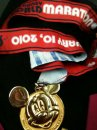
 (this one is my marathon medal from Disney World)

Because I ran the Walt Disney World marathon in January, when I complete the Disneyland half marathon in September I will have earned the coveted “Coast to Coast” medal, too. 

So, lest you think I run because I always enjoy running, let me again point out key points from above:  A family weekend.  In Disneyland.  A shirt for a half hour’s work.  And a medal.  Seeing my husband, my dad, and my mom each cross the finish line.  And then another shirt, the next day, for two hours’ work.  And two more medals.

Bring it on!

Today’s Attempt to Combat My Dawn Phenomenon with Exercise

March 17th, 2010

I have a wacky schedule; most mornings I eat a snack before leading bootcamp and have breakfast after that. Then about 2 hours after breakfast, my blood glucose rises steadily through lunch. Frustrating. I have tried a bunch of different insulin options and food options, but none work 100%.

Today’s attempt is not one that I can repeat often, but I figured I’ll give it a shot anyway. I had breakfast an hour ago, my CGM says I’m 130 and on the way up. I haven’t changed any basals and was conservative with my breakfast bolus. My plan is to do an hour of full body weights (Tracey Staehle’s The Parts Series, Bootcamp Premix) and see if that helps keep me within range. The weight workout I have planned is not cardio intensive but is still sure to get my heart rate up, especially since I will be alternating between upper and lower body moves.
___

Okay; change of plans. I just checked; I’m 96. I have 2.8 units still active for my breakfast, so I am going to do a temporary basal. I’ll just do 30 minutes with that, taking 67% of my typical rate. I’m off!
___

Good work. I just checked; I’m 94 after my workout. My CGM said I was 129-130 the entire time, so at least my blood glucose levels weren’t swinging. I did eat about 8 jelly beans (maybe 12-15g CHO) about 10 minutes into the workout because I felt my heart rate rise and got nervous about going low.

So, it all seemed to work today. Put a check in the “win” column for today: not only did I get in a fairly good workout, I may have prevented a 250+ later. All good.

What works for you and your dawn phenomenon?

Making An End Run Around Type One Diabetes Complications

March 15th, 2010

Living with a malfunctioning organ (insulin dependent diabetes means my pancreas cannot produce insulin and cannot help to regulate the amount of glucose in my bloodstream) means I will someday encounter any number of physical complications. We all know it and we all know we’re supposed to keep our blood glucose levels “in a healthy range.”

Did you just shift in your chair? Roll your eyes? Take a deep breath?

I do, every time someone who doesn’t live with Type 1 says it. Because it’s HARD. The human body is an amazing complicated and finely tuned machine. With one piece broken—one piece of hundreds—I need to use a lot of brain power, three machines, and count everything I eat and more days than not I still don’t get it “right”.

So, in my attempt to bring my Type-A self to a place I can be okay with that, I looked at what complications I’m likely to meet: heart disease topped the list. http://www.diabetes.org/living-with-diabetes/complications/women/coronary-heart-disease.html

Alright! I can do something with that!

I take care of my heart through cardiovascular exercise. I treat it as best as I can without being fanatical. My eating isn’t great. My stress levels are high. My speed isn’t impressive.

But my endurance can outlast most.

I am very lucky that I enjoy physical activity; I love how it makes me feel and I really love having the confidence to know I can climb over a fence or get out of a window without too much trouble. (I will save a discussion of why I think about these things for another post.) I love going to the grocery store and assuring the checker I need no help out to my car. I love not having to buy Queen-sized underwear.

Most days, it’s the small things in life that make it fun. It’s the big things that make it all worth it. And it’s the strategy to keep going as best as I can that makes it all possible.