Archive for the ‘My Soapbox’ category

Ever Thought Having Type 1 Meant You Were Limited?

December 17th, 2010

Some of these studies lead me to so many more questions than there are answers.

For example: who thought of the initial study in the first place?  What made the originator wonder about it?  Do they have diabetes themselves?  Who do they know, and what is that person doing, that made the question come to mind at all?

Alas, these questions remain unanswered for me on today’s study.

The title of this one is Aerobic Exercise Capacity and Pulmonary Function in Athletes With and Without Type 1 Diabetes so you can see why it caught my eye.

Of course, if I wanted to read more than the abstract I’d have to pay for it and I’m not one to do that… although maybe I’ll head to the health library and check it out someday because I’m curious.

The abstract describes the research design and methods and I’m already offended: they differentiate between those with type 1 diabetes and those without by describing them as “individuals with type one” and “healthy.” 

Ahem.   (Although maybe I should perhaps blame a translator for that one, though, because the study comes from Brazil so maybe they originally phrased it in a more palatable way.)

The researchers also broke the groups into athletes and non athletes; as expected, the athletes had a higher maximum volume of oxygen (V02 max) than the non athletes.  (An increased V02 max is one of many results of consistent aerobic training.)

The only real difference it seems they found between those with type one diabetes and those without was that the type one participants had a lower anaerobic threshold.  This anaerobic threshold is the point at which the body uses a different energy source (lactic acid rather than oxygen) to fuel muscles and interval training is the way to raise this thresholdOne of several reasons I am always in support of interval training! 

In all, the conclusion is what I consider a happy one: aerobic capacity in subjects with type 1 diabetes with programmed exercise is similar to the capacity of normal athletes despite lower anaerobic threshold.

Yet more proof that type one diabetes has no business getting in the way of your being a fit and healthy exerciser.

So what are you waiting for?
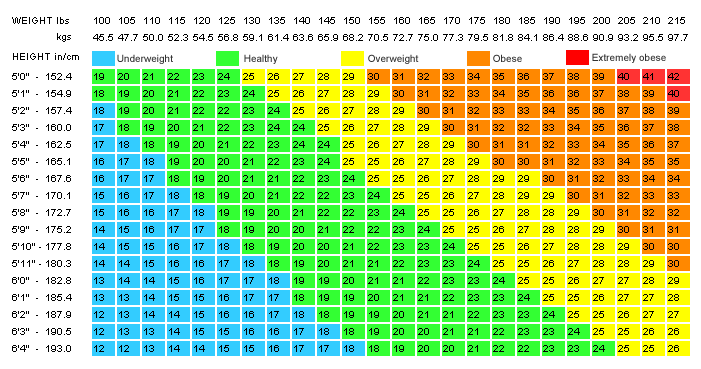
What is BMI, anyway?

December 7th, 2010

Very simply, your BMI is your Body Mass Index and is an easy way to measure if you are overweight, underweight, or in a normal range.  It’s one of the numbers you should pay attention to over the long haul, as seeing the numbers can help you keep your weight in check.  Ideally, once you have reached a normal weight your BMI shouldn’t change over time.  If it does, either your height is changing or your weight is changing.  (Either change is good to note to stay healthy!)

Did you know the BMI measurement was “invented” in the mid 1800s?  A Belgian statistician and social scientist named Quetelet (currently topping my list of favorite names) came up with the formula: an individual’s body weight divided by the square of his or her height.  Although it doesn’t measure body composition (percentage body fat), it can still be useful.

Looking at what I used to weigh, I had a BMI of 32.  I was obese.  It is funny to think about it now, but also pretty frightening.  I am now at roughly 23-24.  Not bad.

In a recent study, researchers compiled data from more than 1.4 million people and came up with some interesting results for the best Body Mass Index in otherwise healthy adults.

Get this: the subjects (healthy adults) with the best survival rate after ten years were the nonsmokers with a BMI of 20-24.9.

At the same time, obese nonsmoking women with a BMI of 30-34.9 were 44% more likely to die than the 20-24.9 group.  Forty-four percent higher risk of dying within ten years. 

Yikes.  The difference between a BMI of 24.9 and a BMI of 30.0 is about 30 pounds.  Thirty.  If you have more than 30 pounds to lose, start working on losing it now to treat yourself and your body appropriately—the longer you wait the less time you have to do it.

Faring even worse was the group of extremely obese nonsmoking women with a BMI of 35-39.9: they were 88% more likely to die within 10 years than the 20-24.9 group.   The study also found a correlated increased risk if the subjects reached a BMI greater than 25 by the time they reached 50 years of age.

And these are all non-smokers! 

I blog about this subject today because knowledge is power and I am always aiming to empower you.  It’s exciting to see a changing BMI because it only enforces the fact you can absolutely change your body.  YOU HAVE THAT POWER.

Awesome, isn’t it? 

If you need some help please don’t hesitate to contact me; we’ll talk about a strategy and keep you on a path to success!

Forecasting The Future?

December 6th, 2010

I remember receiving Diabetes Forecast in 1988 for maybe a few years.  And then I stopped for a long time and only started receiving the magazine again when I started blogging.  (Always looking for new ideas and topics!)

And you know what?  I just don’t like reading it.  I never have.

I do my best.  I really do try to read the whole thing through without getting upset.  But it just doesn’t make me feel good to read it.  Ever.

I’m not sure how much has to do with the fact I feel that a large part of the magazine directed to type 2 diabetes doesn’t apply to me or my disease, but I don’t really think that is the true issue that might explain my discomfort with reading the magazine.

I just don’t like looking at all the Don’ts and the Eventuallys and the Watch Outs.

I don’t like being told I’m a potential victim.  In fact, I hate it.  I hate it so much I’ve pretty much designed much of my life to combat the thought in advance.

I don’t like reading about how to eat fewer carbohydrates.  I don’t like reading that eggs might be bad for people with diabetes.  I don’t like seeing ads for socks and comfortable shoes.

I simply don’t like it.

Maybe I’m denying this truth of diabetes.  It feels more like I’m questioning how true these complications really are.  For ME.

Paging through the December 2010 issue I see:

–       Know when to ask for help before things get out of control.  Talk to your doctor or diabetes educator or to a trusted friend or family member.

–       In 2008, 1 in 5 U.S. hospitalizations involved patients with diabetes.

–       More than 60% of lower-limb amputations that aren’t caused by injury occur in people with diabetes.

–       The story of metformin’s past, present, and possible future

–       Help me fight a silent killer

See, living with diabetes isn’t just about doing my best to keep my blood sugars in check and eating well and exercising to keep my body working as well as possible all the time every day no matter what else is going on in the world or my personal life or career.

It’s also about seeing articles about heart attacks and morbid obesity and losing feet or toes and answering questions and explaining and hearing and seeing advertisements for blood sugar meters that seniors can’t understand and are complaining about the pain of checking their blood sugars twice a week.

I don’t need the fear motivation.  I don’t need to discuss the pain of finger pricks.  I have lived with my disease for nearly 23 years.  Each and every day.  I’m not one who needs convincing to take care of myself. 

I could use some humor; I could use some motivation and encouragement.  I think we all could.

How about it, Diabetes Forecast? 

I’ll look for some of that in the next issues but I’m sad to say, I won’t hold my breath.

Thank you, International Journal of Pediatrics…

December 2nd, 2010

There was a “first-ever” field study performed on the performance of young athletes with type one diabetes.  The study tried to establish whether sports performance was affected by a low blood glucose or by a high blood glucose.  They monitored the lows the day before a game, hours before it, and during.  The study found no evidence that a prior bout of nocturnal hypoglycemia influences sport skill performance the following day, but they did reach a conclusion about hypoglycemia during an event.

Guess what they found.

Yes indeed they did find that hypoglycemia during a game significantly decreased participants’ sports performance and cognitive abilities.

Not to diminish the work of any of these researchers, but my response to this study and conclusion is (yet again on a type one study of athletic performance): NO DUH. 

I really wonder: do these researchers even know anyone who has lived with type one?  (Not to toot my own horn too loudly, but I could tell them some of this stuff without the need for them to go through a whole study.  Really.  I could even give them data from my meter and my running performance logs.)

It doesn’t surprise me to see that the sports skills they tested were best performed when the athletes were in an acceptable blood glucose range.  The skills did not markedly diminish when the athletes were high, but they tanked when blood glucose was low.

If you’ve ever been high or low or anyplace in between, this should make sense to you, too, no matter what activity is at issue.  Even sitting and working at my desk I can tell you that (most of the time) I work best when my blood glucose is in range, I’m less comfortable when high, and I can’t do a productive thing when I’m low. 

Some of the evidence I’d give the researchers is that of one of my best half marathon finishing times and I know for at least seven of those miles I was pushing 300.  Yet the other day I knew I was low because my mile time was slower than the previous mile’s time. 

I don’t know why they are doing these studies.  I don’t know why they don’t just ASK.  It makes me feel almost like a lab rat or “subject” instead of a regular person.

I mean, I know my diabetes makes me different than the average athlete.  I get that, and I’m in no way wishing to minimize the work involved in exercising with any type of diabetes.  I just wonder why the researchers felt it was important to perform a study when they could have simply asked a type one diabetic.

Nevertheless, their conclusions here are sound:

In summary, we found that hypoglycemia, but not hyperglycemia, impairs sports skill performance and cognitive function in youth with type 1 diabetes. In contrast, prior exposure to hypoglycemia the night before competition does not appear to influence performance the following day. As such, vigilance in glucose control that limits hypoglycemia during sport should maximize competitive capacity in adolescents with type 1 diabetes. In addition, any obvious decrement in sport performance, such as poor passing, failed free throws, serves, and so forth; should be a warning sign to young athletes with diabetes to check for hypoglycemia by monitoring their blood glucose levels and treat hypoglycemia with additional carbohydrate intake.

(And, since I’m railing against the study already, why did they limit this study to “youth” with type one?  Hopefully they limited it so they could publish it in the Journal of Pediatrics and weren’t trying to make any other kind of statement.  Or is there some kind of assumption that us type ones stop being athletes once we turn 18?)

Maybe I should come up with a new slogan: Live. Check. Move.

Happy (Hectic) December!

December 1st, 2010

December is a crazy month.  So how do you work in a workout when you’re slammed for time??

1.     Make time. 

You need to prioritize your fitness if you are ever going to keep it up through the zany holiday season.  Schedule your workout time.  Then do it.

If you have a family calendar, write in the time you need on the days you select to work out.  Then do it.  Don’t let the “oh, I need to do x, y, or z” come before your workouts.  There will always be a reason to procrastinate.  Don’t let yourself get away with it: stay organized, stay focused, and keep yourself in the fitness game.

2.     Find time. 

There are so many ways to eek out a little more time in the day.  It’s crazy, yes, but it’s good to know that if you determine you don’t have time to get fit, you are likely truly saying you haven’t made fitness a priority. 

You can get up earlier.  You can walk instead of drive.  You can exercise instead of sit on the couch.  You can do some strengthening or stretching exercises while you zone out at the end of your day.  There is always time!

For me, this has meant I have set my alarm for 3:30 to work out before leading bootcamp at 6 in the morning.  It has meant I ate dinner late at night after I worked out.  It has meant changing clothes at the office and going for a jog before heading home.  It has meant that I know when I say “I don’t have time” I really mean “I don’t want to make the time today.”  Big difference, isn’t there?

3.     Squeeze the workout in. 

Maybe December isn’t the month for 90 minute workouts.  Maybe December isn’t the month for two hour trips to the gym.  Maybe finding the amount of time you’re used to spending working out isn’t working… so you need other ways to squeeze quality workouts into limited time.

So, instead of spending 60 minutes at an easy cardio pace, spend 30 or 40 minutes at a more intense pace.  Add intervals or hills into your regular routine and shorten the length of the workout.

Instead of lifting a medium weight for 15 reps, lift a heavier weight for 10 reps.  Instead of doing a full body weight workout and 30 minutes on the treadmill, do 10 minutes at a quick pace, an upper body workout for 15 or 20 minutes and finish with 10 minutes on the treadmill at that same or even quicker pace.

There are all kinds of ways to mix it up and fit in a workout no matter how limited your time is.  You just have to want it, plan and be creative.

It is going to be SO FUN

November 30th, 2010

I really do try and not preach at you in my blog.  It’s one of my rules: I don’t want to be someone I wouldn’t want to hang out with… and I don’t ever feel like being preached at so I try to avoid preaching… I really do.

But.

Maybe today will sound like I’m preaching.  I just really like this idea, and have had nothing but positive responses to the idea in practice.  I think it would be a great thing for you to try, too.

It’s a holiday lights walk.  (Or a holiday lights run, whichever floats your boat.)

I set an arbitrary day (December 15) and an arbitrary time (5:30pm…it’s dark out but it is early enough to get home in time for dinner but not so late as to interfere with dinner by too much) and an arbitrary place to meet (for me, at a neighborhood park).  I am inviting everyone I know and everyone I meet.

I asked them to show up at the park wearing light and reflective clothing, a Santa hat if they want, and bring a flashlight.  I’m going to hand out jingle bells on safety pins so they can attach the bells to their shoelaces.

IT IS GOING TO BE SO FUN.  I am so looking forward to it!!  ITISGOINGTOBESOFUNSOFUNSOFUN.

I know some streets that have awesome light displays and I mapped out a route using gmaps pedometer that would take us through some of the best streets.  For the walk, I mapped out a little less than 3 miles.  For the run, I mapped out a little less than 6 miles.  Most groups can do this mileage in an hour.

Last night, I pre-ran the route to double check that it was as safe as a nighttime run can be: I looked at the condition of the sidewalk, the traffic, where the stop signs are, all that jazz.  I was really surprised at how fun the route felt, even by myself.  I don’t know how it happened, but it felt like the entire way was a little bit downhill.  (And there are two hills I know I travelled, so I’m even more confused!)

I’ve been safety pinning the jingle bells while I watch TV. 

Did I mention I’m excited about this?

Here is where I may start to preach: this was really REALLY easy to plan.  You can absolutely plan the same exact thing in your neighborhood, and I think you should. 

I know a lot of people won’t be able to make it.  I figure even if one other person can come, we’ll have fun.  So grab your friend.  Grab your coworkers.  Grab people you know from church or book club.  Set the time, be clear about where to meet and what to wear and bring, and then get out there and enjoy the holiday sights!

And if you’re in my neck of the woods, come join us!!

Sharing Wisdom

November 29th, 2010

Can’t believe it has been four whole days without a blog from me, can you. 

I have an online diary/ tracker that tells me what I’ve done each day for exercise.  I think I started it in late 2008 or maybe it was late 2007.  Anyway, it tells me what is going on.  I like it.

Looking at my tracker helps me know what I’m missing, and keeps me on track to keep me fit and healthy, and if I’m lucky it helps me stay injury free.  (Injuries suck and I want to avoid them.)

Since I try here to share wisdom I’ve either gathered for myself or I’ve tried to learn from others, I’m happy to have seen a Runner’s World article from March (yes I know that was 8 months ago; I save all of my RWs!) 2010 about how to stay active and healthy.  Many of the items are running-specific, but some of them apply to any and all activities.  I’ve edited the list and added my own take:

  1. Know your limits.

I can’t work out every day at the same intensity.  No one can.

  1. Listen to your body.

Your body, as you know, has something to say 100% of the time.  Sometimes it’s just a steady hum, sometimes it’s a gentle prod, sometimes it is an ice pick in the shin with each step.  Whatever your body is telling you, you need to listen.

  1. Nix negative thoughts.

If you can figure out how to stop the “can’t” and the “wah” and the “won’t” and the “bad” and the “gross” or the “weak” or whatever it is and substitute in a “now” and a “try” and a “go” and a “work” and a “yay” and a “phew” and a “yes” and a “push” and a “good” you will be so much better off in every area of your life.  Try it.  Please.

  1. Find an outlet. 

Seek out what boosts your spirits and perform those activities rather than something that drags you down.  Nobody who knows anything wants you to do something that drains you emotionally without finding something that will regenerate your emotional wellbeing.  (Ha!  Not that we know what “well-being” means…) Exercise spurs endorphins for you… if you find the right thing for YOU.  It’s worth finding what that is.

  1. Seek out support.

Find friends who exercise and use them.  Use them for cheers and for venting.  If you want support, you need to seek some out.  Have you ever tried complaining to a non-exerciser about not being able to make it to the gym yesterday?  That blank look is just as bad as the “you’re crazy” response.  Find others who can relate to your goals and support you reaching them.  You are worth it.

Reviewing the list, I think it could apply to nearly every area of our lives and not just exercise.  Cool.

More About Food (isn’t it always about food)

November 23rd, 2010

I am not a medical professional.  I cannot give nutritional advice or guidance.  I am able only to share basic information: if you have more specific questions I advise you to seek a professional trained to give nutritional and dietetic advice.

But.

Food labels.

More specifically, CLAIMS on food labels.

See, diabetes is complicated and I personally do not appreciate (read: Do. Not. Appreciate.) marketers messing with me and my efforts to do my best.

I came across notes from a presentation I was at a number of years ago; I had forgotten some of the points and thought you might be interested in them.  I took a look at the FDA website and they don’t look like they have changed.

Fact: THE FDA DOES NOT EVALUATE NOR REGULATE TERMS PLACED ON LABELS OUTSIDE THE NUTRITION FACTS LABEL (the box with the calories, carbohydrate, serving size, etc)

If you’ve ever done carb counting you know what you look for in that Nutrition Facts box:

  • Single serving size
  • Number of servings in container
  • Number of carbohydrates in serving size

(I often take it another step beyond this and calculate how many carbohydrates are in the entire package, then, and divide that by how much of the container I think I’m going to eat.  It’s somehow easier for me.  It’s what I did with Weight Watcher points, too.)

And then there began the entire “Carb Craze” a number of years ago that messed with labeling even more:

*Net Carbs         *Non Impact Carbs         *Impact Carbs

These carbohydrate whizbang mathematics mean nothing: they have no legal or scientific definition.  If you subtract fiber when you count your carbs because your doctor or CDE told you to, keep doing whatever you were taught.  Don’t pay attention to this hocus pocus.  You know what impacts your blood sugar far, far better than any food marketer!!

And what is a sugar alcohol, anyway?  It is a carbohydrate with a chemical structure similar to sugar and alcohol, sure, but they are not completely absorbed the way that sugar is.  So not only will they mess with your digestive system, they will also mess with your carbohydrate counts.  I mean, how does one reliably calculate for “incomplete absorption”??  I will always vote against “sugar free candy” because they are concocted using a lot of sugar alcohols.  Crazy, disruptive, and not even very tasty!! 

More words they use to make “food” sound like you want to buy it but actually have zero meaning and are unverified by any reputable agency: natural, nontoxic, sensitivity tested, no chemical, no hormones, ozone-friendly.

I’m just saying: if you are buying “food” because it is ozone friendly, you need to see a registered dietitian.  Stat.

Yes, diabetes is the thinking person’s disease.  We have to think all the time.  But more than that, we have to be critical when it comes to our food choices.  We have to know all of this stuff on the labels and what it means for us and our bodies.  You’ve always got to be learning and taking mental notes since our bodies change over time and without warning.

It’s complicated. 

So stop messing with me, food marketers!! 

If you need me, I’ll be in the produce section.  I feel safer over there…

The Wee Hours

November 17th, 2010

A couple years ago I had an eye doctor tell me that each fall he gets a load of patients complaining of worsening vision; it happens each year right around Daylight Savings Time.

I’ve noticed since the time changed that when I’m driving I can’t see people walking their dogs or jogging as well as I could when it was brighter.  (Duh.)

Makes me think of a running rule I know: If you have to ask: does this driver see me? The answer is no.

Since I’m all about getting you outside and getting you exercising (your dog should pay me a commission) I need to also be all about you doing so as safely as possible.  YOU ARE AT THE MERCY OF THE DRIVER’S EYESIGHT anytime you are within 100 yards of them.  Let’s review some bad ideas and move towards a safer way to move out there.

Very Bad Idea #1: going out there in dark pants and a dark shirt.  Drivers won’t see you from afar and may not see you at all until they are dangerously close (30-40 feet or less!!).  BE SMARTER THAN THIS.

Still A Very Bad Idea #2: going out in dark pants and a light shirt.  Better than #1, but the difference is negligible from the driver’s side.  They won’t be able to see you until they are at best 50 feet away.  Not enough.  BE SMARTER STILL.

Not Great But Better Idea #3: going out in clothes and shoes with reflective details.  The reflective details help the driver see you, if the driver has headlights on and is paying attention within 100 yards.  The more reflective details, the better.  BRIGHTEN UP.

Getting Even Better Idea #4: going out with a brightly colored jacket or top can help the sleepy drivers out there see you sooner as you move.  Reflective panels on the sleeves help the drivers detect your motion as far as 150 yards away.  BRIGHTER + LIGHTER = BETTER.

This Is A Good Idea #5: get outside in the dim dark dreary morning or evening wearing a reflective vest or blinking red light.  As long as the reflective material covers at least half of the vest and the light is an LED caution hazard pay attention driver blinking red, you’ll put the drivers in a better position to avoid you from nearly a quarter of a mile away… which is precisely what you want.   BRIGHTER + LIGHTER + BLINKING = FANTASTIC.

Let’s All Do This One Great Idea #6: get out there and wear a headlamp or handheld light with an LED whitish beam that moves as you move.  The motion will signal to all drivers from nearly a half mile away that you are a human being (or a dog: don’t forget lighting your dogs!!) and they should not drive into you.  This one takes the cake for the smartest thing you can do to protect yourself and warn those drivers.  BRIGHTER + LIGHTER + BLINKING + MOVING = SAFEST AND SMARTEST.

I took these ideas from a great article in Runners World (January 2010).  Thanks, RW!!

November is National Diabetes Month– Wahoo? Hmm.

November 12th, 2010

I’m not sure who made November National Diabetes Month.  I went to the Centers for Disease Control and Prevention since I figured they’d know. 

I found the page that started with a let’s be nice and say “off-putting” sentence:

You have the power to prevent and control diabetes.

It didn’t necessarily get better as I continued to read:

If you already have diabetes, managing the disease can lower your risk of complications such as kidney failure, heart disease and stroke, blindness, and amputations of legs and feet.

So maybe I shouldn’t be looking to the government health agency for much help.

I went to the American Diabetes Association’s website since I figured maybe they could be more of a help. 

Ah.  They want a donation from me. 

Moving on, I did a search on the site for what to say about November.  More information

American Diabetes Month®

November is American Diabetes Month, a time to communicate the seriousness of diabetes and the importance of diabetes prevention and control. For years, the American Diabetes Association has used this month as an opportunity to raise awareness of the disease and its serious complications.

Still not quite happy with this.  I try to communicate something about my disease every day… so a full month dedicated to doing precisely that seems… simultaneously superfluous and unnecessary.  (And I’m rather confused why the ADA felt a need to trademark the term “American Diabetes Month”.)

So off I went next to the JDRF website.  (Maybe they won’t tell me to prevent and control my diabetes.)  Oh wait: still a plug for money and self-serving laudations for what JDRF is doing when it comes to research.  Well, I guess it’s closer. 

Renewal of U.S. Government Special Diabetes Program Will Ensure Progress toward Better Treatments and a Cure for Type 1 Diabetes

NEW YORK, Nov. 5, 2010 – Thanks to significant research advances in recent years, people living with type 1 diabetes have received better treatments and therapies. Scientists have made headway in uncovering the possible cause of type 1 diabetes, and in their efforts to find ways to prevent, treat, or reverse the autoimmune disease and its complications. Despite this progress, we still have a long road ahead of us to identify a cure that will eliminate type 1 diabetes once and for all.

Alright.  I’m done with my search.  I am still not finding what I want on three of the biggest national resources I expect should be supporting ME and MY DISEASE. 

I don’t need a month each year to wear blue, or gray, or whatever.  I don’t need to send money to organizations so that they can design holiday cards and mail me a catalog about the holiday cards. 

Nope.  That isn’t what the month is to me.  To me, November being Diabetes Month is about what every other month, day, hour, and minute is about: keeping myself healthy, emotionally and physically, and living my life. 

My diabetes comes first some days, and my life comes first some days.  It’s hard to explain to a lot of people how constant the diabetes thinking really is.  It’s hard to explain being at a restaurant or at someone’s house and wondering if I should bolus before I’ve seen the food (preferable to time the insulin to meet the carbohydrates entering my system to keep my blood sugar levels more even), or after (safer in that I can visually guess the carbohydrate counts and don’t risk my insulin hitting my system before the food has left the kitchen on its way to me).  It’s hard to explain how I don’t even realize I’m checking my blood sugar at work until I see a coworker get nervous and stop talking to me because he’s busy watching me check.  Or, for that matter, how that coworker’s response FEELS to me.

I wonder if November being Diabetes Month really does increase awareness of my type one diabetes.  I suspect it doesn’t.  Given the fact that the American Diabetes Association still seems concerned about me losing a foot, I am not sure they understand my type one.

Good thing November holds other special events for me in my life: if it were a special month just because it is Diabetes Month I might be disappointed!