Archive for the ‘Uncategorized’ category

What on Earth am I Complaining About?!

May 10th, 2011

I met another one yesterday. 

I called my new health insurance to see what copays would be for Humalog versus Apidra, and the woman I spoke with said my insurance began May 1, 2011 and terminated April 30, 2011 so she couldn’t give me an answer.

Seriously.

So I called a different number for the new insurance and spoke with someone to confirm I really do have coverage.  (I do.)  I told her it mattered because I have type one diabetes so I’ll need to be filling a prescription soon.

She asked me when I was diagnosed.

Now, you probably know that normally, when you’re on the phone with someone or are standing in front of them and you mention you’ve got type one diabetes, “when were you diagnosed” isn’t the first question.

It isn’t the first question unless they know what they’re asking.

It turns out; her son has type one diabetes.  He was diagnosed when he was 18 months old and he’s eight now. 

Oh, and he’s autistic.

As  I’m struggling to process what it must be like to take care of an 18 month old with type one (which, by the way, I still haven’t been able to do even though I’ve been trying for more than a decade), the “autism” part filters in.

Wow.

She kind of tried to shrug it off and say simply “I’m a lot more patient than most people.”

Wow.

I mentioned that I blog about what it’s like to live with type one and she sounded interested because, she said, she doesn’t know what it feels like.  She said “he can’t communicate what it’s like with me; when he’s screaming I know he’s low.”

Wow, again.

It brings to mind the one-legged marathoner who kept me from ever feeling badly as I ran behind him for twenty six miles.  He had some struggles in his life, I’m sure. 

It brings to mind those facing a disease for which there is no hope of survival, or that means an existence dictated by hospital beds or morphine. 

I mean, sure, diabetes is difficult, but are you kidding me?!  We can actually DO something about our health in our daily lives and we can have full active intelligent happy amazing lives.  We can even do it without others knowing we count every carb or prick our fingers, if we decide that is the best way for us to get through.  

We with diabetes are so very lucky to be living right now rather than even a few decades ago!! 

I guess I just feel silly sometimes when I’m faced with a bigger reality than my own.

And this is the part for which I will never ever forgive myself: I didn’t wish her a happy mother’s day.
Tips for Dealing with and Preventing Plantar Fasciitis

May 9th, 2011

If you know how to pronounce “plantar fasciitis” you’re probably rolling your eyes or grimacing right now.  (If you can’t pronounce it, that’s okay: most people can’t either say it or spell it.  “Plantar” is phonetic but fasciitis gets confusing with all the “i”s in there: fash—eee—eye—tis.)

Plantar fasciitis is that painful condition in one or both feet that a lot of people have had to deal with at one time or another.  It’s a drag, to say the least.

You may feel it most when you first get out of bed in the morning and put your foot on the ground.  Your heel may hurt like the dickens throughout the day, and may feel worse as you stand or walk or climb stairs.

I’ve known a fair number of people who have given up on most exercise because of their incredibly painful feet.  (You can probably guess how I feel about that!!)

Ouch.

I’m in favor of doing things NOW before you’re in pain to strengthen the muscles and connective tissues in your feet so you can prevent plantar fasciitis from rearing its ugly head.

First of all, the plantar fascia is the strong connective tissue/band (fascia) connecting your toes/ball of your foot to your heel at bottom (plantar surface) of your foot.

As you take steps through the day and during your workouts, your foot naturally collapses inward and flattens out.  If the exercises are new, higher impact than you’re used to, or if your shoes don’t fit correctly or you aren’t wearing shoes at all, the plantar fascia can become overstressed and irritated and stop functioning correctly.

Then your heel will start to hurt.

Like I said, it’s a drag!

To strengthen your plantar fascia before it’s irritated and causing you problems, try these two little tricks when you’re on facebook or watching TV.  Remember, you’re in charge on these and if you’re already experiencing symptoms of an inflamed or irritated plantar fascia, see a podiatrist for medical advice tailored to your body.

  1. Toe Grabbies.  Put a washcloth on the floor and place your bare foot on the ground with your toes on the edge of the washcloth.  Try to move the washcloth under your heel without raising your foot or heel off the ground!
  2. Ball Rollies.  Place either a tennis ball (brave enough thank you very much) or a golf ball (more brave/pain tolerant) under your bare foot on the ground.  Roll it back and forth on any sore spots from at least 30 seconds to one minute at least once per day.  Start with this one sitting down before you try it standing up.  You are in charge of how much weight you put on the ball—you want the ball to be massaging your plantar fascia, not breaking anything, so be careful!

The names for these exercises are simply what I would call them in my own head—something about adding “-ies” to the end of words that signify something requiring effort makes the exercises seem like they require less effort.

Enjoy!

No More Sit & Be Fit

May 6th, 2011

Sometimes I’m glad I don’t attend some talks at the fitness conventions I attend.  The report from this one sounds like it would have been rather depressing to hear in person.  This one was given at the ACSM Health and Fitness Summit last month by Len Kravitz, Ph.D., a well-known expert when it comes to the physiology of exercise.  He reported on the new science of sedentary behavior referred to as “Inactivity Physiology.”

Ugh.

Inactivity Physiology isn’t necessarily about what exercise and the lack of exercise does to a body.  It’s about what happens when you SIT for the majority of your waking hours.

We all kind of do that, don’t we?  (Well, most of us do, now that we aren’t responsible for feeding the horses, milking the cows, tending the fields, thatching the roof, or hunting for food.)

Apparently, regular exercise for 30-60 minutes three times a week isn’t enough to fully combat the effects of SITTING for the massive entirety of the remaining time.  Nope; that inactivity causes a dramatic drop in an enzyme (lipoprotein lipase) that regulates blood fats.  In particular, the lipoprotein enzyme captures fat from the blood and uses it as fuel.

Which, in turn, results in higher and higher levels of all the bad stuff: triglycerides, cardiovascular disease, and lower levels of the good (happy!) cholesterol.  All that stuff we as people living with diabetes need to WAGE A WAR against in our bodies. 

Turns out, we’ll need to wage that war STANDING UP instead of SITTING DOWN.  No question.

It makes me want to figure out a way to rig your computer chair to dump you right this minute as you read this so you will spend less time today simply SITTING.

I’d keep typing, but that would encourage you to stay and read.  I’m hoping you GET UP and GET GOING even if it’s for a teeny trip around the office/house/room. 

Go for it!!!  We all need it!

23 Days

May 5th, 2011

Reading the Forecast article about Nat Strand, winner of the Amazing Race and fellow type one, I was irked by the mention that the show producers wouldn’t carry any additional supplies for Nat.  I’m not so sure they SHOULD have, but it bothers me anyway. 

Although, clearly, she and her partner Kat DID win, so no matter what the producers did or did not do to support Nat’s life with diabetes, Nat rocked them allSo there.

But it made me wonder how I would manage all my supplies for a 23 day trek around the world.  First of all, I probably wouldn’t do it.  I’m not that brave when it comes to world travelling, nor am I interested in the frantic competition I think Amazing Race probably feels like… I’m perfectly happy to stick to my own routines, hectic as they may seem (despite me never really travelling more than 50 miles from home).

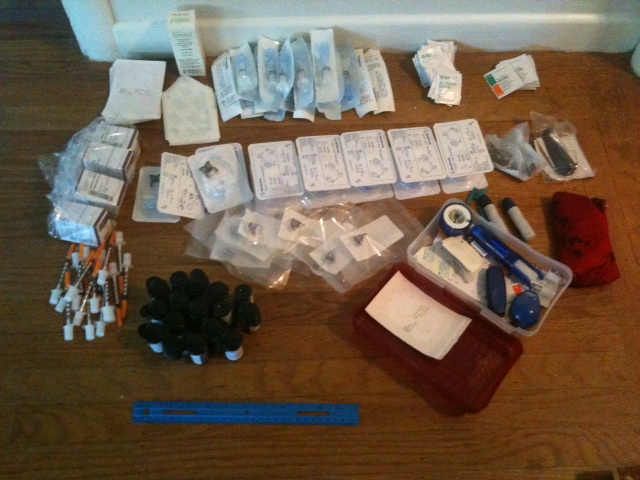
It turns out, I don’t actually have in my house right now all the supplies I would want to take with me for 23 days.  I don’t have enough vials of insulin, despite the fact I have plenty of insulin.  If I didn’t know where I was going or where I’d end up but I knew I’d be out of touch with my doctor or pharmacy, I’d take a lot extra!!  If I didn’t know I’d be someplace Medtronic and FedEx could reach within 24 hours, I’d take a lot more syringes and some long-acting insulin (turns out I don’t have any of even that in my fridge; shame—or something—on me).

And I’d take about triple the test strips I currently possess.  And an additional meter and a heck of a lot of batteries for all of the assorted gadgets.  (I would estimate I’d check 12-16 times a day… at least, that’s what I do when I’m sick or something is really crazy.)

(I probably wouldn’t bring the blue ruler, though: that was just for those who don’t know what any of this stuff is because they aren’t on pumps.)

Still, if I had only one backpack that needed to carry all of my supplies AND all the low food I’d want, AND a significant supply of food to carry me through the crazy places Amazing Race sends people, I think I’d go ahead and just wear the same outfit for the entire 23 days.

Priorities, people.

What would you bring if you were to prepare for 23 days out in the world??

Tired of Your Own Excuses?

May 4th, 2011

Do you ever listen to yourself and get tired of hearing your own excuses?  I do.  I’m not putting myself on any other level than anyone else on this: I think some days I accomplish perhaps more than some average bears only because I’m scared that my true laziness will someday be revealed!

I do get tired of my excuses though.  I get tired of pondering changes or worse yet knowing what steps to change I should make, having them even in order as to priority, and for some reason not making the changes.  Do you know what I’m talking about?

Not that me being tired of hearing them leads me to stop making the same excuses all the time.  (I told you, I’m just like everyone else when it comes to some things.)  Sometimes I need some time to get riled up enough at my own excuses that I make a change, take a step, and really get moving in the right direction.

So when someone else gets a bee in their bonnet about hearing excuses I have to laugh a little.  Because I understand: life is about choices, and we don’t always agree with the choices others around us have made.  (Stood next to a smoker lately?)  As a trainer, I am sometimes hired by a client who is trying to avoid their own excuses… or, rather, perhaps they want to tell the excuses to someone new.

I also love it when the bee in that bonnet has also been in MY bonnet, and has spurred me to say the same exact things that I’m hearing them say.  It makes me feel like I am doing the right thing with myself.

You can read the blog that I read if you want some additional reading today.  I like how the author moves from a complaint (hearing excuses) to an action plan (create a priority list)—one of my favorite transitions to make!  If you can complain about it, there is someone out there who can help you with an action plan to fix it.

If it is fitness-related, you already know someone you can call who can literally get you moving in the right direction.

If it’s health-related, you may have a team in place already and you can add me to your team for the day-to-day living you are working on.

No more excuses. 

Be The Change You Want To See

May 3rd, 2011

I was happy to be a part of the Diabetic Youth Foundation’s FUNraiser this weekend and I had a great time walking with the families and kids.  Thanks, DYF!

Before we launched on our walk, one boy stood up and started talking about how much camp had changed his family and his (type one) brother’s life for the better.  He made some comment about his brother’s classmates initially thinking diabetes was contagious when his brother was first diagnosed.

We all kind of laughed when he said that… who could be so silly to think diabetes is contagious?!

But I’ve been thinking about it ever since!!  I don’t remember anyone ever asking me if my diabetes was contagious, but I guess I can see how some not in the know can think diabetes is contagious… radio and TV commercials area always mentioning “diabetes” (of course, those are almost 100% of the time directed towards those living with type 2, not type 1 diabetes) only proliferate the staggering amount of mis-information.

That said, I quickly did a google search for “diabetes contagious” and I am really disappointed by what I found!!

I found a lot of replies on general question sites that involved phrases like “is stupidity contagious?!” and “please don’t be so ignorant” and some really sarcastic things I seriously doubt someone would say as a response in real life.  (At least, I hope they wouldn’t!)

Now seeing THAT kind of thing upsets me.

Listen, I’m just as frustrated as the next person living with type one about the misinformation out there about “diabetes” and I feel just as gypped out of a full name that doesn’t have to share the disease name with an older larger sibling taking all of the gloryI’m just as tired of answering the “can’t have sugar” questions and I’d be just as happy to have no one look at me as they ask me again “but you aren’t overweight…?”

But really?  Answering an honest question about either type of diabetes with disdain and mockery?

We can do better than that.

We need to take steps if we want to eliminate the misinformation out there.  Yes, WE need to be the ones to explain what life really is like.  WE need to do it—no one else can.

It comes back to being the change we wish to see in the world—one little step and one little answer at a time.

100% Winner 100% of the Time

May 2nd, 2011

I struggle just like anyone else with the concept of “winning”… I’m competitive enough with others and with myself to put quite a bit of importance on that idea of being at the top or in the front or wearing the gold.

It isn’t one of my better qualities: it gets in my way a lot.

That said; I’ve come to understand this is something I do, and like living with diabetes, it is easier for me to learn to strategize and cope rather than fight every day.

Some ways I’ve come to learn to cope with not being the best/ fastest / smartest / kindest /most popular /prettiest/ funniest/ healthiest/ most graceful at everything I ever do or try:

Re-define what “winning” is.  When it comes to diabetes, this one is a lot like removing judgments from blood glucose readings.  If you can think of a different goal than “finishing first” or “highest score” or “80-120 all the time” (none of which I believe to be possible for the overwhelming majority of us on any kind of consistent long-term basis), and organize your thinking with that new goal in mind, you are well on your way.

Be realistic in your own criticisms.  Sure, we can be fairly hard on ourselves and sometimes that is warranted.  But a lot of the time it only serves to delay our progress by weighing on our psyches.  If you really are trying to improve your time or achieve some similar objective goal, you are going to need to clock your progress and really see how you are objectively doing.  If it isn’t an objective goal, be as honest as possible with yourself and kindly evaluate yourself now versus yourself a year ago, or in whatever time frame is reasonable.  It’s essential that you evaluate your positive AND negative progress, and evaluate both without harsh or hateful words directed inward.

Keep the true end goal in mind all the time.  If you want to accomplish a specific goal like acing a test or losing 20 pounds or what have you, you need to also look beyond that stated goal.  Are you trying to ace the test so that you feel smart?  Are you trying to lose weight to bring down your blood pressure?  If these end goals are the real thing, then it is sometimes easier to achieve those than the stated specific goal. 

If you only got 89% and wanted to get 90% on that test, you could absolutely be a winner because you learned the material and actually were smarter than before, even with missing an answer. 

It’s all relative, and it’s all pretty transitory.  What sticks with us are our feelings about ourselves and our own worth. 

I say 100% winner, 100% of the time.

Meeting Other Diabetics

April 29th, 2011

I am super excited to be a part of the Diabetic Youth Foundation’s Bay Area Walk FUNraiser this weekend.  I am excited not only because I feel good helping such a fantastic organization doing amazing work year-round, but I’m also excited because I get to meet more people just like me who are living with diabetes.

I haven’t always felt that way.

I promise.

I remember going to my first ADA walk with my mom shortly after I was diagnosed.  It wasn’t exciting at all.  I was still trying to figure out what was going on with my own diabetes; I don’t think I spoke with any other person at the event.

I stopped attending a lot of the diabetes-oriented events after that, and after a few “support group” meetings that were nothing but bitter complaint sessions in smelly hospital meeting rooms.

No fun.  At all.

I do know I met another type one when I was in high school; she was pretty normal and she was the first person who told me about wearing an insulin pump.  She also actually liked her doctor—a new idea for me.  We never really socialized since she was older than me, but it somehow made something better for me to know she was out there at my school.

(The only other person I knew with type one went to my grade school and she was very shy and no fun so I never really knew what to do with her.  I knew her before I was diagnosed myself so all I really remember was her sad face when someone had a birthday at school and brought cupcakes to class.)

It wasn’t until I (for some odd reason, considering how I felt about others I had met) signed up to work at the DYF’s Bearskin Meadow Camp that I really had to interact with other type ones—interact with them as PEOPLE, AND as fellow type ones.

I think it was the PEOPLE part that has made all the difference for me.

If you have had the same experience meeting other diabetics that are “just like you” in only one area, but completely not like you in the rest of their non-diabetic lives, then you’re just like I was for the first 10 years I lived with the disease.

Since I have come to learn that everyone living with (at least type one, I can’t speak for type twos on this) diabetes is, in fact, EXACTLY LIKE ME.  Not one of us cares to be defined by the disease.  Each one of us has dreams and hopes and plans that really don’t have one iota to do with what our blood glucose levels decide to be at any given moment.  Not one of us cares to be slowed down by diabetes, and each of us have pretty full lives ASIDE from what we do to care for our bodies.

It’s important to get to know others with diabetes, if only to reinforce for yourself that others out there are just like you and doing what they choose to do, diabetes or not.

Feet & Toes What’s A T1 Girl To Do

April 28th, 2011

One of my biggest healthcare pet peeves is The Foot Issue I have to deal with as a 23 year veteran of life with type one diabetes.

People have been checking my feet for 23 years. 

Every time I want to kick them.

It’s not about my feet!!

I can reach my feet. 

I can physically feel my toes from the outside and from the inside. 

I only have cold toes when I’m standing around in 40 degree weather. 

I’m more ticklish than anyone else I’ve ever met.  I can feel a feather on the tops and on the bottoms of my feet.

Leave my feet alone.

Check instead for whether I have infections at the sites of my pump catheters or continuous glucose monitor sensors. 

Now there’s an idea!!

Ask me if I ever get lumps under the skin from a painful site.  Ask me if I’m using the right catheter for me, and if I’m rotating my sites to prevent buildup of scar tissue

Stop going down your list and LOOK AT ME, the person/patient in front of you.

Listen to what fills my daily life. 

Ask me if I do yoga in bare feet, if you want to check the health of my tootsies. 

BUT, please don’t ask me if I can put on a pair of those Vibram five-finger shoes.  Because the answer to that question, sadly, is: not so much!

I kept putting toe #2 in slot #3 and then I'd get a bunch of toes all squished into one slot. I don't think that's due to my diabetes!

Stop Using Pain As An Excuse to Avoid Exercise!

April 27th, 2011

I hear the “I can’t” excuse sometimes from clients when I ask them to do various moves.  Some of their fear is warranted, and I can understand some of it for a week or two, but there comes a point when the “I can’t” really does sound a lot like “I won’t.” 

I read this today and thought it was so good I wanted to share.  The author is, by the way, an orthopedic surgeon.

Don’t Use Pain As an Excuse

by AOSSM April 20, 2011

By Dr. David Geier, AOSSM

One of the most common reasons patients give for not exercising is an injury or pain. People often use knee or shoulder pain or some other limitation as an excuse for not playing sports or being physically active. And while certainly musculoskeletal injuries can affect participation, rarely should these injuries keep people on the sidelines permanently.

Joint pain is unfortunately a fairly common affliction among the United States population. According to the Centers for Disease Control and Prevention, in 2006 approximately 30% of adults reported that they experienced some sort of joint pain in the previous 30 days. Musculoskeletal injuries are rarely completely incapacitating, however. While many weekend warriors cite old knee or shoulder injuries as reasons that they can’t exercise now, with so many options available, even people with real injuries should be able to modify their routines and still get in a good workout.

For example, a female with early knee arthritis can still perform cardiovascular-enhancing exercise. She might not be able to run long distances six or seven days a week, but she might be able to run two days a week and swim or ride a bicycle the other days to decrease the repetitive impact on her knees. A male with rotator cuff impingement from overuse at work or in the yard might have to back off from tennis or baseball, which might aggravate his shoulder, but he could play soccer or another non-throwing sport. And for athletes who enjoy lifting weights, simply adjusting a few of the exercises might be enough to exercise in spite of a current injury.

For those who fear that they are making an injury worse, they should see a sports medicine physician. Most injuries do not need surgery, and often there are simple initial treatments, such as physical therapy, home exercises, taping, or anti-inflammatory medications. And while patients are often reluctant to go to the doctor for fear of being completely shut down from a sport or activity, sports medicine physicians usually try to encourage treatments and rehabilitation that get people back to sports and exercise as quickly as possible.

Finally, even if the activity is potentially detrimental to a joint, it might not always be that bad. Someone with near bone-on-bone knee arthritis is possibly making his knee worse running every day. Having said that, if he wants to keep running, the benefits of his overall health might outweigh the risks to his knee. Daily exercise can provide multiple medical benefits, including improved cardiovascular function, lower blood pressure, and weight loss, as well as improved sleep and mood. Even if he needs a knee replacement in the future, the medical upside to exercise is significant.

While aches and pains can be an obstacle to physical activity, they shouldn’t be permanent barriers to all exercise. If you are worried about injuries or exercise modification discuss it with a doctor [or speak with a trained fitness professional!] and know that being physically active is possible despite these pains.

As always, contact me if you need help finding a way to stay active and pain-free.