Archive for the ‘Living with Type 1 Diabetes’ category

Getting Off to a Great Start

October 6th, 2010

I know some of you have toyed with the idea of starting to run… but how?  You see my mentions of these crazy-sounding 15-20 miles and two of your friends just ran a 10k… but you’re feeling stuck at the thought of running down the block!!!

First of all, it is critical for you to realize every single person you see running started running by taking a step or two.  It was someplace a heck of a lot slower than what you see and a heck of a lot harder than it looks like now.

Which is all good information to have: we have all been there. 

Second point: some runs are good ones and some ones aren’t so good.  Don’t go out expecting to feel fantastic each day… that’s not the way the cookie crumbles.

Third point: running requires self-motivation.  I can’t make you enjoy running if you hate it, and I can’t make you lace up your shoes and keep putting one foot in front of the other.  That stuff comes from YOU. 

Last point: learn from others.  You will have to figure out what works for you and your diabetes, but overall, there are a ton of knowledgeable runners out there.  No need to (ha ha) reinvent the wheel.

In keeping with that last point, I post here an excerpt from Jason Karp, Ph.D.’s newsletter.  You can find Dr. Karp at www.runcoachjason.com

For beginners, the most important part of running is to make it consistent.  The focus should be on getting out the door every day to run.  Once you have developed a running habit and have a solid base, it’s time to add some quality to your running to increase your fitness. Start by adding one quality workout per week.  Do that for a while and then you’re ready to train using a planned training program.  Rather than follow a generic plan, however, look for one that is skewed to your strengths.  If your strength is endurance, focus more on mileage and tempo runs and less on interval training.  Run longer intervals, trying to get faster with training, such as 1,000-meter repeats at 5K race pace, increasing speed to 2-mile race pace or decreasing the recovery as your training progresses.  If your strength is speed, focus less on mileage and more on interval training.  Run shorter intervals, trying to hold the pace for longer with training, such as 800-meter repeats at 2-mile race pace, increasing the distance to 1,000 meters or increasing the number of repeats as your training progresses.  Work your strong points and train using the whole continuum of paces, from slow running speeds to very fast speeds to enhance both your aerobic and anaerobic abilities.

The Medal

October 5th, 2010

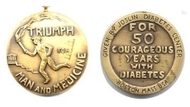
So it has really only recently (within the past two years) come to my attention that there is a MEDAL.  I could get a MEDAL for living with diabetes for 50 years.

Well, then.

I have run more miles than I care to count just for a single medal.  I’ve gotten on a plane, flown across the country, frozen my tuchis off, run 26 miles, and nearly crashed on the ice on the ground at the water stations for a medal!

But this one would be a pretty cool one to earn.

It’s the Joslin medal.

I think the history is critical to understand why they even count years with diabetes… keep in mind, I am really only in the third generation of type one diabetics who did not receive a death sentence along with their diagnosis.   I remember my grandma cried for days when I was diagnosed and I never understood why.  Now that I’m old enough to understand what a type one diagnosis meant to her, it makes more sense.  Maybe she remembered seeing kids in hospital beds, wasting away.

That has never been a part of my disease.  My disease doesn’t have a time limit. In fact, I quite honestly have never really seen many limits for myself related to my type one diabetes.  I know I faced one when I realized I could never be a commercial pilot… and when I realized I needed special permission for some things… but other than that… yeah, I kind of draw a blank.

Now, I understand there are limits out there.  I just don’t choose to see them. Why limit myself??  I’ve got limits in terms of time, space, means, ideas, geography, practicality, gravity, financial… with all of those limits out there why would I let my diabetes add one??

Yes: Be smart.  Learn.  Plan.  Figure.  Calculate.  Estimate.  Determine.  Be flexible.

But never stop.  Stopping will not only shrink your world, it will cause you to impose needless limits on your own life.

They don’t award medals for that kind of behavior.  Nope; they award medals for those people who have gone out and done their best amidst some daunting adversary conditions.

I’m thinking I have 27 years until I get that medal.  Maybe I should download the application now, just so I have it.

OMG I see they have a 75 year medal too!!!  Now I want that one too!!!!  :D

How long before you earn YOUR medal??

Why Is My Blood Glucose Sometimes Low after Physical Activity?

October 4th, 2010

I’m  going to try and run 20 miles this morning since yesterday’s run was a bit of a bomb (my foot, knee, and hip weren’t feeling like they had 20 safe miles in them!) so I’m stealing from Joslin since I won’t have time to write a blog today (20 miles takes a while).  This is good information to have in your brain when it comes to exercise… the more you know, the better you’re able to handle what life throws at you!


Low blood glucose is defined as a blood glucose level below 70 mg/dl if your meter measures whole blood, or 80 mg/dl or below if it measures plasma glucose (a plasma blood glucose of 90 mg/dl or below with symptoms is also a sign of hypoglycemia).

One of the most common causes of low blood glucose is too much physical activity. In fact, moderate to intense exercise may cause your blood glucose to drop for the next 24 hours following exercise. This post-exercise hypoglycemia is often referred to as the “lag effect” of exercise.

Basically, when you exercise, the body uses two sources of fuel, sugar and free fatty acids (that is, fat) to generate energy. The sugar comes from the blood, the liver and the muscles. The sugar is stored in the liver and muscle in a form called glycogen. During the first 15 minutes of exercise, most of the sugar for fuel comes from either the blood stream or the muscle glycogen, which is converted back to sugar. After 15 minutes of exercise, however, the fuel starts to come more from the glycogen stored in the liver. After 30 minutes of exercise, the body begins to get more of its energy from the free fatty acids. As a result, exercise can deplete sugar levels and glycogen stores.

The body will replace these glycogen stores but this process may take 4 to 6 hours, even 12 to 24 hours with more intense activity. During this rebuilding of glycogen stores, a person with diabetes can be at higher risk for hypoglycemia. Here are tips for safe exercising.

Guidelines for preventing exercise related hypoglycemia

  • Check your blood glucose before exercising to make sure your blood glucose is sufficient and/or consume an appropriate snack.
  • Avoid exercise at the peak of your insulin action.
  • Avoid late evening exercise. Exercise should be completed 2 hours before bedtime.
  • Avoid alcohol consumption prior to or immediately after exercise.
  • Avoid hot tubs, saunas and steam rooms directly after exercise. These continue to maintain an increased heart rate and may continue to lower your blood glucose.
  • Limit your exercise sessions to 1 or 2 per day. Additional sessions increase the likelihood of hypoglycemia.
  • In the past, it was believed that injecting insulin into exercising muscle increased absorption of the insulin resulting in hypoglycemia; now it is believed that the timing and action of the insulin are more likely to be the key factors.
  • Check your blood glucose immediately after exercise to prevent low blood glucose from occurring hours after exercise. It may also be necessary to check your blood glucose more often for 2 to 4 hours after exercise. Moderate intense exercise may cause your blood glucose to drop for the next 24 hours following exercise

If blood glucose is less than 100 mg/dl immediately after exercise

  • Follow post-exercise snack guidelines. If you are not scheduled for a snack or a meal for 30-60 minutes after exercise, 15 grams of carbohydrate should be sufficient to prevent a low blood glucose. If no meal or snack is scheduled for more than one hour, take 15 grams of carbohydrate and 7-8 grams of protein.
  • Increase carbohydrates before exercise.
  • Decrease the dose of active insulin for the next exercise session.
  • Consider decreasing the insulin dosage following exercise.
  • If your blood glucose at bedtime is still less than 100 mg/dl, double your bedtime snack, or if possible, decrease your insulin dose acting during bedtime.

Guidelines for unplanned exercise

Sometimes exercise or physical exertion occurs spontaneously or is unplanned. You may need extra food at these times in order to maintain the balance between your insulin or oral medication and the energy needed to exercise. A number of factors will determine if you need food and how much food is necessary.

  • Snacks may be necessary for exercise beginning 2 hours or more after your last meal.
  • Snacks may be needed for exercise lasting 1 hour or more.
  • Long duration or all-day activities may require both a snack adjustment and an insulin adjustment.
  • If you are attempting to lose weight, adjust your insulin or medication rather than eating extra food.

Be sure to talk to your diabetes educator for more information about how exercise will work best with your diabetes.

Eating and Counting, Counting and Eating

October 1st, 2010

It’s no big secret that diabetics care about the carbohydrate counts of the food we eat.  We have to—if we didn’t care about how many carbohydrates we ate, we’d be bouncing around with much more metabolized sugar in our blood stream than is healthy.  (I mean, more than we do anyway.)

I remember having to match the food I ate to the insulin I took.  What a miserable way to eat!  If I was hungry, I ate the same thing as if I weren’t hungry.  Every meal was supposed to be the same, in an effort to minimize the variances that comprise an interesting and enjoyable life.

No wonder that system didn’t work out very well for me.

Now that I match my insulin to the food I eat, I have a much better time with things.  Meals are more enjoyable, and it just feels good to use my brain and have options when it comes to feeding myself.

I read a question from a parent earlier who asked how people count carbohydrates at a restaurant, if the food isn’t listed in a calorie book.

Hmm.

I don’t think the point of counting carbohydrates is to make it an exact science.  I think the point is to get as close as we can, but there comes a point where you need to simply let go. 

If it were easy, we’d all do it and we’d all have non-diabetic A1cs and we’d never go high or low.

Right.

So get used to the fact that this is the human body.  If it were simple, we’d all live long healthy lives with little difficulty.  If it were a mathematic equation we’d study, pass the exam, and next time when we get the same exact question we’d have the same exact result.

But that isn’t diabetes.

Diabetes involves a TON of guesses.  Educated guesses, of course, but still: when it comes down to it we are guessing.  So quite honestly if you are off by 5 or 10 grams when you’re counting a new food, one day you’ll go low and another day you’ll go high.  It’s just how the disease works in our body.

Don’t skip a new restaurant because you don’t know if they rinse their pasta before serving the spaghetti, leaving starchy water on the pasta which may result in more carbohydrates on the plate.  Don’t avoid trying a new dish because you don’t know how many carbohydrates are in the sauce.  Don’t go only to restaurants with calorie counts on their wall… who knows if the person in the kitchen used a different size spoon than the person making the calculations?

Do take a class in carbohydrate counting.  Do get a set of measuring cups and use them as serving spoons at home for a few weeks.  Do look at what the sizes look like on your plate.  Learn the basics for what you need to count, and use that knowledge in the world.  Interact with your world and involve yourself.  Take guesses.  Let go of the idea of ever getting it “right”.  (It’s going to change tomorrow, anyway.)

Your world is as big and as beautiful as you let it be.  Don’t let the variances that affect your life with diabetes make that world smaller by one inch.

It’s Official. Gulp.

September 30th, 2010

I received my registration confirmation in my inbox this morning.  It’s now official: I’m running the Silicon Valley Marathon October 31st

I know I discussed this marathon months ago, but now that It Is Official I get to speak about it further.

I am running the Silicon Valley Marathon to support Run the Coast which in turn supports The Iron Andy Foundation, a nonprofit organization dedicated to sending kids with diabetes to camp.

If that doesn’t make you want to get up and run for several hours, I don’t know what will.

This will be a new one for me—doing something BECAUSE of my diabetes, ON DISPLAY in a way I’m not accustomed to ever in my life.  Cool.

Sure, working at Bearskin Meadow Camp my disease was on display and on the table all the time… but so was everyone else’s diabetes!  So this time may be a bit different.  Diabetes Outside has put my diabetes out therewhere it hasn’t ever really been before.

Duh.  Start a blog and write about diabetes what on earth do you expect.

Still, this marathon will be very exciting for me.  Physically, of course, I’m apprehensive about the 26.2 miles.  Mentally, a part of me is dreading the challenge and the other part of me is so excited to see what happens I can barely stand it.  Emotionally, I’m split as well.  I’m thrilled to be doing something and speaking about my diabetes and my running and my fitness with my disease and I’m thrilled to do so in an effort to send kids to diabetes camp.

But you probably know as well as I do just how privately we each deal with our diabetes every day.  I don’t mean that we hide our numbers or are afraid to say something to someone else… I mean that there are simply a LOT of blood checks and a LOT of minute adjustments and a LOT of calculations.  To speak about all of them would leave little time for anything else!

So, the other side of my emotional response includes some trepidation about being a type one diabetic, running for Run the Coast and Team Iron Andy, and doing so AS a diabetic, FOR diabetics.  It’s just going to be interesting.  I wonder if it will even be an issue.  (Probably since I’m blogging about it now, it won’t be.)

But I’d best stop typing and get back out there and train.  I only have a few weeks left! 

If you’re interested in donating to either Run the Coast or The Iron Andy Foundation, you can find links to do so on their websites.  Better yet, join us out on the course!

Enjoy!

What is an “ab”??

September 28th, 2010

One important and rarely mentioned aspects of physical fitness is body awareness.  I think those of us with type one or type two diabetes have a leg up in this arena because we have a heightened awareness of what happens inside our bodies.

I’ve used that heightened awareness to my advantage when it comes to physical fitness.  (Any kind of advantage counts in my world.)

You can move through any exercise you perform without a moment of thought—just do what you’re told to do or climb onto the machine and go.  But when you involve your brain and some basic knowledge of anatomy, you can use it to benefit the time you spend exercising

You put more thought in, you get more results out.

This is true about any exercise, but today let’s talk briefly about abdominal muscles.  I mean, when was the last time you asked yourself what “abs” are, anyway?!

The simple answer is that “abs” is short for “abdominals” and generally refers to the group of muscles that I simply (and entirely unprofessionally) think exist to keep your insides from falling out. 

When it comes to abdominal exercises, it’s good to understand what muscles are involved so that you can think about the move and stimulate more muscle recruitment

Just like any muscle, it is impossible to target just one area of the mass.  (Try using only your upper bicep muscle…) but you can do certain moves that recruit areas a bit more than other areas.  For example, a crunch when correctly performed stimulates the upper areas of the rectus abdominis than it does the lower areas.  Likewise, a crunch with your hips simultaneously lifting off the ground will stimulate and fatigue the lower areas of the rectus abdominis more than it will the upper areas. 

Try to feel the differences in your abdominals next time you are doing an ab workout.  Think of your anatomy and visualize the differences when performing a regular crunch and when you crunch straight up with your knees to one side (which will recruit more obliques than a regular crunch).

It is generally simple stuff, but the more work you can do to understand what is physically going on inside your body, the better results you will see from the outside.

Go to it!

Let’s Hear it for Nat (or is it Kat?)

September 27th, 2010

Let me say this first: I have never seen an episode of the Amazing Race.  I know, I know, that is shameful to a lot of you, but still.  I haven’t ever seen it.

But I love the fact that last night I received three emails and my Facebook friends lit up the screen with messages about Nat Strand (or is it Kat Chang?) competing in the challenge.  And she has type one diabetes. 

And she checked at some point on camera and had a BG of 337.

Y.A.Y.

That’s really the best part of the whole story, for me.  I wouldn’t question whether or not she “should” compete with type one, or whether her type one diabetes would affect how she performed, or any aspect of how challenging the balancing act might be for a type one competitor on Amazing Race.

We all do the blood sugar balancing act every day with everything we do… so why should a competition like the Amazing Race be any different?

But the joy I read on Facebook last night from all of my type one friends told me something.  It told me we are all searching for some type of validation that we are not alone with our struggles.

Logically, I know I’m not alone when I see the 300s and even the occasional 400s.  I know I’m not the only one who gets frustrated seeing what seem like endless 200s.  I know bouncing from 40 to 240 to 290 to 30 happens to all of us some time or another.

Yet something about seeing someone else, someone doing something active, exciting, and interesting and racing across the world while doing what we each do all day long AND seeing a 337 on her meter just makes me smile.

It made a lot of my friends smile, too.

I’m happy for Nat (?) that she got a place on the Race.  I’m happy that she has a good teammate (Kat?).  I’m happy that they both look like they are smart strong educated people and they are quick to smile. 

I’m really happy to see all of that and know that she hears the secret mental monologue too.   Mine never ends– does yours?

Go Team!!!

Ramifications of Different Parenting Styles

September 22nd, 2010

A number of years ago, researchers studied four styles of parenting to see what style resulted in obese or overweight children.  The results aren’t terribly surprising, if you have ever been a kid yourself and thought about the kind of upbringing you’ve had.

It has very interesting implications for parents of type one kids, if you ask me.

First off, I should explain one thing of note: the study refers to “parents” but only really ever refers to “mothers”.  I’m not saying this is a surprise, but I would have worded the study differently if I were in charge.  (Which I am most definitely NOT.)

The four parenting styles are:

Authoritative– have high demands for maturity and self-control from their children but also display high levels of sensitivity, emotional warmth, and involvement. There is often a give and take between the parent and child in which the parent acknowledges the child’s worth and opinions but maintains certain limits. The authoritative parenting style is often considered the ideal and has been associated with improved child outcomes, such as higher academic achievement, increased self-regulatory ability, frequent use of adaptive strategies, fewer depressive symptoms, and fewer risk-taking behaviors.

Authoritarian– have high demands for self-control but low levels of sensitivity. They often are insensitive to the child’s developmental needs, providing minimal emotional support, and are viewed as strict disciplinarians. The authoritarian parenting style has been associated with poorer outcomes among children, such as lower academic grades, compared with the authoritative style.

Permissive– characterized by low expectations for self-control and discipline in the setting of high sensitivity and warmth. Children from these families may be more self-confident but often show lower levels of self-control (eg, higher rates of drug use and school misconduct) than do children from authoritative or authoritarian homes.

Neglectful — defined by low levels of both demands for self-control and sensitivity. Neglectful parenting is associated typically with unfavorable child outcomes, such as high rates of depression, smoking, and poor school achievement and psychosocial development.

Perhaps not surprising, by the time children in the study reached first grade, a number of them were already overweight.  The breakdown by parenting style was:

Authoritative- 3.9% of the kids were overweight

Authoritarian- 17.1% of the kids were overweight

Permissive- 9.8% were overweight

Neglectful- 9.9% were overweight

I imagine these results for a child’s weight might look very similar to results of kids with either type of diabetes.  Maybe not in terms of their body weight, but in terms of their blood sugar management and overall health

Depending on what side of the equation you are on, think about the parenting style you experience.  We all know some potential consequences of growing up include drug use, poor grades, depression, smoking, and drinking.  The complicating factor here is that with diabetes, the  ramifications of each are much much more damaging for those with diabetes than they are for those living without diabetes. 

Most of us won’t have too many chances to get it “right”… we need to make the best healthiest decisions as many days as possible.

I can’t applaud parents enough for all you deal with; most significantly to me must be the pervasive and omnipresent question: “am I doing the right thing?”   We know you love each other.  But sometimes the way we express it has big-time effects.

Maybe it’s worth a conversation someday soon with your child or your parent.  Maybe some of this is easier to change than you fear.  Maybe it just takes some awareness on both sides of the equation.

George and Gracie and My Pump Stuff

September 20th, 2010

I try and provide readers of this blog interesting, insightful, and informative material every day.  I also try to keep the posts under 500 words since I’m fairly certain I just am not that interesting and I don’t want to hold anyone hostage.

Having said this, I understand that they can’t all be winners.

Like today, for example.  I read through some of my usual sites and blogs for tidbits of information I could expound upon… and literally fell asleep.   

So I reflected back further into my morning and remembered something that made me smile.  So I’m going to write about how my cats deal with my diabetes.

(I absolutely know you have some pet stories to share too and I expect to hear them.  Please share!!)

I have two kitten loves: Gracie and George.  G&G are now almost 9 years old!  Can’t believe that.  They are litter mates and the best kittens ever.

Sitting in the sunshine; what a way to live!

George is stretched out and Gracie is on the right

Gracie is the best player I’ve ever seen.  She either wants to play or she wants to sit on her white bath mat or she wants to sleep curled up at my husband’s pillow.  Unless she’s playing, she will start to purr when we come close to kiss her. 

George is what the vet called “juicy” and “food-driven”.  If he had an opposable thumb he would rule the world (if it would get him a cheeseburger).  He is a funny guy and is thrilled when one of us sits down and he can sit on our laps for roughly four hours before he has to move.  Of course, if it’s 5:00am or 5:00pm that means dinner so he’s there staring at me by 4:55 every day, twice a day. 

This morning I watched Gracie stick her head into our bathroom trash can, root around very briefly, and emerge with the wrapper from my pump reservoir.  She absolutely loves those things!  She takes them all over the house—currently she has several of them under our bed and likes to chew on them while we try to sleep.  I’m very impressed that she could select it out of the trash so delicately.  She is a little raccoon.

How cute is this girl?!

George knows how to best wake me up in the morning if I’m sleeping past 5am (BREAKFAST!).  He tries to purr and meow and stand on me and even jump on me from the headboard.  But he knows there is one thing he can do that will sit me up out of bed faster than anything else.  He usually tries the other tactics first, but after his patience has been exhausted, he goes in.  He sticks his head under the covers, finds my pump, and starts to open his mouth near the pump cord.  I know that I have no time before he chews the cord in two and I’m stuck replacing the whole set.  He’s only done it once, when he was a very young kitten, but he is so smart he knows what works.

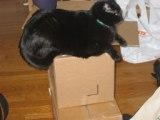
George doing his job of inspecting each box that comes in.

Animals are the greatest, aren’t they?

Muddling Through Transitions

September 17th, 2010

I have been having a weird couple of weeks lately, full of transitions.  I am not a fan of transitions because I feel like my life works better when I can plan and I can’t plan very well for what I don’t know will happen.

I think my workouts and diabetes have both suffered a bit. 

My husband has been working really long hours and night shifts, so we aren’t seeing much of each other.  The problem I have with that is not only do I miss him, but he often makes dinner when I’m exercising.  Having dinner together means we eat vegetables and a full meal—I’m not so good at full meals when I’m randomly by myself.

I have also felt a bit of a slump as I come down from my post half-marathon high and see the full marathon ahead of me on Halloween.  Running has been far from my thoughts—farther that I would like, this close to a marathon!

And I have been busy mentally and physically planning to start a new chapter of my bootcamp life as I leave employment of nearly 5 years and go out on my own.  Scary stuff at any time, but with economic news what it is, I continually debate whether I am doing a smart or foolish thing.

Which is all to say, I am a bit worn out.  The effects of these kinds of transitions ripple through my daily life, of course, and it takes some stern focus to keep at it.  My highs and lows seem random, and I don’t feel like I can really divert my attention right now to get fully back on track.

So, I muddle through.

I also make sure to take time, even if it is 5 minutes, to do things that bring me peace and help me take a mental break.

I got some books from the library yesterday.  I bury my face in the fuzzy bellies of my two cats.  I play puffball with George and string with Gracie.  I listen to my bootcampers sharing aspects of their daily lives a little bit more intently. 

I try to escape completely, just for a little bit, from my thoughts.  I think I would be a mess of tangled nerves if I didn’t.

I scale back on my workouts, and lift lighter weights, do shorter workouts, and plan runs with friends instead of trying to push myself alone.    

I’ve been in these transitions before, more times than I care to list.  Like I said, I’m not a fan!  But knowing I’ve been through them before helps me to relax through this one and keep my focus.  Knowing that if I worry too much about my blood sugars or my exercise or my eating or whether I am arriving early or late each day I will only wear out sooner, and have nothing to show for it.  Knowing that the small things today are only temporary, and my recent blood sugars will quiet down, and things will work out in the long run.  And knowing how important it is to take those small moments of joy and really experience them for what they are—a moment of joy and relaxation in the midst of transition and what sometimes feels like turmoil.

Maybe I’m growing up a little.