Archive for the ‘Random Musings’ category

What is an “ab”??

September 28th, 2010

One important and rarely mentioned aspects of physical fitness is body awareness.  I think those of us with type one or type two diabetes have a leg up in this arena because we have a heightened awareness of what happens inside our bodies.

I’ve used that heightened awareness to my advantage when it comes to physical fitness.  (Any kind of advantage counts in my world.)

You can move through any exercise you perform without a moment of thought—just do what you’re told to do or climb onto the machine and go.  But when you involve your brain and some basic knowledge of anatomy, you can use it to benefit the time you spend exercising

You put more thought in, you get more results out.

This is true about any exercise, but today let’s talk briefly about abdominal muscles.  I mean, when was the last time you asked yourself what “abs” are, anyway?!

The simple answer is that “abs” is short for “abdominals” and generally refers to the group of muscles that I simply (and entirely unprofessionally) think exist to keep your insides from falling out. 

When it comes to abdominal exercises, it’s good to understand what muscles are involved so that you can think about the move and stimulate more muscle recruitment

Just like any muscle, it is impossible to target just one area of the mass.  (Try using only your upper bicep muscle…) but you can do certain moves that recruit areas a bit more than other areas.  For example, a crunch when correctly performed stimulates the upper areas of the rectus abdominis than it does the lower areas.  Likewise, a crunch with your hips simultaneously lifting off the ground will stimulate and fatigue the lower areas of the rectus abdominis more than it will the upper areas. 

Try to feel the differences in your abdominals next time you are doing an ab workout.  Think of your anatomy and visualize the differences when performing a regular crunch and when you crunch straight up with your knees to one side (which will recruit more obliques than a regular crunch).

It is generally simple stuff, but the more work you can do to understand what is physically going on inside your body, the better results you will see from the outside.

Go to it!
Let’s Hear it for Nat (or is it Kat?)

September 27th, 2010

Let me say this first: I have never seen an episode of the Amazing Race.  I know, I know, that is shameful to a lot of you, but still.  I haven’t ever seen it.

But I love the fact that last night I received three emails and my Facebook friends lit up the screen with messages about Nat Strand (or is it Kat Chang?) competing in the challenge.  And she has type one diabetes. 

And she checked at some point on camera and had a BG of 337.

Y.A.Y.

That’s really the best part of the whole story, for me.  I wouldn’t question whether or not she “should” compete with type one, or whether her type one diabetes would affect how she performed, or any aspect of how challenging the balancing act might be for a type one competitor on Amazing Race.

We all do the blood sugar balancing act every day with everything we do… so why should a competition like the Amazing Race be any different?

But the joy I read on Facebook last night from all of my type one friends told me something.  It told me we are all searching for some type of validation that we are not alone with our struggles.

Logically, I know I’m not alone when I see the 300s and even the occasional 400s.  I know I’m not the only one who gets frustrated seeing what seem like endless 200s.  I know bouncing from 40 to 240 to 290 to 30 happens to all of us some time or another.

Yet something about seeing someone else, someone doing something active, exciting, and interesting and racing across the world while doing what we each do all day long AND seeing a 337 on her meter just makes me smile.

It made a lot of my friends smile, too.

I’m happy for Nat (?) that she got a place on the Race.  I’m happy that she has a good teammate (Kat?).  I’m happy that they both look like they are smart strong educated people and they are quick to smile. 

I’m really happy to see all of that and know that she hears the secret mental monologue too.   Mine never ends– does yours?

Go Team!!!

Injury Struck. Bummer!! Now What?

September 24th, 2010

Injury. 

Ut oh.

Anyone who exercises or moves at all risks injury.  This is not news.  But how do you handle it when injury strikes?

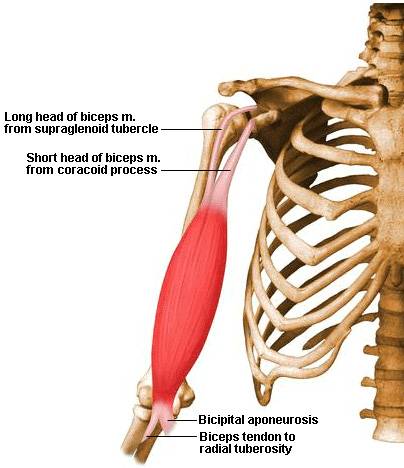
The biceps has two (bi) insertion points at the shoulder and one near the elbow.

I can’t say I am “injured” today… but I can tell you that yesterday I demonstrated a triceps dip for one of my bootcamp classes and nearly lost my grip—my right arm didn’t obey the commands I thought my brain sent.  And then I tried to work out a few hours later and was doing jumping jacks to warm up and heard myself yelp aloud in the empty house. 

I don’t usually yelp.

So I stopped my workout, bolused to correct in advance for the basal rate I had lowered the hour before the workout, and took off my shoes.

Game over.

I’m not even sure precisely what is wrong with my right arm.  I think it is a problem with the long tendon of my bicep, at the insertion point of my biceps brachii muscle

and my shoulder (supraglenoid tubercle), but I can’t remember doing anything that caused an injury.  I know my shoulder has been sore after I got my flu shot a few days ago and did a hard core pushup workout, and my CGM is in my right triceps muscle right now… so maybe it’s a combination of these myriad of assaults on my right upper arm.

Anyway, it’s time to dust off my protocol for injury that I use on myself:

  1. Having a reason to rest is the only requirement. 
  2. Any suspected or logically anticipated injury is a reason.
  3. When injured, if I can work out without involving the injured area, I might.  (I ran this morning and plan to run again Saturday if it is a good idea.)
  4. You can hurt yourself worse if you work out too soon.  One workout isn’t worth it if you risk being out for weeks or months with a serious injury.
  5. If two body parts hurt or ache simultaneously, skip the workout.
  6. After being sick, rest one additional day beyond the day you say “I’m feeling better; I’m going to try a workout!”
  7. After being injured yet without medical advice, wait one more day after you want to go back.  If you did see a professional for the injury, follow their advice and wait.  Rest.  Take care.

But, of course, now I have nothing to do… besides play Angry BirdsThose dang pigs!

(Update!  I figured out what move I did incorrectly to cause the random pain.  Phew; now all I need to do is rest!)

Balancing Act

September 23rd, 2010

Do you remember learning how to ride a bike?  Do you remember how many skinned knees it took you and how long you felt it took to train with training wheels and how many times you put your foot down just to avoid falling over?

And they say simple things are just like riding a bicycle.

I don’t recall it being simple at all!

But once you have the basics down, you have a only a few solid decades of good balance.  However, if you don’t use your balance you will lose it.

So, try some simple exercises to help you work on and improve your balance.  This will help you avoid falls by helping you stay upright as you navigate icy sidewalks, squished grapes on the grocery floor, and still-damp soccer fields.

Stand on one foot when you brush your teeth in the morning, and the other foot when you brush your teeth at night.  When you find a dime on the ground, try squatting to pick it up on one foot instead of two. 

When you sit down on the couch, don’t collapse into the cushions right away—touch your butt down and then hover over the seat for as long as it takes you to start trembling.  When a new show comes on, hover again but try it standing on one foot with the other leg out in front of you.  If you aren’t strong enough yet, put your heel on the ground to help.  Do 3-10 single leg squats like this on each side!

(The first person to make fun of you must do twice the reps you do.) 

The next time you’re on the phone, stand up and swing one leg in front and behind you 20 times before changing legs.  Stand next to a wall or countertop if you’re nervous!  You can always put your other foot down—there is nothing to stop you!  You are in charge of your body.

You can also try holding your knee close to your chest as you stand upright and tall.  Hold your knee in as close as you can for 3-5 seconds before you switch sides.  Do as many as you can.

Take a few minutes to do these simple balance training exercises and you’ll be doing a very good thing for yourself and your balance.  No skinned knees required!

Ramifications of Different Parenting Styles

September 22nd, 2010

A number of years ago, researchers studied four styles of parenting to see what style resulted in obese or overweight children.  The results aren’t terribly surprising, if you have ever been a kid yourself and thought about the kind of upbringing you’ve had.

It has very interesting implications for parents of type one kids, if you ask me.

First off, I should explain one thing of note: the study refers to “parents” but only really ever refers to “mothers”.  I’m not saying this is a surprise, but I would have worded the study differently if I were in charge.  (Which I am most definitely NOT.)

The four parenting styles are:

Authoritative– have high demands for maturity and self-control from their children but also display high levels of sensitivity, emotional warmth, and involvement. There is often a give and take between the parent and child in which the parent acknowledges the child’s worth and opinions but maintains certain limits. The authoritative parenting style is often considered the ideal and has been associated with improved child outcomes, such as higher academic achievement, increased self-regulatory ability, frequent use of adaptive strategies, fewer depressive symptoms, and fewer risk-taking behaviors.

Authoritarian– have high demands for self-control but low levels of sensitivity. They often are insensitive to the child’s developmental needs, providing minimal emotional support, and are viewed as strict disciplinarians. The authoritarian parenting style has been associated with poorer outcomes among children, such as lower academic grades, compared with the authoritative style.

Permissive– characterized by low expectations for self-control and discipline in the setting of high sensitivity and warmth. Children from these families may be more self-confident but often show lower levels of self-control (eg, higher rates of drug use and school misconduct) than do children from authoritative or authoritarian homes.

Neglectful — defined by low levels of both demands for self-control and sensitivity. Neglectful parenting is associated typically with unfavorable child outcomes, such as high rates of depression, smoking, and poor school achievement and psychosocial development.

Perhaps not surprising, by the time children in the study reached first grade, a number of them were already overweight.  The breakdown by parenting style was:

Authoritative- 3.9% of the kids were overweight

Authoritarian- 17.1% of the kids were overweight

Permissive- 9.8% were overweight

Neglectful- 9.9% were overweight

I imagine these results for a child’s weight might look very similar to results of kids with either type of diabetes.  Maybe not in terms of their body weight, but in terms of their blood sugar management and overall health

Depending on what side of the equation you are on, think about the parenting style you experience.  We all know some potential consequences of growing up include drug use, poor grades, depression, smoking, and drinking.  The complicating factor here is that with diabetes, the  ramifications of each are much much more damaging for those with diabetes than they are for those living without diabetes. 

Most of us won’t have too many chances to get it “right”… we need to make the best healthiest decisions as many days as possible.

I can’t applaud parents enough for all you deal with; most significantly to me must be the pervasive and omnipresent question: “am I doing the right thing?”   We know you love each other.  But sometimes the way we express it has big-time effects.

Maybe it’s worth a conversation someday soon with your child or your parent.  Maybe some of this is easier to change than you fear.  Maybe it just takes some awareness on both sides of the equation.

Active Couch Potatoes?!

September 21st, 2010

No news flash here: if you sit more, you are at a higher risk of heart disease.  In a study, the number of sitting hours was only 23 per week.  Week!  

“Men who spent more than 23 hours a week watching TV and sitting in their cars (as passengers or as drivers) had a 64 percent greater chance of dying from heart disease than those who sat for 11 hours a week or less.”

Ut oh.

But what if you sit all day, but go to the gym for an hour on your way home and hit the elliptical for 30 minutes? 

Sorry.

Not a lot of difference in your health. 

Regular workout sessions do not appear to fully undo the effects of prolonged sitting. ‘‘There seem to be different pathways’’ involved in the beneficial physiological effects of exercising and the deleterious impacts of sitting, says Tatiana Warren, a graduate student in exercise science at the University of South Carolina and the lead author of the study of men who sat too much. ‘‘One does not undo the other,’’ she says.”

Keeping in mind how progress may in fact lead us into regression:

“Decades ago, before the advent of computers, plasma TVs and Roombas, people spent more time completing ‘‘light-intensity activities,’’ which require between one and a half and three METs. Most ‘‘home activities,’’ like mopping, cooking and changing light bulbs, demand between two and three METs. (One exception is ‘‘butchering animals,’’ a six-MET activity, according to a bogglingly comprehensive compilation from 2000 of the METs associated with different activities.) Nowadays, few of us accumulate much light-intensity activity. We’ve replaced those hours with sitting.”

(Ut oh.  I’m guilty of this one.  Roomba has been a godsend in my house.  We are in a 2 bedroom duplex with wood floors and it’s absolutely insane how much dust we can make and how much fur two cats can create.)

However.  At the office, the printer is down the hall from my computer.  At home, I generally hop up at every commercial break or every few chapters in my book.  I go into the kitchen to see what food is there, or grab a cat to play with.  I park far away from the doors.  I walk to the grocery store. 

These are all ways to increase the exercise you get in your daily life—the kind of movement that our elders don’t even consider because it used to be part of the package.  So get up, get moving, get grooving, and keep at it

You and your heart will appreciate it.

George and Gracie and My Pump Stuff

September 20th, 2010

I try and provide readers of this blog interesting, insightful, and informative material every day.  I also try to keep the posts under 500 words since I’m fairly certain I just am not that interesting and I don’t want to hold anyone hostage.

Having said this, I understand that they can’t all be winners.

Like today, for example.  I read through some of my usual sites and blogs for tidbits of information I could expound upon… and literally fell asleep.   

So I reflected back further into my morning and remembered something that made me smile.  So I’m going to write about how my cats deal with my diabetes.

(I absolutely know you have some pet stories to share too and I expect to hear them.  Please share!!)

I have two kitten loves: Gracie and George.  G&G are now almost 9 years old!  Can’t believe that.  They are litter mates and the best kittens ever.

Sitting in the sunshine; what a way to live!

George is stretched out and Gracie is on the right

Gracie is the best player I’ve ever seen.  She either wants to play or she wants to sit on her white bath mat or she wants to sleep curled up at my husband’s pillow.  Unless she’s playing, she will start to purr when we come close to kiss her. 

George is what the vet called “juicy” and “food-driven”.  If he had an opposable thumb he would rule the world (if it would get him a cheeseburger).  He is a funny guy and is thrilled when one of us sits down and he can sit on our laps for roughly four hours before he has to move.  Of course, if it’s 5:00am or 5:00pm that means dinner so he’s there staring at me by 4:55 every day, twice a day. 

This morning I watched Gracie stick her head into our bathroom trash can, root around very briefly, and emerge with the wrapper from my pump reservoir.  She absolutely loves those things!  She takes them all over the house—currently she has several of them under our bed and likes to chew on them while we try to sleep.  I’m very impressed that she could select it out of the trash so delicately.  She is a little raccoon.

How cute is this girl?!

George knows how to best wake me up in the morning if I’m sleeping past 5am (BREAKFAST!).  He tries to purr and meow and stand on me and even jump on me from the headboard.  But he knows there is one thing he can do that will sit me up out of bed faster than anything else.  He usually tries the other tactics first, but after his patience has been exhausted, he goes in.  He sticks his head under the covers, finds my pump, and starts to open his mouth near the pump cord.  I know that I have no time before he chews the cord in two and I’m stuck replacing the whole set.  He’s only done it once, when he was a very young kitten, but he is so smart he knows what works.

George doing his job of inspecting each box that comes in.

Animals are the greatest, aren’t they?

Muddling Through Transitions

September 17th, 2010

I have been having a weird couple of weeks lately, full of transitions.  I am not a fan of transitions because I feel like my life works better when I can plan and I can’t plan very well for what I don’t know will happen.

I think my workouts and diabetes have both suffered a bit. 

My husband has been working really long hours and night shifts, so we aren’t seeing much of each other.  The problem I have with that is not only do I miss him, but he often makes dinner when I’m exercising.  Having dinner together means we eat vegetables and a full meal—I’m not so good at full meals when I’m randomly by myself.

I have also felt a bit of a slump as I come down from my post half-marathon high and see the full marathon ahead of me on Halloween.  Running has been far from my thoughts—farther that I would like, this close to a marathon!

And I have been busy mentally and physically planning to start a new chapter of my bootcamp life as I leave employment of nearly 5 years and go out on my own.  Scary stuff at any time, but with economic news what it is, I continually debate whether I am doing a smart or foolish thing.

Which is all to say, I am a bit worn out.  The effects of these kinds of transitions ripple through my daily life, of course, and it takes some stern focus to keep at it.  My highs and lows seem random, and I don’t feel like I can really divert my attention right now to get fully back on track.

So, I muddle through.

I also make sure to take time, even if it is 5 minutes, to do things that bring me peace and help me take a mental break.

I got some books from the library yesterday.  I bury my face in the fuzzy bellies of my two cats.  I play puffball with George and string with Gracie.  I listen to my bootcampers sharing aspects of their daily lives a little bit more intently. 

I try to escape completely, just for a little bit, from my thoughts.  I think I would be a mess of tangled nerves if I didn’t.

I scale back on my workouts, and lift lighter weights, do shorter workouts, and plan runs with friends instead of trying to push myself alone.    

I’ve been in these transitions before, more times than I care to list.  Like I said, I’m not a fan!  But knowing I’ve been through them before helps me to relax through this one and keep my focus.  Knowing that if I worry too much about my blood sugars or my exercise or my eating or whether I am arriving early or late each day I will only wear out sooner, and have nothing to show for it.  Knowing that the small things today are only temporary, and my recent blood sugars will quiet down, and things will work out in the long run.  And knowing how important it is to take those small moments of joy and really experience them for what they are—a moment of joy and relaxation in the midst of transition and what sometimes feels like turmoil.

Maybe I’m growing up a little.

I really only have one thing to say about this: OMG!

September 16th, 2010

You know I read a lot of blogs and try to peruse the internet for the latest and greatest idea/study/happening.  Today has a winner that might beat everything.

INSTANT RECESS.  For adults.

Check it out!  Dr. Toni Yancey came up with the idea and I can’t tell you how much I adore it.  Instead of taking a coffee or (heaven forbid!) cigarette break, the entire office takes an exercise break.  Ten minutes of simple, basic moving about and then back to the grind.

I bet you 95% of those who take the exercise break go back to their desks with smiles on their faces.  Maybe more.

I think part of the problem here is that some people have had some experience with exercise being boring.  So they don’t want to do it.  So they don’t do it.  And when they hear how much they should do it, they want to do it even less than before.

So how do we fix that?

We make exercise fun.

I have a bootcamper who finished her first month with me and announced “I thought I hated exercise.  After I came to bootcamp, I realize that I don’t hate exercise!  I hate the gym!!” 

How wonderful!!

This is why I stress to everyone that it isn’t about hating what you do for exercise.  If you want to stop calling it “exercise” for crying out loud don’t call it exercise.  But move yourself.  Get your heart rate up.  Get off the couch.  Get outside.

Go have fun.  Play.  Take a break from the sucky parts of your day.  Get moving and get smiling.  Talk to each other, even if your words come out in gasps.  There isn’t competition at recess, unless it’s who can make it to the swings faster or go higher or zip faster down the slide; whatever it takes to have more fun.  Even for ten minutes!

I bet if you mention this at your next staff meeting you will NOT get only angry stares and glares.  I bet at least one other person will think this is a great idea.  Shoot; send a link to this post to your boss!  As our world values efficiency and expediency more and more, our overweight bodies have become less efficient.  Who wants slow employees?  We all want a vivacious workplace – no one wants to hate heading to the office every day.

So let’s get it started with an Instant Recess.  Ready?  Set?  GO!!

Who is a Sleeping Beauty?

September 15th, 2010

I had a weird night’s sleep last night.  Being a daily blogger now, this kind of thing makes me want to write about how important sleep is to our general health and fitness. Thank goodness I receive the IDEA Fitness Journal and can read articles about sleep!

First, we know we feel better when we get enough sleep.  But are you aware of all the physiological things that happen when we don’t get enough sleep? 

Sleep serves three main functions for our bodies:

  1. It serves as energy restoration period from daytime activities (recharge!)
  2. It affords bodily protection at night when sensory capacities are down-regulated and
  3. It affords the brain needed time to consolidate important experiences and memories for learning

So how much does the average person need to sleep to reap the benefits?  Most adult men and women need 7-8 hours of sleep a night.  Infants need 14-15 hours, toddlers need 12-14 hours, preschoolers 11-13 and school-age kids 10-11 hours.  (My cats need 20+ but that’s a different story.)

However, if you don’t get adequate sleep you will fall into the “chronic sleep restriction” category and susceptible to impaired metabolic and neuroendocrine function, glucose regulation, and waking behavior

Ick.

With an elevated sympathetic nervous system resulting from a chronic lack of adequate sleep, evening cortisol production increases.  This has shown to increase food intake and the accumulation of abdominal fat.

Double ick.

More critical than cortisol, however, is the interference with glucose metabolism that chronic sleep restriction causes, establishing a high association between sleep debt and [type two] diabetes.

Quadruple ick.

You’ve probably noticed in your own life that when you get tired you begin looking for external help: many people begin to consume more high-energy foods and drinks when they suffer from chronic sleep.  Additionally, the fatigue one feels inhibits physical activity and increased sedentary behavior—just what you DON’T need when you are dealing with increased cortisol production and impaired glucose metabolism!

Fortunately, there are many options for us to create good sleep opportunities for ourselves and our family members.  The University of California, Berkeley Wellness Letter (2008) offers the following suggestions:

  1. Cut down on caffeine consumption in the late afternoon and evening.
  2. Do not smoke or use any other products with nicotine before bed, as nicotine keeps many people awake. [Don’t even get me started on this one!!]
  3. Create a “noise-free” sleeping environment.
  4. Create a sleep-friendly bedroom by doing the following: use comfortable linens and pillows, put up darker shades, replace a worn-out mattress and keep the bedroom cool during sleep hours.
  5. Drink fewer fluids after dinner, to minimize trips to the restroom.
  6. Attempt to deal with stressful issues during the day and put them away at night (seek professional consultation as necessary).
  7. Set a regular time to go to bed and a consistent time to wake up.  Keep to this schedule.
  8. Avoid brining work projects and personal paperwork to bed.
  9. Avoid bringing food to bed.
  10. Limit naps to a maximum of 30 minutes and try to take naps earlier in the day.

Good luck, sleepy heads!